





What is an AI SDR?

What’s one of your first steps once you decide it’s time to start building out your pipeline?
You hire an SDR.
But when 84% of sales reps failed to hit quota in 2023 (some even say 91% missed quota), the revenue generated no longer seems to merit the cost of an SDR.
That’s where AI SDRs (also known as virtual SDRs) transition from a nice-to-have to a true differentiator.
Tl;dr summary
- AiSDR is an AI sales assistant that turns lead data into personalized outreach and handles prospecting, follow-ups, and replies.
- AiSDR beats human SDRs on speed, consistency, and cost, sending messages nonstop for about $900 per month.
- Cost per email is under $1, making it more scalable than manual outreach.
- Teams use AiSDR to fix slow follow-ups, weak personalization, and low lead volume.
- AiSDR blends AI-driven outreach with human-led calls and relationship-building for better results.
AI SDR definition
An AI SDR (artificial intelligence sales development representative) is specialized software that uses AI to automate standard sales tasks that a human SDR would typically do, such as:
The tasks of an AI SDR or AI BDR are defined by your team. You can delegate your entire outbound process or specific time-consuming tasks like follow-ups and mailbox warm-up.
Ultimately, your trust in an AI SDR determines the depth of its integration into your sales efforts.
FREE GUIDE
AI SDRs vs Human SDRs
If you’re set on expanding your sales team by adding an SDR, you should know the advantages of AI SDRs and human SDRs.
AI SDRs
There are several areas where an AI SDR will easily outperform a human:
- Scalability – AI SDRs can handle large volumes of data and tasks in a short amount of time.
- Consistency – AI SDRs provide steady results and aren’t affected by writer’s block, fatigue, bias, or temptation to end work early (so long as the underlying prompts are good).
- Automation – AI SDRs can fulfill many daily sales tasks on autopilot without needing to track time or complete a Jira ticket.
- Price tag – AI SDRs are considerably cheaper than humans as they can work 24/7 without breaks, benefits, vacation, overtime, or holiday pay.
Human SDRs
Before you jump on the AI SDR bandwagon, there are some ways that human SDRs outshine AI:
- Emotional intelligence – Humans know how to understand and respond to emotions, which can lead to stronger relationships with prospects (or avoiding awkward situations like bringing up a tragedy in a tone-deaf manner).
- Cultural nuances – Similar to emotional intelligence, humans are more capable of picking up on cultural nuances and cues like humor, slang, and event sensitivity.
- Flexibility – AI SDRs are inherently limited by the structure and info in their prompts while humans are more capable of responding appropriately to unscripted situations.
- Face behind the name – No matter how much an AI SDR tries to put a face to a name, it won’t be able to hop onto a Zoom call in a minute to have a live chat (for now).
Cost & performance breakdown: AI vs Human
Here’s a breakdown of how AI SDRs and human SDRs compare in terms of cost and performance.
To compare price tags, we compared the price of a one-month subscription to AiSDR versus one month of a human’s salary before on-target earnings and benefits.
| AI SDR | Human SDR | |
| Cost | $900/month | $4,500/month |
| Time to draft a personalized email | 10-15 seconds | 10-30 minutes |
| Time to follow up | < 10 minutes | 5 minutes to 4 hours* |
| Remembers to send follow-up | Yes | Sometimes (may slip their mind due to workload or distractions) |
| Personalization | Yes | Sometimes (more personalization = more time & energy) |
| Reliant on templates and sequences | No | Yes |
| Vulnerable to typos | No | Yes |
| Vulnerable to “bad days” | No | Yes |
| Easily distracted | No | Yes (e.g. social media, emails, meetings) |
| Consistent email quality | Yes | No (quality will change due to feeling stressed, rushed, etc) |
| Morale | Constant | Fluctuates (good days, bad days, holidays, unhappy with manager) |
| Time to onboard | from 2 hours | 3-4 months |
| Availability | 24/7 | ~8 hours per workday (minus breaks & meetings) |
| Cost of scaling | $900** for 1,200 additional messages | $4,500/month for a new SDR |
| Cold emails sent per day | up to 30 emails per mailbox | up to 30 emails per mailbox |
| Cost per email | $0.90 | > $4.50 |
**Discounts available based on volume
Based on this, it’s safe to say it’s a lot easier to become profitable with an AI SDR than a human SDR specializing in email marketing.
An AI SDR’s ROI looks even better if you can combine multiple tools into one AI SDR and shed unnecessary subscriptions. That said, before you buy an AI SDR, you’ll want to evaluate AI SDRs and see which one best meets your needs and situation.
AI SDRs & human SDRs working together
Here’s a quick refresher of what’s an SDR: A Sales Development Representative is the first line of contact in your sales process.
They specialize in outreach, qualifying leads, and making sure only the most promising prospects reach your sales reps. It’s a role that blends strategy, persistence, and people skills to drive real pipeline growth.
If they’re set up correctly, AI SDRs and human SDRs can complement each other very well, allowing you to optimize your sales processes and reduce wasted resources.
Here’s what a possible workload split might look like if you opt for a hybrid team of AI and human SDRs:
| AI SDRs | Human SDRs |
| Email drafting Initial cold outreach Answers to inbound requests Personalization at scale Objection handling Processing auto-replies Follow-ups Mailbox warm-up Prospecting and intent research Lead data enrichment Lead scoring Repetitive work | Cold calls Complex questions In-person meetings and calls Relationship building Cultural and emotional nuances Unscripted situations Refining strategies and plans Closing sales Providing feedback |
Why implement an AI SDR?
There are several possible reasons why you might decide you need an AI SDR, but many of them can be boiled down to one of two overarching reasons.
- Your budget is limited and an AI SDR is an affordable alternative.
- Your SDR performance is lacking.
We’ve already discussed the cost of AI versus human SDRs, so let’s take a look at some of the most common red flags of poor SDR performance. We’ll also cover how a solution like AiSDR solves each red flag.
Failure to send follow-ups
AiSDR works through the leads in your campaigns according to the cadence you set, even if it’s 10 emails with daily follow-ups or 3 emails with follow-ups every 4 days.
AiSDR’s emails take into consideration all previous emails to a specific lead, and makes the follow-up’s language unique so that it won’t trigger Gmail’s or Outlook’s spam filters.
No meaningful personalization
To ensure relevant messaging, AiSDR tailors emails according to lead segment and personalizes language with the help of each lead’s LinkedIn bio and 3 most recent posts.
You can even connect AiSDR to your HubSpot account and (a) tailor emails to leads using 3 custom HubSpot properties and (b) enrich your lead data in HubSpot using AiSDR’s Lead Discovery engine.
High SDR turnover
Every time an SDR leaves, you’re forced to recruit, hire, and train a new SDR.
If you’re lucky, you’re set back just a month, but most likely, it’ll be 3-4 months before your new SDR is onboarded and ready to work at full capacity.
AiSDR can be up and running in just 2 hours.
With AiSDR, the only factor limiting your outgoing volume from day 1 is the number of mailboxes that are warmed up.
Low volume of qualified leads
AiSDR’s AI Prospecting lets you continuously search for, analyze, and add leads according to your criteria.
As a result, your outreach targets people who are more likely to be qualified leads interested in your solution.
Low lead conversion
A low lead conversion rate is a massive sign that something is wrong with your current processes.
AiSDR helps you experiment with different frameworks (e.g. AIDA, Justin Michael), strategies, and tools that can get your conversion rate back on track without breaking the bank.
For example, you might try adding AI videos or gifs to make your emails more visually dynamic, or you can configure intent search parameters to help you dive deeper into prospects and locate high-potential deals.
Too many lost opportunities
Lost sales opportunities can happen for several key reasons:
- Your SDR was slow to respond.
- Your SDR forgot to send a follow-up.
- Your SDR had a bad day, which was reflected in the email’s copy.
As an AI SDR, AiSDR never has a bad or off day, nor does it forget to send follow-ups when it’s supposed to. AiSDR also replies to incoming emails and inbound requests in less than 10 minutes.
AI SDRs for inbound sales
When inbound leads come in, AiSDR engages each one within 10 minutes of a prospect submitting a form. In comparison, the average response time of human SDRs currently sits at nearly 48 hours, with 73% of inbound leads never receiving a first reply. By automating follow-ups, AiSDR ensures no lead slips through the cracks.
From there, AiSDR automatically checks prospects for ICP fit, enriches lead data with any available signs of intent, and adds them to the appropriate campaign if everything looks good. This keeps your pipeline clean and your team laser-focused on closing deals.
The best part?
AiSDR works around the clock, 24/7. With over 75% of inbound inquiries happening outside the traditional 9-to-5 window, AiSDR makes sure you’re the first to respond. In a game where speed and timing are the definitive factors in winning or losing a deal, AiSDR keeps you ahead of your competition.
Subscribe to our Newsletter
How AI SDRs are redefining lead generation
AI SDRs are changing lead generation as we know it by instantly identifying and qualifying prospects using real-time data signals and LLMs trained on your best customers.
Instead of relying on manual research, AI SDRs analyze thousands of firmographic, behavioral, and intent signals from public profiles, website activity, and third-party data feeds. They score every contact against your Ideal Customer Profile before delivering pre-qualified leads in seconds.
The AI then creates personalized outreach referencing relevant case studies, pain points, and product insights for each prospect. This delivers a continuous flow of high-value, researched leads in minutes rather than days, giving businesses a competitive advantage through speed and precision.
Top 5 AI SDRs
Now that we’ve gone over what makes an AI SDR cool, here’s a rundown of five of the best AI SDR sales apps.
AiSDR
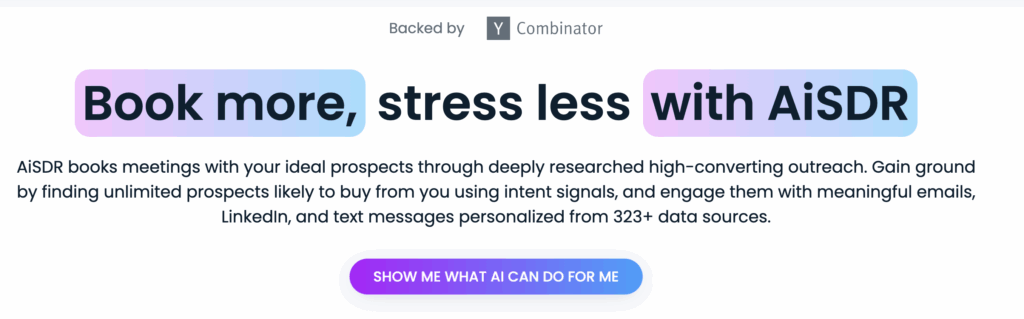
AiSDR is an AI sales rep that engages inbound and outbound leads through personalized emails, LinkedIn messages, text, and AI videos. Once a lead replies, AiSDR drives the conversation by answering questions, handling objections, and qualifying prospects.
AiSDR makes sure emails are timely and relevant by tailoring the language using LinkedIn and HubSpot data, as well as tactics and frameworks from 50+ sales leaders.
All AiSDR users also receive 24/7 customer support, even during weekends and holidays, as well as a dedicated Slack channel and personal support agent.
Most issues reported with AiSDR relate to integrations, in particular the lack of a Salesforce integration (Sneak peek: A Salesforce integration is in the works and scheduled for release this year).
Unify GTM

Unify GTM enables teams to capture buyer intent signals, run AI agents for account research, and engage prospects with personalized outbound campaigns within a unified workflow.
It provides scalable playbooks and multi-channel sequences (email + LinkedIn), backed by managed deliverability and end‑to‑end analytics.
However, some users report feature gaps compared to alternatives, and pricing for teams above the Growth tier requires direct consultation, which can reduce transparency for smaller buyers.
Topo

Topo offers AI SDR agents trained on company-specific data to handle outbound workflows such as prospecting, qualifying, and booking meetings across multiple channels.
Its standout features include integrations with major CRMs, personalized outbound messaging, and built-in support for deliverability infrastructure and sales rooms.
However, users have noted limited flexibility when configuring campaigns for less common industries and a need for tuning during onboarding.
Artisan
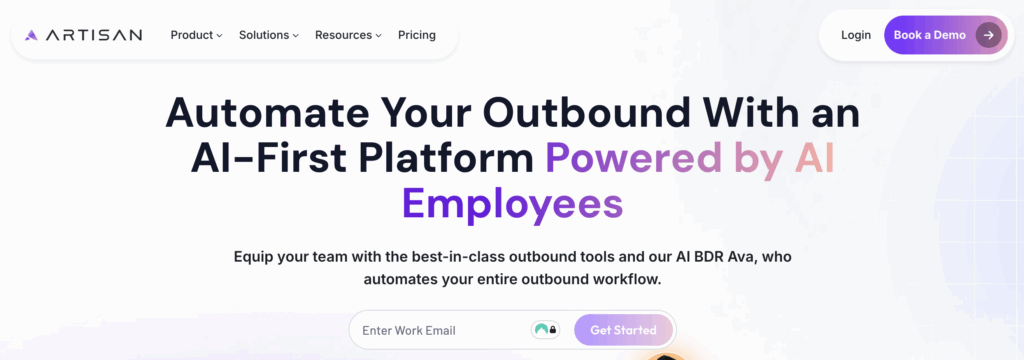
Artisan is building AI sales agents called artisans that can be added to sales processes and automate the work of business development representatives.
Using Artisan, you can browse lead databases and scrape the web to collect data about potential prospects. It also offers playbooks designed to bolster cold email outreach and personalization.
However, tracking outreach performance via the dashboard is not always straightforward. As one user explained, Artisan counts replies like “Remove me from your mailing list” when calculating a campaign’s response rate, leading to inflated metrics. There’s also no convenient way to see which leads responded positively.
Breeze

Breeze AI works natively within HubSpot and supports go-to-market teams with tools for prospect research, message creation, and outbound execution inside the CRM.
One benefit is its deep integration across the HubSpot ecosystem, allowing reps to access AI assistance for tasks like writing, enrichment, and campaign setup without switching platforms.
That said, more advanced capabilities are only available on premium plans and may take time for teams to learn and fully operationalize.
How do AI SDRs fit into different sales processes?
AI SDRs can plug into every stage of your sales engine and drive precision, speed, and scale in your outreach.
Here’s how three companies used AiSDR to turn specific sales challenges in their sales process into measurable wins:
Outbound prospecting
Instead of casting a wide net, AI SDRs pinpoint high-fit prospects using intent signals, firmographics, and activity history. That’s how Metal achieved 3.5% response rates and 1.92% conversion rates with AiSDR, generating 1.8× more revenue in one quarter.
Inbound qualification
Many inbound leads slip away because they were forced to wait too long, sometimes even 48 hours, for a response they might never get. AiSDR responds within 10 minutes, asks qualifying questions, and feels only high-fit prospects into your pipeline. With this, Bina scored a 9.72% lead response rate using AiSDR’s HubSpot integration.
Targeted account outreach
ESLNA used AiSDR to engage Airbnb, Delta, and Disney with personalized messages based on real-time intent data, achieving 32% reply-to-demo rates and booking their first Fortune 500 meeting in three days. AI handles research so that reps can focus on closing strategic accounts.
AI SDR success stories
AI SDRs have been game-changers for many businesses by making sales smoother and more efficient.
Here are a few more use cases where AiSDR users achieved strong outcomes:
| Company | Results | Highlight |
| PodiumX | 4 meetings booked in the first month | Hands-off outreach engine |
| The Archangel Group | Reply rates up to 7.12% | Omnichannel outreach for 7 clients |
| Mary Technology | 4 demos booked in 3 weeks | 8.04% response rate |
| Medisafe | 29 meetings booked in 30 days | Full HubSpot sync + pharma outreach |
| AstroLabs | 9 webinar sign-ups in 24 hours | 184 leads processed |
| Xcela | 7 meetings booked from 400 leads | 5.25% response rate, 33% reply-to-demo rate |
- PodiumX set up a hands-off outreach engine, booking 4 meetings within their first month.
- The Archangel Group ran omnichannel outreach for 7 clients, scoring reply rates up to 7.12%.
- Mary Technology booked 4 demos in 3 weeks with an 8.04% response rate.
- Medisafe booked 29 meetings in 30 days for top pharma brands, fully synced to HubSpot.
- AstroLabs turned 184 leads into 9 webinar sign-ups within 24 hours.
- Xcela booked 7 meetings from 400 cold leads with a 33% reply-to-demo rate.
These tales of success show the impact a good AI SDR can have on a company’s sales.
Book more, stress less with AiSDR
FAQ
What does AI SDR stand for?
AI SDR stands for artificial intelligence sales development representative. It is an AI-powered sales agent that performs the tasks a human SDR would normally do, such as prospecting, qualifying leads, follow-ups, and mailbox warm-up.
Our AiSDR goes beyond this, personalizing outreach, handling objections, and continuing conversations to qualify prospects before passing only high-fit leads to your sales team.
How much does an AI SDR cost?
AiSDR costs about $900 per month for 1,200 messages, which brings the cost per message to under $1. This makes it more scalable than manual outreach and significantly less expensive than employing a human SDR.
Can AI SDR replace human SDRs completely?
AI SDRs cannot fully replace human SDRs. Humans are better at emotional intelligence, cultural nuances, flexibility in unscripted situations, and providing a personal face behind the name.
Rather, AiSDR helps to free sales reps from a mundane, heavy-lifting routine to focus their energy on establishing stronger relationships with the clients and closing more deals.
When to use a hybrid AI + human SDR setup?
A hybrid setup works when AI SDRs handle large-scale automated outreach, lead qualification, and follow-ups, while human SDRs focus on building relationships, handling objections, and managing tasks that require empathy and cultural understanding.
What results can AI SDR deliver?
Businesses using AiSDR have achieved results such as booking meetings in the first month, reply rates of over 7%, multiple demos booked in weeks, increased revenue by 1.8x, and processing hundreds of leads within a single day.



AI SDRs are special software that use artificial intelligence carry out sales tasks typically done by human SDRs. Find out more about them.
 Summarize with
 ChatGPT
 Claude
 Perplexity
 Grok
Grok 
 Google AI