










[AI SDRs in Action] How We Got 7x More LinkedIn Replies with Connection Notes
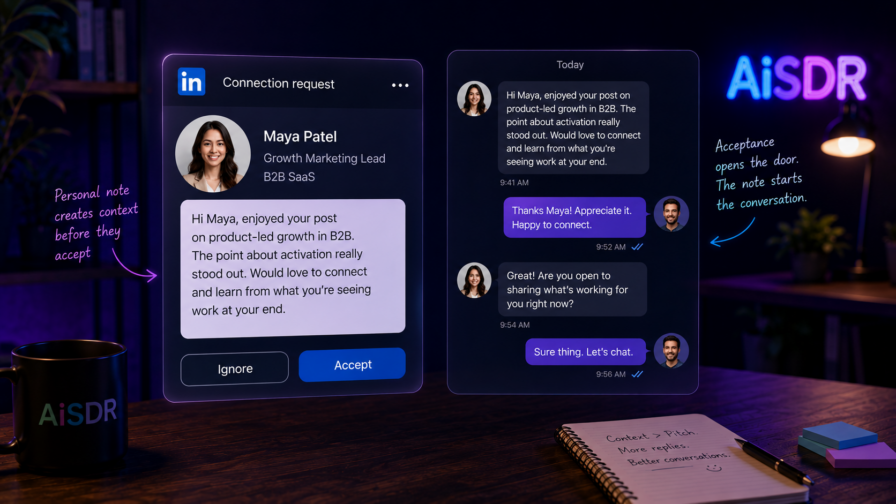
Short answer: The note didn’t change who accepted the request. But it did change what happened after they did.
We tested LinkedIn connection requests carrying a personalized note against identical requests sent with no note at all. Acceptance barely moved, while replies multiplied 7x.
Most teams judge connection requests by acceptance rate. That’s the number that hid the real result here.
| Use a note if… | Skip the note if… |
|---|---|
| You’re on LinkedIn Premium or Sales Navigator, where you can add a note to every request without hitting a cap | You’re on a free account with a limited number of personalized notes each month, and yours are better spent on priority targets |
| Replies, positive responses, and booked meetings are the goal, and pipeline is what you’re optimizing for | Network growth and reach are the goal, and you want more connections per week |
| You have a real post, event, or signal to reference | You have no specific context |
This is part of our How AiSDR Uses AiSDR series, where we publish the wins and the misses. The full spreadsheet lives at aisdr.com/outreach-experiments/.
We went into this fully expecting AI personalization to beat plain templates everywhere. Across most of our cold campaigns, it did exactly that. But one market pushed back in a way we didn’t see coming. It changed how we think about where personalization is worth the effort.
Hypothesis
Here’s the claim we set out to test: adding a personalized note to a LinkedIn connection request lifts acceptance rate.
We wanted to know if that held even when the audience was already warmed up with likes before the request went out.
LinkedIn outreach guides argue both sides of this. One camp says notes hurt acceptance because they read as a sales pitch. The other says notes lift acceptance because they give the person a reason to say yes.
So we also tracked replies and positive replies. An accepted request gives you access. It does not give you a conversation. If acceptance held flat, we wanted to see where the note was doing its work instead.
Methodology
Both audiences came from LinkedIn social signals. We defined the topics our buyers talk about, and AiSDR surfaced the people posting and engaging on those topics.
We built 2 matched audiences from the same signals, industry posts our leads engaged with or wrote themselves. We split them evenly: one group got a note, the other didn’t. Both groups, about 450 leads each, got the same warmup: a like on a recent post before the connection request went out.
We tracked 3 numbers because each one tells a different part of the story: acceptance, response rate, and positive response rate. Acceptance tells you how many people let you in. Response rate tells you how many of them talk to you. A positive reply meant the conversation showed enough interest or relevance to deserve sales attention.
Look at acceptance alone and the note looks pointless. Look at all 3, and the note wins.
Results
Acceptance came out flat, with a gap between the 2 groups of under 3 points. At this volume, it’s effectively noise.
| Metric | Without note | With note |
|---|---|---|
| Connection acceptance | 37.3% | 34.6% |
Response rate | 2.6% | 19.2% |
Positive response rate | 0.7% | 7.7% |
Then the downstream numbers split wide open, with the note campaign generating 7x the replies and 11x the positive responses.
The clearest way to see the difference is in what happened immediately after someone accepted. Roughly 55% of accepted connections on the note side turned into a genuine reply, compared with about 7% on the no-note side.
The audience type, the warmup, and the follow-up sequence were identical. The only difference was whether the person had read a couple of sentences from us before they hit accept.
Key takeaways
Here’s what we changed in our own playbook after reviewing the experiment:
- Pick the outcome before the tactic: The no-note version won on acceptance.The note version won on replies and positive replies. Neither result matters without a defined campaign goal.
- Treat the note as the first line of the conversation: A connection note does not need to pitch the product. Its job is to establish context that the follow-up can continue.
- Notes win for pipeline: If the goal is replies, positive responses, and meetings that show up, the note version wins and it isn’t close.
- Likes carry the acceptance: Warming the audience with likes did the work we assumed the note was doing.
- Use real context or skip it: Reference a post, event, shared topic, or clear signal. Do not force a note when the only available copy is a template. Generic personalization gives the prospect no reason to remember you.
One caveat: This was a signal-based audience already active on the topics we sell into. A colder, broader list would likely behave differently. We’d expect the note to matter less when there’s no shared context to reference.
What’s next in the lab?
Here are a few threads we’re currently pulling on:
- Note length and angle: Does a question outperform an observation? Does referencing their post beat referencing their role?
- Warmup timing: How many days should sit between the like and the connection request?
- Note vs first DM: Can the follow-up message carry the same context and get the same reply lift, freeing the note for accounts that need it most?
- Voice notes after acceptance: Whether a voice note beats text as the first message once someone connects.
We run these tests on our own pipeline with the same platform our customers use. Every experiment here goes through the AiSDR sequence builder, which means likes, connection requests, DMs, and follow-ups sit in one flow rather than across a stack of separate tools.


Steal our tests
We run experiments like this connection note test every month on live campaigns, and publish the results either way.
Subscribe once, and new results reach you as each test completes.
FAQ
Should I add a note to LinkedIn connection requests?
It depends entirely on what you’re measuring. Use one when you have real context and replies are the goal. Skip it when connection volume matters more, or when the note would sound generic.
In this test, the note did not improve acceptance. It produced 7.4× the reply rate.
Do connection notes hurt acceptance rates?
Acceptance was 34.6% with a note and 37.3% without one. That is a 2.7-point difference. Whether the gap reflects a real effect or normal variation depends on the cohort size and raw counts.
Larger studies report wider gaps, so your results will vary depending on audience quality and how sales-heavy the note reads.
What’s a good LinkedIn connection acceptance rate?
Most 2026 benchmarks put the platform average in the high 20s, with anything from 30% up considered a healthy result. Both of our campaigns landed above that bar.
Why not just track acceptance rate?
Because it’s the metric most likely to mislead you. A campaign can register an impressive acceptance rate while producing almost no conversations, which is precisely what our no-note version demonstrated.
How long should a connection note be?
Short enough to read in one glance and specific enough to prove you examined their profile. If you can’t reference something specific, the note contributes nothing and you’re better off sending the request without one.
Can AI write these notes at scale?
Yes, and that’s how we ran both campaigns. AiSDR researches each prospect, drafts the note from what it finds, and handles the likes, the request, and the follow-up sequence in one flow. We measure the output in replies and meetings rather than messages sent.
More experiments from the AiSDR team:



Does the connection note influence metrics? Yes, but not the one you’d expect.
 Summarize with
 ChatGPT
 Claude
 Perplexity
 Grok
Grok 
 Google AI