










[AI SDRs in Action] Do AI memes get more replies in cold email?

Short answer: no.
In our own outbound, adding an AI-generated meme to the final email didn’t move replies, and it didn’t lift meetings either.
| Use AI memes if… | Skip memes if… |
|---|---|
| You’re emailing peer-to-peer audiences like sales managers and RevOps ICs who expect a casual tone | You’re targeting senior buyers or regulated industries, where memes read as unprofessional |
| Your primary KPI is replies and engagement rather than booked meetings | Pipeline is the goal, and memes didn’t lift it for us |
| You can run a balanced test and watch meeting conversion rather than only the reply rate | Your replies are already strong and you’d rather not risk the tone |
This is part of our How AiSDR Uses AiSDR series, where we publish the wins and the misses. The full rundown lives at aisdr.com/outreach-experiments/.
We’ll be completely honest with you here: We genuinely wanted the memes to win this one.
For months, we’d been dropping an AI-generated meme into the final email of our outreach sequences, and it simply felt right to the whole team. It seemed more human and less robotic, which is exactly the kind of touch that earns a reply when a more polished pitch would get ignored.
We were fully prepared to write the post about how a well-placed meme beats a plain-text email.
Hypothesis
Adding an AI-generated meme to the final email in a sequence should lift both reply rates and booked meetings, compared with the same sequence that ends in plain text, and that was the testable claim we set out to prove.
The logic behind it was reasonably simple, since inboxes are crowded and competitive, and the final email in a sequence is usually where forgotten deals quietly go to die. A meme placed right at the very end might be just enough to jolt a distracted reader into finally replying.
Methodology
We run our own outbound on AiSDR, and before we made the public case for memes, we decided to test the idea properly.
We ran 2 campaigns aimed at the same audience type, which was people who had recently engaged with a competitor’s LinkedIn posts. Both campaigns deliberately used the exact same ICP, the same sequence structure, and the same send window. The only variable that we deliberately changed was the final email in the sequence, which carried a meme image in one set and plain text in the other.
Results
In the end, the meme set simply did not win, because the response rate came out effectively flat, at 5.39% with memes against 5.32% without, while the meetings per engaged lead stayed statistically level, at 0.625% versus 0.718%.
The replies themselves certainly did show up in the inbox, but the underlying pipeline simply refused to move at all.
| Metric | Meme set | No-meme set |
|---|---|---|
| Response rate | 5.39% | 5.32% |
| Meetings per engaged lead | 0.625% | 0.718% |
On both of the numbers that truly matter, the two sets landed in the same place, so the memes showed essentially zero lift on the one metric that we care about most.
Memes may well pull additional replies out of people. But those replies don’t necessarily convert themselves into booked meetings.
Here is a real example that came straight out of the meme set, and it captures the problem neatly: the meme itself landed nicely, but the meeting never materialized, because the lead simply passed us along to another team instead of booking any time on the calendar.
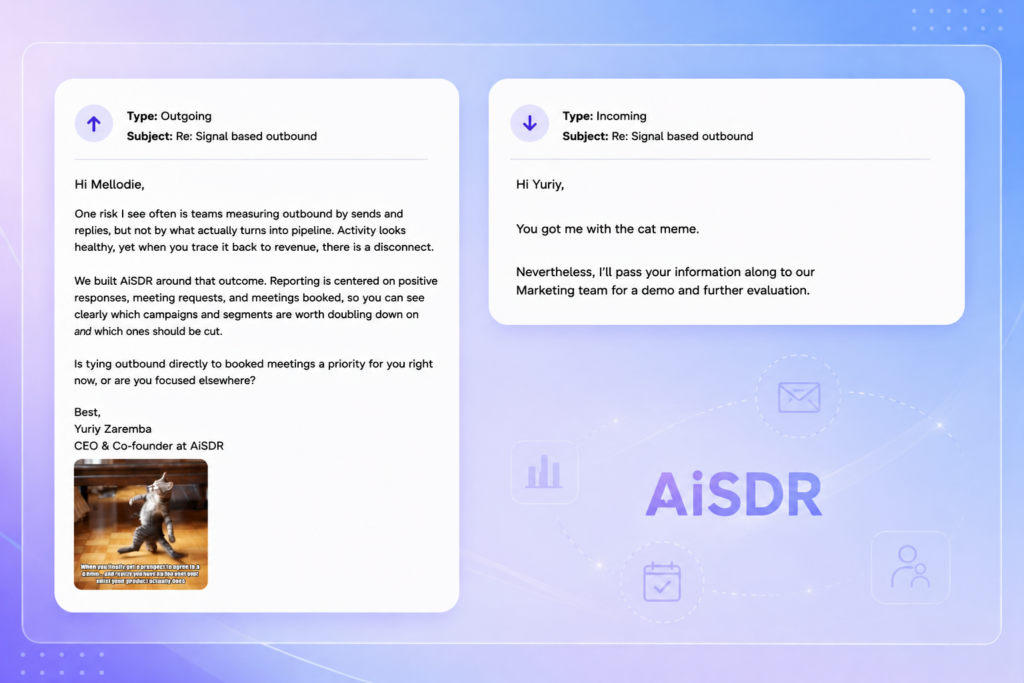
Decision-makers often perceive memes in cold email as unprofessional, and whether a meme lands successfully depends heavily on the industry and the particular type of company that you’re targeting. The people who do reply warmly are often not the serious buyers you need.
So if your only goal here is simply more replies, then memes might genuinely look like a perfectly reasonable win. But if your real goal is pipeline, then they have to prove that they lift meetings rather than only engagement, and in our own controlled test they clearly failed to do exactly that.
Key takeaways
Here’s what our own test ultimately told us, once all of the numbers were finally in:
- The response rate didn’t move – 5.39% against 5.32% is effectively flat.
- Meeting conversion didn’t improve – the meme and plain-text sets stayed statistically level, at 0.625% and 0.718% meetings per engaged lead.
- More replies wouldn’t have helped anyway – the warm replies that memes pull in are often not serious buyers.
What’s next in the lab
The next test is already queued up. We’re comparing AI memes against a plain-text first message, and we’re tracking positive replies per lead as the primary metric.


Steal our tests
We run experiments like this meme test every month on live campaigns, and publish the results either way.
Subscribe once, and new results reach you as each test completes.
FAQ
Do AI memes increase cold email reply rates?
Not according to our own data. In a matched-ICP test, the meme set replied at 5.39% while the plain-text set replied at 5.32%, which is effectively flat either way.
Did memes book more meetings?
No, they did not. The meetings per engaged lead came out statistically level, at 0.625% with memes and 0.718% without. The memes demonstrated no measurable lift on pipeline whatsoever.
Should I use memes in cold outreach?
It really does depend quite a lot on your particular audience and the market that you sell into. Keep memes switched off by default for senior buyers in regulated industries. They may be worth a test for peer-to-peer audiences like sales managers and RevOps ICs, but only if they can prove that they lift meetings rather than only replies.
What is AiSDR testing next?
We’re pitting AI memes against a plain-text first message, with positive replies per lead serving as the primary metric. Every experiment, wins and losses alike, gets published at aisdr.com/outreach-experiments/.
More experiments from the AiSDR team:



We wanted them to win. They didn’t. Reply rate barely moved, and the replies we did get shared a pattern we really didn’t love.
 Summarize with
 ChatGPT
 Claude
 Perplexity
 Grok
Grok 
 Google AI