










[AI SDRs in Action] How AI personalization beat our cold email templates
Short answer: mostly yes, but not everywhere.
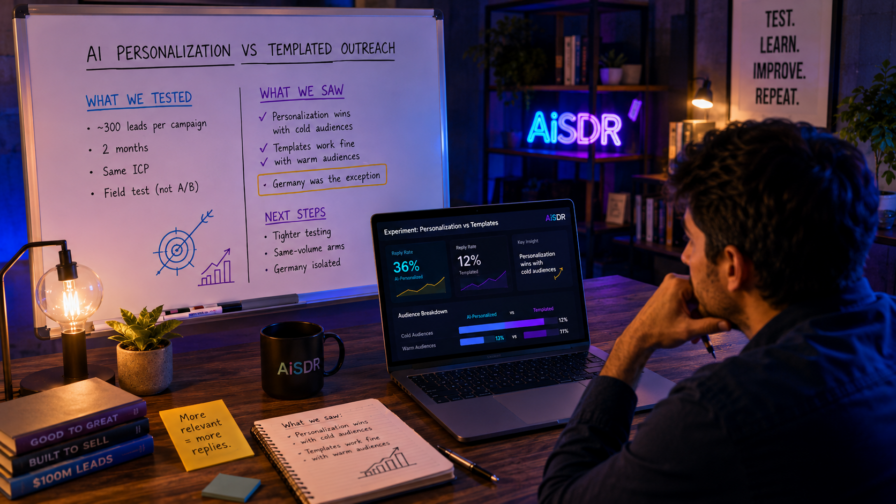
Across roughly 2 months and about 300 leads per campaign, AI-personalized cold emails pulled more replies than templated sends. The clear exception was Germany, where long, formal templates performed about as well as personalized emails did.
| Personalize your cold outreach if… | Lean on templates if… |
|---|---|
| You’re reaching cold audiences who have never heard of you | You’re emailing formal-business markets like Germany, where structured copy reads as professional |
| Your leads sit close to the work, like sales leaders, marketing leaders, and ICs | You need a consistent baseline before investing in per-lead personalization |
| You want replies that reference something real, even when the answer is no to a demo | You’d rather spend your personalization effort where it moves the outcome most |
This is part of our How AiSDR Uses AiSDR series, where we publish the wins and the misses. The full spreadsheet lives at aisdr.com/outreach-experiments/.
We went into this fully expecting AI personalization to beat plain templates everywhere. Across most of our cold campaigns, it did exactly that. But one market pushed back in a way we didn’t see coming. It changed how we think about where personalization is worth the effort.
Hypothesis
AI-personalized cold emails should get more replies than templated ones, in every market and for every kind of buyer. That was the claim we set out to test.
The logic was straightforward. A message that references real detail proves the email wasn’t blasted out to a random list, and more relevance should mean more replies. So we expected the personalized set to win across the board, from early-stage founders to individual contributors, and from the US to Europe.
Methodology
AiSDR ran 2 campaign types against the same broad ICP, and the split between them was deliberately simple:
- Set A | AI-personalized outreach – messages drew on each lead’s recent activity, role, company context, and visible signals.
- Set B | templated outreach – messages used only basic variables like first name, company, and role, with no deeper AI personalization added.
Each campaign included about 300 leads. The test ran for 2 months across multiple industries and several buyer personas. We then compared replies across the cuts that mattered most, including audience type and Germany versus other regions.
Results
AI personalization beat templates in most of our cold campaigns. But the win wasn’t universal, and Germany turned out to be the clear exception.
| Segment | What performed best | Why it happened |
|---|---|---|
| Cold audiences, most markets | AI personalization | It proved the email wasn’t sent to a random list |
| Germany and DACH | Templates matched personalization | Structured, formal copy reads as professional |
Cold audiences: personalization helped
For cold leads, AI-personalized emails pulled more replies than templated ones. The gap wasn’t subtle. A cold email has one job: prove it wasn’t sent to a random list. Personalization did that better.
People often replied by mentioning the exact detail we’d referenced, even when they turned down a demo. They clearly noticed the message, and in a crowded inbox that is what counts. Templated cold emails carried no comparable proof point, so they simply blended into the background.
Germany: the exception
Germany broke the pattern entirely. We had expected personalization to win everywhere, and it simply didn’t. German leads replied to long, structured templates at roughly the same rate as they did to the personalized emails.
Our working hypothesis here is cultural. In markets where formal business communication is the default, a structured template reads as professional, while a short personalized note can look like the lower-effort option. That isn’t a final finding yet. It’s a testable idea, and we’re already queuing follow-ups in Japan, Switzerland, the Nordics, and other formal-business markets to see whether the same pattern holds up.
Reply quality also mattered
Personalized emails produced more of one specific reply type, which we think of internally as “no to the demo, yes to the reply.” The lead didn’t want a call, but they answered anyway, usually because the message referenced something real about their work.
That outcome isn’t a loss at all.
The conversation stays open, and your team ends up with a real person to follow up with later on. The email earned a human response instead of getting deleted, which may also help your sender reputation over time. We now track these replies separately rather than folding them into the negative bucket.
Key takeaways
Here’s what the field test told us:
- Cold audiences replied more to personalization – referencing something real proved the email wasn’t a random blast.
- Germany didn’t follow the pattern – long, structured templates performed about as well as personalized emails.
- Personalized emails opened more conversations – the “no to demo, yes to reply” response keeps a real person in play.
What’s next in the lab?
We already know how we want to push this further. The next round digs into the Germany result specifically. We’re testing structured, formal copy across other formal-business markets like Japan, Switzerland, and the Nordics, to see whether the pattern holds.
A few things we’re carrying into every future campaign:
- Match personalization depth to the audience – founders and CEOs need sharper signals rather than longer personalization, while sales leaders, marketing leaders, and ICs get more value from added context.
- Test formal copy in DACH-style markets – structured, professional writing may well beat casual personalization in those regions.
- Track “no to demo, yes to reply” as its own outcome – it isn’t a booked meeting, but it isn’t a hard no either.


Steal our tests
Every experiment we run lands in one live sheet, this personalization test included.
Drop your email, the sheet opens right away, and new results reach you as each test completes.
FAQ
Does AI personalization beat templated cold email?
In our field test, yes for cold audiences. Personalized emails pulled more replies because they proved the message wasn’t sent to a random list. Warm audiences and formal markets like Germany were the notable exceptions.
When are templates good enough?
Templates hold up well for warm leads who already know you. They also perform surprisingly well in formal business markets like Germany, where structured copy can read as more professional than a casual personalized note.
Why did Germany break the pattern?
Our working hypothesis is cultural. Where formal communication is the default, a structured template signals professionalism, while a short casual note can look like the lower-effort choice. We’re testing more formal markets next to check whether the pattern holds.
Why doesn’t this post publish reply rates?
Because it wasn’t a clean A/B test. We didn’t lock the per-segment rates or sample sizes before writing, so we’re holding back rate-level claims until the next and tighter round of testing.
More experiments from the AiSDR team:
IT’S ALREADY WORKING



Does AI personalization actually beat templated cold email? Mostly yes, except in Germany.
 Summarize with
 ChatGPT
 Claude
 Perplexity
 Grok
Grok 
 Google AI