











10+ Evaluation Criteria to Consider When Hiring Your Virtual Sales Rep

The right AI sales assistants will transform your sales process. Finding them is no trivial task though. A good AI needs to help your team work smarter (not harder), fit in with your core software, and – most importantly – get the job done.
Not only is the market already flooded with AI sales assistant software, it’s projected to grow globally from $31.5 billion in 2022 to $92.8 billion in 2032.
To make your buyer’s journey smoother, here’s a breakdown of criteria you can use to evaluate AI sales assistants.
What’s an AI sales assistant?
An AI sales assistant is smart software that helps you increase sales. It’s powered by AI technologies, such as machine learning (ML), natural language processing (NLP), and predictive analytics.
AI-powered virtual sales rep software like an AI SDR sifts through mountains of information from various sources, including your CRM platform, social media, and customer interaction logs. It then uses relevant information to improve messaging, automate sales-related tasks, forecast trends, and optimize processes.
Role of AI in sales
AI sales assistants are a game-changer for sales representatives. They turn data into insights that help you make better decisions.
This type of software is called an assistant for a reason. Sales and marketing teams use AI sales assistants to automate routine tasks, such as manual data entry and bookings, so they can focus on more complex work.
By implementing an AI-based virtual sales rep, your employees can uncover hidden patterns and trends, like spotting shifts in customer needs, the most promising leads, and revenue streams hiding in plain sight. The guesswork is turned into informed action.
The best part? ML algorithms can ensure that the software sharpens with every interaction, leading to improved forecasting accuracy and higher quality of customer interactions.
Industries where AI sales reps work best (and where they don’t)
Can AI sales reps do their magic for any company?
Not really. Some industries benefit more than others from AI-powered sales:
- Software-as-a-service (SaaS)
- E-commerce
- Real estate
These industries share certain traits:
- High lead volume, especially at the top of the funnel
- A large share of repeatable, rule-adhering operations in the sales team workload
These traits make AI tools particularly efficient in handling sales, although exact applications may vary by industry. In e-commerce, AI will likely generate hundreds of ad creatives and send back-in-stock, cart-abandon, and product-match nudges across email and SMS. In SaaS, it will research leads, score them, and execute email campaigns.
On the other end of the spectrum are industries with high-empathy and high-stakes sales, such as luxury goods, complex enterprise products, or sensitive services. They are defined by:
- Small volume of eligible leads
- Highly demanding customers
- Uniqueness of each sale
If you work in an industry like this, you might leave actual back-and-forth to humans and use AI for surfacing hard-to-spot buyer signals or automating follow-ups.
AI sales rep vs human sales rep: Comparative breakdown
How does an AI sales rep compare to a human colleague? Here’s a side-by-side comparison based on the main criteria.
| Criteria | AI SDR | In-house human SDR |
| Cost | Cost of subscription (AiSDR = $250 per month) | At least $53,000 per year |
| Productivity | Thousands of touches per day in parallel | Limited by calendar and energy to about 100 touches per day |
| Empathy | Good at recognizing intent patterns; limited at nuance and emotion reading | Reads context, builds rapport, navigates complex issues |
| Learning curve | Improves in a matter of minutes as you feed data and tune prompts/playbooks | Onboarding and ramp take weeks or months, requiring a human coach |
| Consistency | Same tone and structure 24/7 if set up right | Performance varies by day, deal, and team member |
Today, AI beats humans on cost-efficiency, productivity, and ramping up, but still lags behind on empathy. That’s why it’s better to delegate heavy lifting like research and messaging to AI so humans can focus on the actual sales calls.
AI performance in a sales job depends on how well you fine-tune it and whether the intelligence layer finds the data you need. Not all AI tools are created equal.
Industries where AI sales reps work best (and where they don’t)
Can AI sales reps do their magic for any company?
Not really. Some industries benefit more than others from AI-powered sales:
- Software-as-a-service (SaaS)
- E-commerce
- Real estate
These industries share certain traits:
- High lead volume, especially at the top of the funnel
- A large share of repeatable, rule-adhering operations in the sales team workload
These traits make AI tools particularly efficient in handling sales, although exact applications may vary by industry. In e-commerce, AI will likely generate hundreds of ad creatives and send back-in-stock, cart-abandon, and product-match nudges across email and SMS. In SaaS, it will research leads, score them, and execute email campaigns.
On the other end of the spectrum are industries with high-empathy and high-stakes sales, such as luxury goods, complex enterprise products, or sensitive services. They are defined by:
- Small volume of eligible leads
- Highly demanding customers
- Uniqueness of each sale
If you work in an industry like this, you might leave actual back-and-forth to humans and use AI for surfacing hard-to-spot buyer signals or automating follow-ups.
AI sales rep vs human sales rep: Comparative breakdown
How does an AI sales rep compare to a human colleague? Here’s a side-by-side comparison based on the main criteria.
| Criteria | AI SDR | In-house human SDR |
| Cost | Cost of subscription (AiSDR starts from $250 per month) | At least $53,000 per year |
| Productivity | Hundreds of outgoing messages per day | Limited by calendar and energy to about 100 touches per day |
| Empathy | Good at recognizing intent patterns; limited at nuance and emotion reading | Reads context, builds rapport, navigates complex issues |
| Learning curve | Improves in a matter of minutes as you feed data and tune prompts/playbooks | Onboarding and ramp take weeks or months, requiring a human coach |
| Consistency | Same tone and structure 24/7 if set up right | Performance varies by day, deal, and team member |
Today, AI beats humans on cost-efficiency, productivity, and ramping up, but still lags behind on empathy. That’s why it’s better to delegate heavy lifting like research and messaging to AI so humans can focus on the actual sales calls.
AI performance in a sales job depends on how well you fine-tune it and whether the intelligence layer finds the data you need. Not all AI tools are created equal.
Main requirements for AI sales software
To be effective, your AI sales software should be able to perform certain functions. These are the mandatory boxes it should tick:
- Assistance with sales processes – AI assists sales teams by automating routine tasks, from manual management to complex tasks like lead scoring. For example, it can evaluate and suggest potential customers based on behavior, engagement, and product fit.
- Task automation – AI takes the grunt work out of sales processes, such as lead follow-up. Smart tools can generate emails and even send calendar links to leads who request meetings.
- Timely communication – To prevent missed opportunities, AI sales tools can send personalized inbound and outbound emails, timely reminders, and book meetings.
- Streamlined data entry – Manually updating a CRM database eats up lots of time. AI sales software captures and logs data from customer interactions automatically with fewer errors than humans make and highlights missing information.
- Full-cycle support – The ideal tool helps sales reps at every stage of the sales cycle. For instance, it could find quality leads based on historical data, offer negotiation strategies during the deal-closing, and keep customers engaged in follow-up communications.
- Data collection and analysis – AI pulls info from multiple sources to reveal actionable trends. Sales reps can use that information to identify products that resonate with specific demographics or tactics that work best in different regions.
- Scaling support – Your tools should scale proportionally with increases in your headcount and client base. Scalability is valuable for businesses that want to remain competitive and maintain quality while expanding their sales offerings.
- Semantic analysis – Your AI software should analyze factors that cause interactions with customers to succeed or fail to learn which sales tactics work best.
- Real-time feedback and communications – Virtual sales rep AI tools help customers deal with simple queries and low-priority problems. Additionally, they help tweak email responses based on customer profile information.
Of course, even the best sales rep software comes with a few potential challenges.
Free guide
Possible problems when choosing AI for sales automation
Companies can run into technical, cultural, and security bumps when choosing AI-based sales software. Tackling these issues early on can make transitioning to the software smoother.
So, let’s take a look at these problems.
Vendor lock-in
You might get stuck relying too much on one vendor’s ecosystem, which makes it harder to adopt other tech when needed. Some AI tools, especially those tied to big software pricing packages, lock you into their platforms.
To avoid vendor lock-in, choose AI tools with industry-standard data formats, open APIs, and custom integration options.
Always stay in control of your tech stack and be ready to adapt as your needs change.
Resistance to change
Sales teams often resist new technologies because they don’t understand them or fear the tech will mess with established workflows.
To make the transition smoother, think about the people, processes, and technology – in this order. Start by understanding your team and how they work, then figure out who and which processes the AI will impact the most.
Once you know who will use the AI and how it fits into their processes, you’ll have a clearer idea of which solution works best. Communicate the benefits of the technologies to key stakeholders to promote buy-in.
Finally, employees should be well-trained in how to use AI, as sales reps will be more comfortable and effective if they understand how to deploy the tools that complement their skills.
Data privacy and security
Data privacy regulations are like a minefield, especially if you have customers across several regions, each with different compliance laws (like GDPR in Europe and CCPA in the US). You can face weighty penalties for noncompliance or lack of oversight.
Ensure that your AI tools allow control over where data is stored and processed. This involves selecting vendors with data centers in compliant regions or opting for software with on-premises storage.
Infrastructure impact
Advanced software requires more server capacity, storage, and processing power. If your IT setup isn’t ready, it could cause errors and slow things down.
As we mentioned, infrastructure scalability is crucial for a sales assistant AI. Most companies select externally managed cloud-based platforms with on-demand scaling of resources.
Problems with output accuracy also exist to some degree. However, this will depend on the algorithms and programming of individual AI rep tools, with the best software having sufficient accuracy for numerous use cases.
Free guide
Key applications of AI sales assistants
AI-driven sales assistants are like a multitool for modern teams. They help different departments in a bunch of ways.
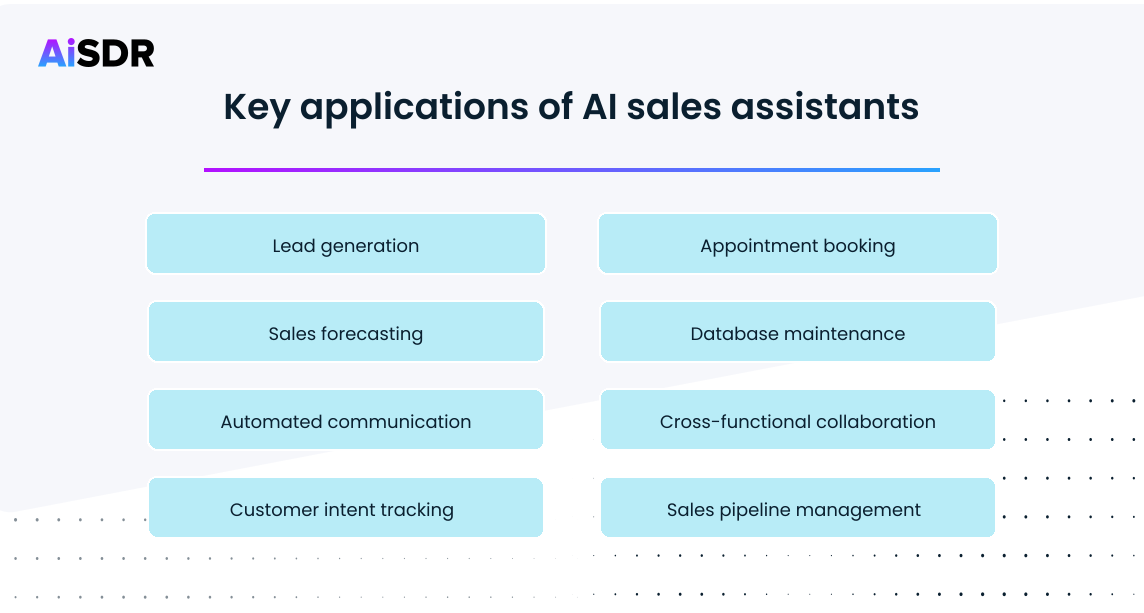
Lead generation
AI sales tools use data analysis and predictive modeling to identify hot leads faster and, oftentimes, more accurately than human agents. Your AI assistant analyzes demographics, past interactions, and online behavior to find leads more likely to convert.
Of course, AI tools can’t replace human judgment. That’s why these tools are called assistants — they can point to the most promising leads, letting the sales team focus their efforts where it matters.
Sales forecasting
ML algorithms and predictive analytics dive into historical data, market trends, and customer behavior to predict outcomes with surprisingly high accuracy.
Need a quarterly revenue forecast? The AI software sales rep can spot deal progression patterns and give you the numbers.
Some AI tools also support scenario planning. When launching a new product, the software can predict how well it will sell in different regions, what demographics will be central to its success, and how it will impact your revenue.
Automated communication
Virtual sales rep tools like AI-enhanced bots can maintain a conversation with customers. They can suggest the optimal time to send emails, adjust the tone of an email based on the customer’s social network profile, run your messaging based on top-performing email frameworks, and avoid certain phrases.
But AI doesn’t just write — it coaches your employees. As they draft communications, the algorithm recommends tweaks to improve clarity, tone, and relevance, ensuring messages hit the mark.
For example, Xcela used AiSDR to automate outbound campaigns, using data from leads’ LinkedIn profiles to personalize communications to get 5 meetings booked out of 284 cold leads.
Generate predictable pipeline without lifting a finger
Customer intent tracking
Through sentiment analysis by NLP algorithms, an AI tool can interpret customer intent to spot satisfaction, frustration, or buying readiness.
More importantly, next-gen AI sales rep software nails the context of conversations. It adjusts recommendations based on each unique interaction, making every customer feel understood and valued.
PodiumX used an AI sales rep to hyper-personalize communication with leads, booking 4 meetings within their first month. Similarly, Metal closed 1.8x more revenue in the first 30 days of AI-powered outreach.
Appointment booking
Most teams spend too much time booking meetings with leads. But AI tools can reduce back-and-forth communication.
The software analyzes your team’s and customers’ availability and proposes an optimal meeting time. Additionally, these tools handle complex scheduling across time zones and multiple participants.
Metal fully automated outreach campaigns with AiSDR. The success of those campaigns and automated appointment booking filled the company’s calendar with meetings with little to no manual effort.

Database maintenance
AI extracts relevant information from emails, phone calls, and other interactions and updates databases in real time. Platforms can provide databases of leads that companies can use to fuel their campaigns.
If a customer’s details change or they show interest in a new product, an AI sales tool can update their profile instantly. This means your sales reps always have the latest information at their fingertips.
Cross-functional collaboration
Bringing your sales data together on one platform can tear down the walls between teams. It gives your managers a full view of how sales, marketing, customer service, and finance are doing, all in one place.
By providing a holistic view of customer interactions across all touchpoints, sales, marketing, and other departments can adopt more cohesive strategies.
Sales pipeline management
AI sales assistants give you a crystal-clear view of your sales pipeline, complete with bottlenecks, high-risk customers, and deals stuck in limbo. Moreover, they provide recommendations on how to move stagnant deals forward.
Some tools offer interactive pipeline views, letting your teams visualize the key indicators and make informed decisions about where to focus their efforts.
But you need to consider more than just the functions of AI sales tools before buying.
Perks to look for when choosing AI for sales
You need software that fits seamlessly with your systems, adapts to your needs, and equips your sales team with the necessary tools.
Legal compliance is non-negotiable. Here’s the bare minimum that an AI tool should have:
- GDPR and CCPA compliance – GDPR is vital if you target leads in the EU, and CCPA is required to reach US-based prospects
- Responsible email list management – Vendors should allow its tool to target only consenting leads, honor unsubscribe requests promptly, and keep proof
- AI governance compliance – Vendors must meet the explainability and record-keeping requirements of the new EU AI Act
Next come the nice-to-haves:
- Software flexibility – A flexible system can facilitate sales strategies, whether that means customizing workflow, adapting actionable rules, tailoring communications, or modifying reporting dashboards.
- Wide functionality – Top-grade AI sales assistant software serves as a holistic solution for multiple purposes. For example, it can help your teams forecast sales, score leads, analyze sentiment, and manage your CRM.
- 24/7 vendor support – Sales teams operate in dynamic environments where problems can arise at any time. Fast support can mean the difference between losing or sealing the deal.
- Ease of integration – Your AI must sync with CRM, Enterprise Resource Planning (ERP), and other sales tools. Look for open APIs and custom integration options to ensure smooth data flow and a unified view of your sales.
- Proactive technical assistance – You’ll need regular software updates to fix bugs, patch security vulnerabilities, and maintain stable performance. A dedicated technical assistance team ensures your AI sales software runs like clockwork.
- Explainable outcomes – Depending on your business, you may need to understand exactly how your AI tool reaches certain conclusions. In that case, you should avoid “black boxes” in favor of explainable AI tools.
Believe it or not, there are even more foundations of a solid AI-based sales assistant.
Checklist: What to look for when hiring an AI sales rep
After shortlisting potential AI sales tools for your company, here’s a final feature checklist before implementing one into your company’s systems:
| Privacy compliance | Ensure the AI complies with GDPR, CCPA, HIPAA, and other regulations. Compliance requires you to handle personal data carefully and obtain clear consent from users. |
| Value for cost | Assess the ROI by comparing the AI’s cost against the value it delivers, including efficiency gains and conversion improvements. Don’t forget to factor in hidden costs like training and integration. |
| Security certifications | Look for certifications such as ISO/IEC 27001 or SOC 2 to confirm robust safeguards, such as encryption, authorization, and multifactor authentication. |
| CRM integration | A basic data sync won’t cut it. The AI sales assistant must integrate with your CRMs and management tools to ensure all teams are on the same page. |
| Ease of use | Choose user-friendly software with simple interfaces that provide clear insights. Look for tools with dashboards that can be customized to fit your sales processes. |
| Training capability | You’ll want an AI tool that you can train to speak in your brand voice and mimic your style, i.e. a tool that learns from your feedback. |
| Use case coverage | The AI tool should be a good match for your use case. If you want the AI to help you craft a strong go-to-market strategy, check if there are success cases of companies doing it before you. |
| Support and training modules | Look for vendors that provide thorough support. You’ll save a lot of time if the tool comes with extensive guides and training modules. |
| Performance tracking and reporting | The AI tools should offer real-time performance tracking and reporting to let you monitor their impact on sales operations and other key performance indicators. |
| Quality of features | Prioritize AI tools that offer consistent performance. The accuracy of predictions should improve over time, learning from new data to refine future recommendations. |
Knowing these answers will help you come to a decision about which AI sales reps to buy (or not to buy).
Top interview questions to ask AI sales software vendors
There’s a lot to find out about an AI tool before you commit. To assist you with this task, we prepared a list of the most important questions to ask.
Data handling and privacy questions:
- What personal data does the AI collect?
- Where is data stored, how long is it retained, and how is it protected?
- How do you handle opt-in/opt-out for marketing contacts in the EU and the U.S.?
Model training and dataset questions:
- Is the model trained on our data only, or do you blend with public/partner data?
- Can we review or constrain sources used for enrichment and first-line generation?
- Do you provide logs or rationales for decisions (e.g., why a lead was qualified)?
Customization and control questions:
- Can we codify our ICP, tone, objection handling, and compliance rules?
- How are playbooks versioned, tested, and rolled back?
- Can we gate high-risk actions behind human approval?
Integrations questions:
- Do you integrate with [your CRM, marketing automation, and messaging tools]?
- Do you feed data back to the other tools, with proper field mapping and attribution?
- How do you avoid duplicate outreach across tools?
Support questions:
- Do we get onboarding, playbook tuning, and real-time performance dashboards?
- What are your benchmarks for time-to-value and reply rate lift?
- How do you handle incident response and SLAs?
With these questions, you can quickly learn the key information about the AI tool. The next step is to calculate its return on investment (ROI).
How to assess ROI when hiring an AI sales assistant
An AI sales rep is an investment just like any other. Compute its ROI as:
ROI = (((Value of Time Saved + Incremental Revenue) − Cost of AI) ÷ Cost of AI) x 100%
These are the key variables:
- Value of Time Saved = hours automated per month × blended hourly rate of the roles saved (SDRs)
- Incremental Revenue = (extra meetings × historical meeting-to-win rate × average deal size) × gross margin
- Cost of AI = subscription + services + integration overhead
If you expect AI to:
- Free 50 hours per month (each hour worth $20)
- Book 6 extra meetings that net one deal worth $10,000 with a profit margin of 15%
- Cost $1,000 per month
- Cost $500 for integration overhead
The first-month ROI is: ((50 x $20 + $10,000 x 15% – $1,500) ÷ $1,500) x 100% = 67%
The annual ROI of AiSDR is actually as high as 400% to over 1,000%, depending on whether you’re hiring it instead of an outsourced or in-house SDR.
Have a conversation with our AI




What do you need to consider when choosing an AI sales rep? Explore 10+ criteria to help make your decision
 Summarize with
 ChatGPT
 Claude
 Perplexity
 Grok
Grok 
 Google AI