









AiSDR vs a Standard Lead Database: What 100K+ Cold Sends Showed Us

“Will I get better results if I send more emails?”
More volume won’t fix a weak list. We tested this ourselves in September by running our own outbound through 2 setups.
We used a popular cold email tool to send 59,064 emails to leads from its built-in database and got 4 positive replies. Signal-based campaigns in AiSDR sent 43,985 messages and got 25 positive replies and 6 booked meetings.
That’s 6.25x more positive replies on ~15,000 fewer sends. The gap came down to lead quality.
Key takeaways
- With similar filters, AiSDR got 25 positive replies and 6 meetings from 43,985 messages, while a popular cold email tool and its built-in database got 4 positive replies from 59,064 emails.
- About 1 in 13 database leads bounced, and most of the 241 replies came from people who were out of office, the wrong contact, gone from the company, or asking us to stop.
- A smaller AiSDR campaign built on a sharper signal reached 608 leads and booked 3 meetings in the same month, with an 8.7% response rate, about 14x our basic-signal campaigns.
- Personalization helps a good-fit lead say yes, but it can’t make the wrong person care.
- Before you add volume, check how fresh your data is and whether each lead has a real reason to hear from you

What was our approach?
Both setups promoted the same thing: Ami – our AI agent for outbound.
We kept the split simple:
- Lead database setup: A popular cold email tool using leads from its built-in database. We set standard filters like industry, company size, and job title. No signals or research.
- Signal-based setup: We ran 2 types of campaigns. For both, AiSDR found fresh contact details for each lead and verified every email before it went out.
- Type 1 – This mirrored the database setup, with the same filters (industry, company size, job title) at a similar sending scale and some personalization.
- Type 2 – This was a smaller set of signal-based campaigns, where a specific signal decided who made the list.
We broke the results down into 3 key findings, with each focusing on one element of outbound: the list, the signal, and the personalization.
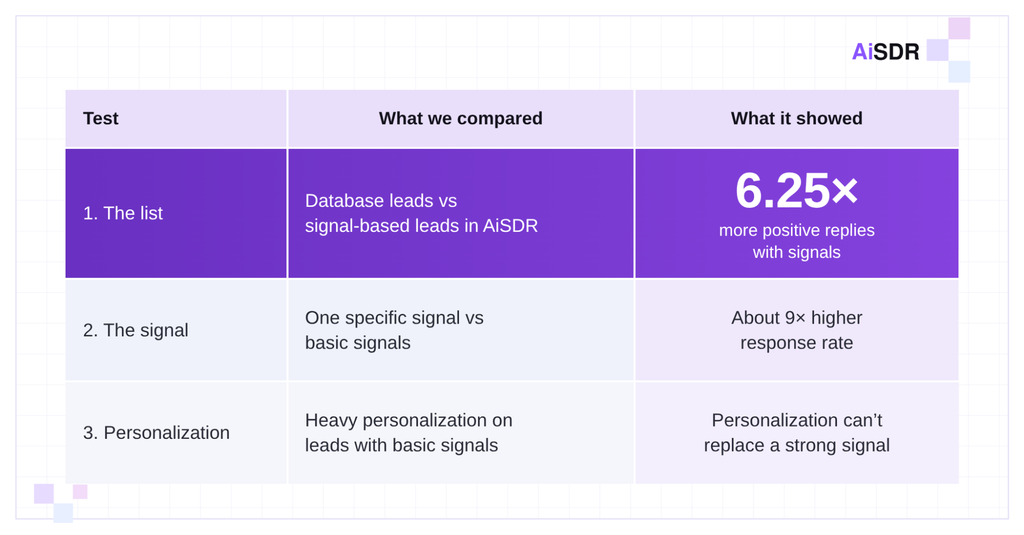
Finding #1: Did the tool or the list make the difference?
Short answer: It’s the list. The cold email tool did its job and sent 59,064 emails on schedule. The trouble started before the first send.
Watching 241 replies came in felt like winning the lottery. Then we opened them:
- Out-of-office notices
- Wrong contacts
- People who’d left the company
- Requests to stop emailing
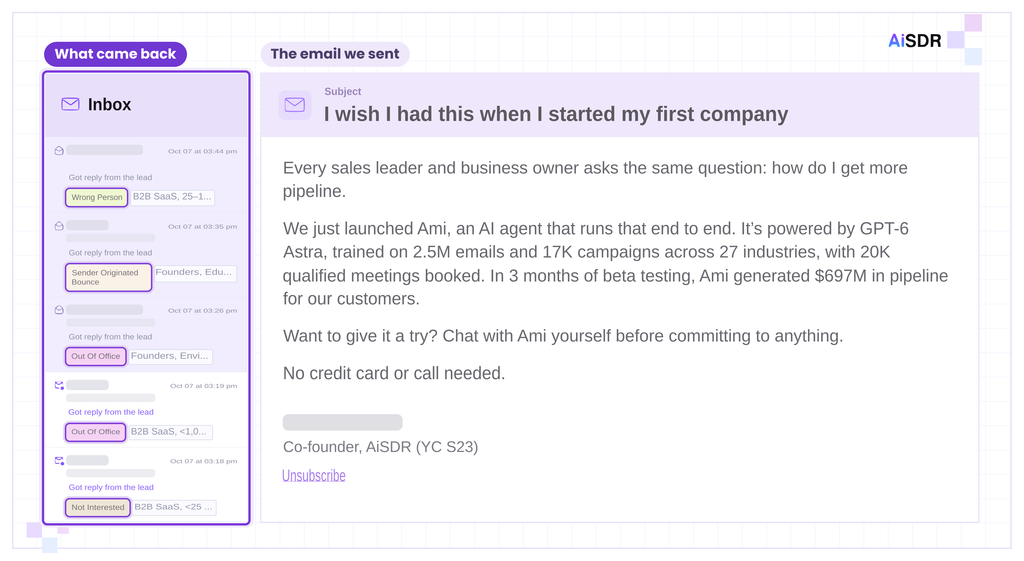
Only 4 replies showed real interest.
The first problem is that a built-in database is collected ahead of time. Each contact is only as fresh as the day it went in, and you can’t see when that was. The vendor says the data is good, and you can’t check that claim until you send. Then the bounces and “no longer with the company” replies start rolling in.
It’s like buying milk with no date on the carton. You only find out it’s gone bad when you taste it. In outbound, tasting means sending.
In our test, 1,778 emails came back “return to sender.” That’s 7.92% of leads, or about 1 in 13. And the damage doesn’t stay in one campaign. Bounces tell Gmail and Outlook you’re mailing an old list, which can push your future emails toward spam. Even the good ones.
The second problem was the filters, and that’s part’s on us.
Industry, size, and title tell you who could buy someday, but they don’t tell you who has a problem right now. Without no signals, the database emailed thousands of people who had no reason to listen. That’s a big reason why so much cold outreach gets ignored.
AiSDR got fewer replies – 90 in total – but more than 1 in 4 were positive. Per lead, that’s nearly 10x more positive replies. AiSDR starts from the signal, then finds contact data on the spot for people who show one and checks each email before it goes out.

The takeaway: A sending tool can only send what you feed it. Fix the list before you touch the copy.
Now for the number that doesn’t flatter us.
AiSDR saw a 0.6% response rate. Out of 14,439 leads, that’s still a lot of people who didn’t care. The signals were basic, like “recently raised a Series A.” So we looked at what happens when the signal gets sharper.

Finding #2: What happens when the signal gets specific?
Picking leads using filters is like scouting baseball players by height and how they look in a uniform. Signals are the Moneyball version, and you pick people based on what they just did.
So here’s the campaign we’d frame and hang on the wall. It had a small list, one sharp signal, and almost a month of steady meetings.
The signal: In the past month, the person wrote or commented on a LinkedIn post about cold email, SDRs, outbound sales, prospecting, sales automation, or lead generation.
A comment isn’t a purchase order. But people rarely join a thread about outbound unless outbound is on their plate.
From there, we kept SDR and BDR managers, heads of business development, founders, and RevOps leaders.
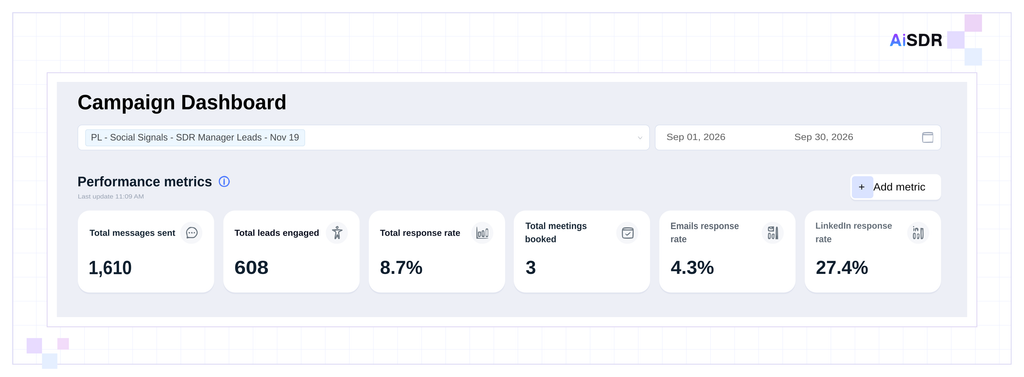
In September, it engaged 608 leads, got an 8.7% response rate, and booked 3 meetings. No giant list or 50,000-email blast.
How this stacks up
Here’s how that campaign compares with the database’s performance and our standard signal-based campaigns:
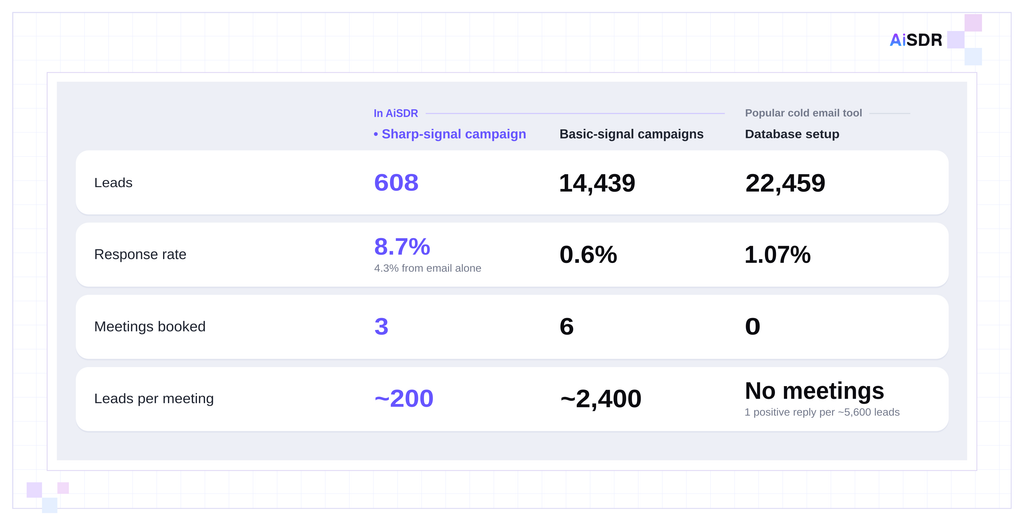
The takeaway: A sharp signal shrinks your list and raises your odds. You need fewer leads, and each one counts for more.
Finding #3: Can great personalization save the wrong list?
No, it can’t. We learned this in an embarrassing way.
A few years ago, we sent a cold email that mentioned someone’s front-yard renovation.
The email was very personal. It just had nothing to do with why anyone would buy. That’s the trap: The more personal an email gets, the more it reads like surveillance, unless it’s tied to a real reason to talk.
Our September batch shows a quieter version of the same problem. It had personalization too. Ami researched leads and worked what it found into the emails, and some of it was excellent.
One email to a nonprofit leader suggested 2 local organizations as possible partners. One had just finished a $2 million renovation, and the other was expanding family support programs in two counties.
Yes, a renovation again.
The difference is that this time it pointed to a reason to talk, and the nonprofit leader wrote back asking for more information and a call.
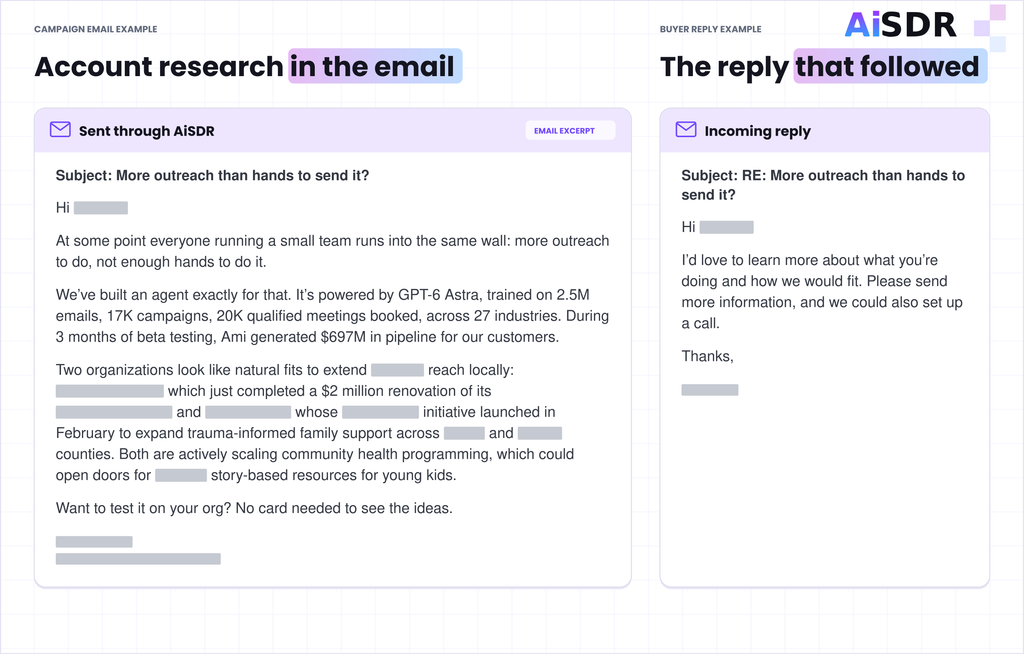
Across all those campaigns, the response rate was still 0.6%. The signal campaign from test #2 ran on AiSDR and hit 5.4%. Great research couldn’t make up for a weak reason to reach out.
Personalization still has a job. It should explain why your offer matters to this person now. Use facts you can check. If an account is hiring SDRs, mention the hiring. Don’t guess at missed targets or budget pressure you can’t confirm.
The takeaway: Personalization helps a good-fit lead say YES. It can’t make a wrong-fit lead care.
What to check before you send the next 10,000 emails
Before you add volume to any campaign, run these questions with your team:
- What happened at this company or with this prospect recently that makes our offer relevant now?
- When was each email address last verified? (“The vendor says it’s fine” doesn’t count)
- Does the signal change the message, or is it decoration on a template?
- Are we watching bounce rate and domain health as volume grows?
If the answers are fuzzy, more sends won’t help.
That’s the order we’ve built AiSDR around. Start with people who just showed a reason to hear from you, find their contact details when you need them, check every address, and then write the email.
Want to see more of our own tests? We publish them, losing ones included, on our AiSDR outreach experiments page.



 Summarize with

 ChatGPT

 Claude

 Perplexity

 Grok

 Google AI