











AI Software Most Effective for Improving Sales: Top Tools for Each Pipeline Stage

Winning customers isn’t about hustle. It’s about making every sales effort count, and AI gives you that edge.
AI tools for improving sales push the efficiency of each pipeline stage to the max. They qualify leads faster, spot buying signals earlier, and follow up automatically. This means less busywork for your reps and more focus on adding value, which increases chances for conversions.
One study even found that 83% of sales teams using AI grew revenue, compared to 66% who went without.
Here’s a closer look at the most effective AI software for improving each stage of the sales pipeline.
Prospecting
Sales prospecting can seem like endless labor with little to show for it. Sales teams work through long lists of leads with little clarity on which ones are actually worth pursuing. Hours go into research and cold outreach, only to end up chasing people who were never going to buy.
One HubSpot survey validates this frustration: 62% of salespeople say deals fall through because prospects either aren’t ready to purchase or don’t believe the product meets their needs.
AI flips that around. It automates the heavy research, filtering leads against your ICP. The result is a precise, dynamic list of people who are more likely to be interested right now, so your team spends time where it counts.
AiSDR
AiSDR is one of the top AI tools for improving sales. It takes the guesswork out of prospecting, starting with your ideal customer profile (industry, company size, roles, locations, etc.). On top of that, AiSDR:
- Builds a prospecting profile for your campaign, picking the right search filters and intent signals that align them with your value proposition
- Sets up campaigns across multiple channels
- Enriches and qualifies leads before engaging
- Creates messages for LinkedIn, email, and cold calls that speak to each prospect’s context
Instead of relying on static lists, you get prospects who already look like a strong fit and messages that show you get them.
For example, ESLNA, a global executive protection and logistical support provider, used AiSDR to zero in on ICP-fit leads. The outcome was a 32% reply-to-demo rate and conversations with major names like Disney, Salesforce, and Airbnb.
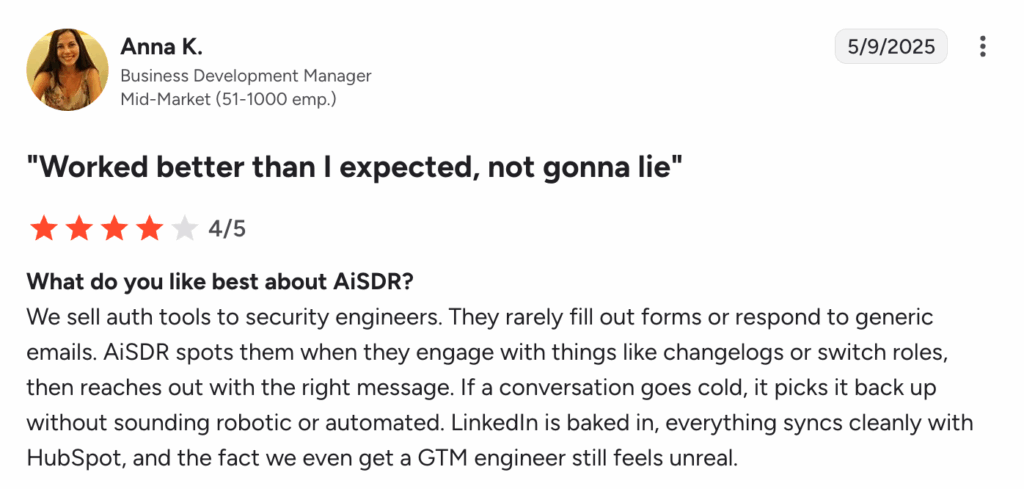
On top of that, one G2 review shared that AiSDR helped them connect with a hard-to-reach audience of security engineers by spotting signals like role changes or interactions with technical content.
Clay
Clay is another tool that uses AI for improving sales prospecting. Here’s how it works:
- Clay connects to 130+ data providers to pull in prospects that match your ICP
- Clay allows you to stack filters like company size, industry, role, tech stack, or location to go full in on the right accounts
- Clay adds real-time triggers such as a new executive hire or a surge in hiring trends, so your lists update automatically as prospects move in and out of your target profile.
Clay also gives reps dynamic lists that adjust as situations shift. Whether it’s a leadership change, hiring momentum, or increased activity, it helps you target prospects who fit your ICP at that specific moment.
On G2, users often highlight that Clay takes care of the time-consuming parts of prospecting and praise its ability to build high-quality lead lists quickly. Some reviews note, however, that while the data coverage is strong, results can vary depending on the specific sources used.
Lead qualification
The qualification stage is where the sales cycle can quickly drag. Teams can fall into the trap of spending too much time asking the same questions, ticking boxes, and manually scoring leads. Not only is this process time intensive, but manual qualification can still let many promising prospects slip through.
Another issue is consistency. Qualification depends heavily on who’s doing it. One rep may mark a lead as qualified based on a short call, while another might disqualify the same lead for a lack of detail. Throw in subjective judgment and uneven CRM data entry, and the results vary widely. Some good leads get dropped too early, while weak ones make it through.
AI tools for improving sales change the game. They score leads consistently and with more precision based on real-time data.
Have a conversation with our AI

AiSDR
AiSDR sharpens filtering out leads with AI-powered qualification. It digs into each lead by harvesting:
- Firmographic data – Company size, industry, geography, roles, and other criteria commonly found in ICPs
- Behavioral engagement – Email opens, link clicks, replies, meeting attendance, response patterns
- Buyer intent signals – Pricing page visits, competitor comparisons, funding announcements, hiring activity, LinkedIn engagement, and other high-intent indicators
By combining all these inputs, AiSDR identifies accounts that have both a strong ICP fit and real intent. This means you’re no longer fishing for prospects blindfolded. You can precisely target the prospects who are ready to buy your product or service.
Another factor that makes AiSDR stand out is its ability to act as an independent AI-driven SDR. It scores and qualifies leads automatically, so your team doesn’t waste time on that task.
Medisafe, a health-tech platform, was losing too much time on leads with no real signals of interest. By automating intent detection, AiSDR helped Medisafe’s SDRs focus only on qualified conversations. The result was immediate: in just 30 days, Medisafe booked 29 meetings with top pharma players.
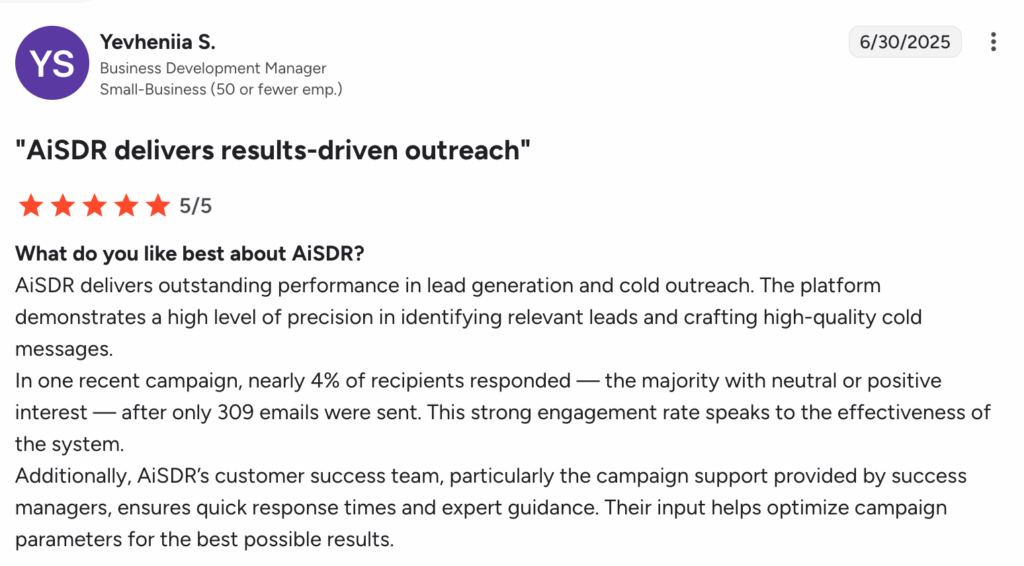
User feedback on G2 also praises AiSDR’s ability to cut through the noise and connect with the right prospects. One reviewer noted the platform’s precision in surfacing relevant leads: their campaign hit a 4% response rate from just 309 emails.
Qualified
Qualified takes a different approach to lead scoring compared to AiSDR, focusing mainly on inbound strategies. It scans the behavior of website visitors and uses a proprietary AI model to predict purchase intent, showing teams which visitors are serious buyers.
At the center of this is Piper, an AI-powered SDR agent that:
- Engages visitors in real time through chat, voice, or video
- Asks qualifying questions to capture the details reps need
When a lead fits the profile, Piper can schedule a meeting or pass the contact directly to the right rep.
Qualified also syncs scores and conversation data straight into your workflows, with deep integrations into Salesforce and other GTM tools. That means reps don’t waste time chasing unqualified visitors or piecing data together manually. The strongest inbound leads are qualified and routed automatically.
On G2, customers mention how this real-time approach leaves traditional leads-in-a-queue models behind, letting teams act the moment intent peaks. Some reviewers note, however, that it can take time to fine-tune workflows to fit different sales processes.
Needs assessment
The discovery phase is where deals can be won or lost. It’s the moment to uncover needs, map out priorities, and build trust. But with fast-paced calls, multitasking, and manual note-taking, sales teams often miss the details that matter most. As a result, reps push generic solutions instead of speaking to what the buyer actually needs.
These gaps show up in many ways, such as:
- Failing to identify who the real stakeholders are and what each one cares about
- Overlooking when the buyer plans to act
- Missing subtle budget signals that reveal priorities and constraints
By automatically capturing, organizing, and surfacing insights for reps, AI solutions ensure no critical detail is lost. So it only makes sense, when looking for AI software most effective for improving sales, to prioritize tools that offer some solid capabilities for this stage.
AiSDR
AiSDR enters the discovery stage with rich context already on the table, including engagement patterns, intent signals, and decision-maker updates. These details might get lost in manual research, but AiSDR picks them up automatically and keeps them in the system.
What really matters, though, is what it does with that context. Instead of handing a pile of data to the reps, AiSDR turns it into qualification conversations. It generates open-ended questions that feel natural but dig deep, surfacing pain points, shifting priorities, and urgency.
The platform keeps conversations moving by answering questions, sending timely follow-ups, and handling common objections using your playbooks until a meeting is booked or it’s time for a human rep to step in.
All captured insights are added to the lead profile automatically, so nothing gets lost in call notes or inboxes. And since AiSDR syncs with tools like HubSpot, reps don’t have to copy-paste or chase information. It’s already where they need it.
On G2, users say AiSDR’s messages feel natural and personalized. They also note the system can handle communication until a call is scheduled, so reps only get involved when it counts.
Launch your campaign into orbit with AiSDR 🪐
Gong
Gong also uses AI for improving sales and supporting the needs assessment stage, but its approach is very different from AiSDR’s. The tool doesn’t engage leads directly. Instead, Gong acts as a conversation intelligence platform, analyzing every customer interaction to surface insights that drive deal momentum.
Here’s what Gong does:
- Automatically records spoken, written, and video conversations and turns them into structured insights
- Uses AI Smart Trackers to flag specific themes in real time, such as compliance, budget, or integration, so reps never miss key decision drivers
- Logs insights for the whole team, making it easier for managers to coach and for reps to stay aligned
In practice, Gong is probably best for inbound or mid-funnel scenarios, where human reps talk to prospects and need deeper insights from those conversations.
On G2, users confirm that Gong makes it easy to see the full picture of every deal and ensure nothing gets lost. On the flip side, some mention it can take time for AI summaries to generate, and accents aren’t always handled perfectly.
Proposal creation
Proposal creation is one of the biggest time sinks in sales. Just when a deal should be picking up speed, reps often get bogged down in tasks that stretch the process out. Hours go into:
- Gathering information (product details, pricing, case studies, compliance notes, or legal terms) from dozens of sources
- Tailoring the content to fit the buyer’s industry, role, and decision drivers
- Formatting and polishing each proposal to make sure design, branding, and language look professional and consistent
AI tools for improving sales can take much of this manual work off the table by automating proposal assembly. This keeps deals moving forward when buyers are most engaged and frees your team from repetitive tasks that take hours.
PandaDoc
PandaDoc is an all-in-one document automation platform with strong proposal features. It helps sales teams create and send polished documents quickly, without losing consistency. Here’s what it brings to the table:
- Templates & content – You can build proposals in minutes using a library of templates and multimedia blocks. Everything stays on-brand and is easy to reuse.
- Data integration – PandaDoc connects with HubSpot, Salesforce, and Pipedrive to auto-fill fields like names, pricing, and product details. No copy-pasting, fewer mistakes.
- Approval workflows – The platform also has built-in e-signatures and payment options that let clients sign and pay in a single step.
And it doesn’t stop when the proposal goes out. PandaDoc tracks when a proposal is opened, which pages prospects spend time on, and when it’s signed, giving reps real insight for timely follow-ups.
The impact shows up in client stories. Consensus, for example, used to build proposals manually, which was slow and error-prone. After switching to PandaDoc, they cut proposal creation time in half and improved win rates. Proposals also became more effective: 84% were viewed by prospects, driving higher close rates.
G2 reviews echo this experience. Users say PandaDoc speeds up proposal writing dramatically, with some noting they can now put together high-quality proposals in as little as 20 minutes.
Negotiations
Negotiation is often the stage where deals slip away. Your product might be an excellent fit; it’s just that buyers never make a decision. That usually happens when concerns go unresolved, and sales teams can’t see what’s really holding things up.
Without visibility into those sticking points, whether it’s budget, trust, or internal approvals, reps are left guessing. The fallback is generic discounts or slow back-and-forth, which sometimes work but mostly rely on luck, not strategy.
While AI tools for improving sales at the negotiation stage can’t replace a human rep on the call (at least not yet), they can make a real difference. By bringing structure and best practices to the process, they help reps surface concerns early and keep negotiations focused.
Accord
Accord is a deal execution and collaboration platform designed to bring structure and visibility to complex sales cycles. Its goal is to give both reps and buyers a clear roadmap of the deal. Here’s what it offers for negotiation:
- Structured playbooks – Reps can follow AI-powered playbooks that standardize winning approaches, like building CFO-ready business cases or handling compliance concerns. This ensures critical steps don’t get skipped.
- Mutual action plans – Accord makes the next steps transparent to both sellers and buyers. Everyone knows who’s responsible for what and when, which prevents stalls late in the process.
- Stakeholder mapping – The platform helps identify key decision-makers and influencers, so reps know who to involve during negotiations and can tailor conversations to each stakeholder.
Plus, Accord syncs data with Salesforce, HubSpot, and other CRMs, so progress is tracked without extra admin work.
As a result, negotiations move forward with clarity, giving reps the confidence that buyer concerns are most likely surfaced and addressed before they can derail the deal.
On G2, users value the visibility Accord provides into how customers interact with the platform. Some also note that prospects can even invite colleagues and collaborate on milestones, which keeps negotiations structured and on track.
Closing
Closing is supposed to be the easy part. The product fits, the buyer’s interested, and the deal is nearly over the line. But all too often, this is where momentum stalls.
The biggest culprits are poor timing and follow-up gaps. A rep might miss the right moment to push things forward, or a contract sits in someone’s inbox while attention drifts elsewhere. Sometimes the buyer simply goes quiet because no one contacted them quickly enough. When that happens, weeks of work can unravel right at the finish line.
AI tools help prevent this by tracking engagement signals, flagging stalled opportunities, and automating reminders. They make sure no buyer is forgotten and keep communication flowing until the deal is closed.
AiSDR
AiSDR is best known for lead generation and engagement. But it also uses AI for improving sales at the closing stage.
Rather than leaving a strong demo hanging, the platform uses meeting notes and CRM data to send follow-ups that feel timely and relevant. These personalized nudges keep your solution top of the buyer’s mind while the deal is still fresh.
What’s more, AiSDR can give closed-lost deals another shot. Many of these get marked “lost” simply because buyers stop responding.
Instead of writing them off, AiSDR looks at past objections and new signals, like role changes or funding announcements, to re-engage accounts. In one case, this approach re-engaged 138 previously silent leads and booked 2 meetings.
Because “unresponsive” isn’t always final 👀
Implementation & onboarding
Closing the deal doesn’t mean the work is over. In fact, customer relationships start at that point. To keep things from stumbling right after the contract is signed, the handoff needs to be smooth.
However, the details reps get don’t always make it neatly to the post-sales team. Context from discovery calls, buyer priorities, and promised outcomes can get lost in messy notes or buried deep in the CRM.
When that happens, the buyer experience feels disjointed. Customers end up repeating themselves, waiting longer to see value, or feeling like the right hand doesn’t know what the left hand is doing. That shaky start puts renewals and upsells at risk before the partnership even begins.
By streamlining the transfer of information, AI onboarding tools ensure that post-sales teams have the context they need to deliver on every promise made during the sales cycle.
Rocketlane
Rocketlane is a purpose-built platform for customer onboarding and implementation. It fixes the messy handoff after the deal closes and helps post-sales teams deliver a smooth, consistent start. Key features include:
- Standardization – Templates, standardizing projects, tasks, forms, and documents to keep onboarding consistent and fast.
- SmartFill – Users auto-import discovery notes, goals, and contract details from CRMs like Salesforce or HubSpot into the onboarding workspace to give customer success teams the full picture from day one.
- Mutual Action Plans – Teams co-create clear timelines, owners, and milestones with customers to keep expectations aligned
- Unified workspace – A single hub exists for tasks, docs, timelines, and status updates, shared across sales, onboarding, CS, and the customer
Frontify, a Rocketlane client, reported cutting its time to first value by 50% after they streamlined onboarding with the platform. On G2, users say Rocketlane “keeps complex deals on track with multiple stakeholders” and makes onboarding “collaborative and transparent.”
Follow-up & support
Once the customer is onboarded, the long game begins. The goal is to keep them happy, engaged, and thriving. But many teams fall short.
A common pattern: instead of anticipating needs, teams wait until customers raise issues. By then, it’s often too late. Early warning signs get missed, satisfaction drops, and upsell or cross-sell opportunities are lost.
AI tools for improving sales flip this dynamic. They track usage patterns, engagement levels, and buying signals to highlight which accounts need attention and when. That way, teams can step in proactively, fixing issues before they escalate or suggesting the right upgrade at the right moment.
Vitally
Vitally is an AI-powered customer success platform designed to keep teams proactive after onboarding and grow accounts. Here’s how it helps:
- Account health scores – Vitally combines product usage, support activity, survey feedback, and sentiment into real-time health scores to show teams which customers need attention.
- Proactive signals – The platform tracks dips in engagement or changes in satisfaction, flagging accounts at risk of churn and those primed for upsell.
- AI Copilot – Vitally’s AI generates instant summaries of accounts and suggests next-best actions, like drafting follow-up emails, or points out expansion opportunities.
- Automated playbooks – With Vitally, common workflows, like renewal reminders, upsell outreach, and onboarding check-ins, can be automated.
One Vitally customer, Navattic, cut churn by 20% after shifting to the platform’s proactive engagement. On G2, reviews tell the same story. Users say Vitally gives them a single place to track customer health across dozens of accounts and makes it easier to step in at the right moment.
More on the topic:
Subscribe to our Newsletter



See the top AI tools for improving each stage of sales
 Summarize with
 ChatGPT
 Claude
 Perplexity
 Grok
Grok 
 Google AI