











Ami (AiSDR) vs Ava (Artisan): What $250/mo Gets You
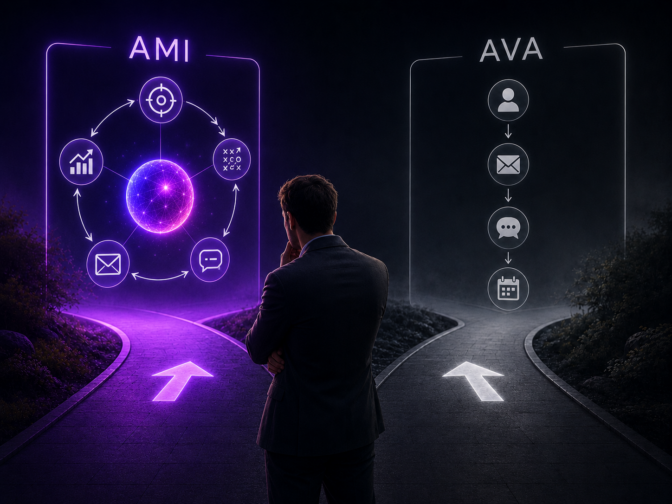
What do you do when a pipeline needs help, but nobody can spare another 10+ hours a week?
Sales already spends just 40% of their time selling. The other 60% goes to prospecting, research, and campaign setup. If you’re a founder or solo seller, that’s time you don’t have.
Hiring an SDR is one option, but that’s a full-time salary to patch a part-time problem. AiSDR and Artisan fix it without the extra hire: AiSDR with Ami and Artisan with Ava.
Key takeaways
- AiSDR Solo costs $250 a month for 200 AI-researched contacts and includes Ami, 1 sending domain, 3 mailboxes, and 1 LinkedIn account.
- Artisan’s Intern plan costs $280 a month and contacts around 500 leads, metered as 10,000 credits rather than a flat contact count.
- Ava runs the outbound motion you define, which means you still set the ICP and decide what the next campaign should be.
- Artisan’s full self-driving Ava sits on the $660 Employee tier and is still marked as coming soon.
- Ami picks the audience, builds the campaign, and works out the reason to reach out now, then adjusts as replies come back. That decision layer is included in Solo at $250.
What makes Ami and Ava different?
Ava’s an AI BDR that runs the outbound motion you define. You set the ICP and campaign direction, and Ava takes over. It works the prospects and moves conversations toward meetings.
Artisan has a “self-driving Ava” in the works, but it won’t be on the Intern plan you get for $280 a month.
Ami’s an AI GTM agent.
It starts with the business context and works out which audience is worth targeting, what campaign makes sense for them, and why there’s a reason to do it now. Ami then runs the campaign and adjusts your strategy based on what happens.
That’s what AiSDR’s Solo plan gets you today.
What AiSDR Solo and Artisan Intern include
Artisan’s Ava takes the campaign you’ve decided on and runs it. AiSDR’s Ami helps you come to that decision before running it.
Here’s a closer look at what you get for AiSDR’s and Artisan’s entry plans.
| Ami with AiSDR | Ava with Artisan | |
| Price | $250/mo | $280/mo |
| Entry volume | 200 AI-researched contacts | ~500 leads contacted/mo |
| AI role | AI GTM agent | AI BDR |
| Prospecting | Included | Included |
| Campaign creation | Ami creates GTM strategies and campaigns | You provide ICP and campaign direction |
| Outreach | Email + LinkedIn | Email + LinkedIn |
| Reply handling | Replies, objections, and follow-ups | Replies, objections, and follow-ups |
| Meeting booking | Included | Included |
| Email infrastructure | 1 domain + 3 mailboxes | Domain + mailboxes included |
| CRM | Native 2-way HubSpot sync | HubSpot sync |
| Buying process | Self-serve onboarding, set up in minutes | Free trial → upsell |
| Commitment | Month to month | Month to month |
If raw volume is what you’re short on, Artisan’s math is friendlier. Artisan’s Intern plan contacts around 500 leads a month against AiSDR’s 200, and there’s a free tier at 300 credits a month if you want to look around before paying anything.
That said, both tools measure volume differently.
AiSDR meters contacts, so 200 means 200. Artisan meters credits, and how far 10,000 credits stretches depends on which campaign type you run.
Lead volume only matters once you know what deserves more of it.
If the first batch shows the audience or angle is wrong, sending the same campaign to another 500 people won’t fix the idea. Ami is built to make that call before you keep scaling it.
Who decides what campaign to run next
Take a handful of SaaS companies, all with 50 to 200 employees, all a good fit for your ICP. One just hired its first VP of Sales. Another is hiring 8 SDRs. A third hasn’t changed much in 2 years.
Same firmographic fit, different reasons to start a conversation, or none at all. 73% of B2B buyers avoid sellers who send irrelevant outreach, so fit alone won’t get you a reply.
That’s why Ami uses buyer intent signals and business context, not just firmographic fit.
Ava monitors those signals too, but Artisan’s own workflow still starts with you setting the ICP and campaign goals, then Ava finds and works the people who fit.
With Ava, that question is still yours to answer: What should the next campaign be, and why now?
Ava can find heads of sales at companies hiring SDRs. Ami is built to reach the earlier conclusion, that a newly hired VP of Sales is the campaign worth running next, because new leaders buy tools in their first 90 days and your product fits that window. You didn’t have to supply that angle.
Ami uses the URL you give it to build the campaign, research the audience behind it, and turn those findings into outreach. It’s trained on lessons from 20,000 campaigns AiSDR has run, giving it context around targeting and messaging decisions that normally take years to build.
What happens after a campaign launches?
Launching a campaign doesn’t prove much on its own. It just means the test is live. What teaches you something is what happens with the replies, and even good replies don’t add up to product-market fit on their own.
That’s the part your $250 keeps paying for after launch. Ami reads replies as they come in and can respond in about 5 minutes. If something needs your attention, it surfaces the conversation in your dashboard and suggests what to do next.
Ava does a lot here too. It can manage autonomous replies and keep campaigns running without somebody manually working every response.
The campaign gets more useful once it’s taught you something specific:
- 1 audience keeps ignoring you while another starts conversations
- Buyers understand the problem but keep pushing back on the offer
- The first 100 prospects give you very little evidence that another 500 should receive the same campaign
With Ami, those conversations, campaign results, and previous decisions stay available as context for what happens next.
One recent customer told us their goal is to turn at least 10 leads into projects over the next 3 months by testing different approaches.

They witnessed the campaign transform. And that’s the kind of behavior Ami owns.
Why AiSDR Solo starts at 200 contacts
200 contacts can look small.
That’s on purpose. Sending more people the wrong message doesn’t get you a better answer. It just burns through more of your list before you find one. And once your domain reputation takes a hit from volume, that’s not easy to undo.
If you’re a founder or an early-stage solo seller testing outbound, your first problem isn’t running out of volume. You need a method worth scaling. 200 contacts is enough to find that without spending your list or sender reputation to get there.
Solo gives you the full product, not a stripped-down trial, at $250/mo with Ami included.
Should you pick Ami or Ava?
Ava can run outbound for you. But do you still want to be the one figuring out what to test next?
Ami takes on more of the hard decisions that would normally sit with a human: what to test, who to target, why a campaign is flattening, and what comes next.
If you’re tired of being the person who still has to open 5 tools and figure out why a campaign’s flat, that’s the job Ami’s built for.
Solo starts at $250/mo with 200 researched contacts, so you can see whether that difference matters before you scale.
Frequently asked questions
How much does AiSDR Solo cost?
AiSDR Solo costs $250/mo for 200 AI-researched contacts. The plan includes Ami, 1 user, 1 sending domain, 3 mailboxes, and 1 Linkedin account for outreach. Solo is designed as a self-service entry point and can be canceled without moving into a long annual contact.
How much does Artisan Ava cost?
Artisan’s startup Intern plan costs $280/mo and includes Ava and around 500 leads contacted per month, HubSpot sync, autonomous campaigns and replies, deliverability monitoring, and Slack integration. It’s billed monthly and includes a free trial.
Can Ava handle replies and book meetings?
Yes. Ava can handle prospect replies, including questions and objections, and book meetings directly on a sales team’s calendar. Artisan also supports human approval gates when a team wants more control.
What does Ami do differently?
Ami is AiSDR’s GTM Engineer. It’s built to work on the campaign itself, including GTM strategy, prospect research, targeting, outreach, and what happens after campaign results start coming back. It draws on patterns from more than 17,150 AiSDR campaigns rather than starting every campaign without historical context.
Which one is better for a founder?
AiSDR Solo is specifically packaged for founders and solo sellers at $250/mo, with a smaller 200-contact meter and the infrastructure needed to run outbound included. Artisan costs $280/mo, but it doesn’t include a fully autonomous Ava.



Compare AiSDR’s Ami vs Artisan’s Ava. See what you get for $250 per month
 Summarize with
 ChatGPT
 Claude
 Perplexity
 Grok
Grok 
 Google AI