











Why Cold Email Open Rate Is Misleading (& What to Track Instead)

Most outreach dashboards treat email open rate as a sign of life. The number goes up, the team feels productive, and the cycle continues.
But open rate doesn’t tell you a person read your email. It tells you an image loaded, and it can be triggered by a security scanner before a human even sees the subject line.
This means open rate isn’t just imprecise. It’s steering you in the wrong direction.
Here’s what to track instead.
Key takeaways
- Open rates are an unreliable vanity metric. They track pixel loads, not real interest.
- High opens can be misleading due to bots, privacy features, and security scans.
- A smarter approach to sales is to focus on real outcomes that affect the bottom line: reply rate, meetings booked, and pipeline generated.
- Better targeting and signal-based personalization drive more replies and conversions.
- AI sales tools like AiSDR connect data, timing, and outreach to turn activity into pipeline.
The myth of cold email open rates
Open rate has become the default way teams judge outbound performance. But it’s far less meaningful than it appears.
How open rates are tracked
To track open rates, most email tools insert a tiny invisible 1×1 transparent pixel into your email. When the email client loads that pixel from the sender’s server, the system records it as an “open.”
In other words, it doesn’t detect whether someone read your message. It detects image loading activity, which has nothing to do with whether a human read your message.
Why inflated opens create false positives
Email systems often record opens even when there is no actual human engagement. That happens when:
- Apple Mail Privacy Protection automatically pre-loads tracking pixels
- Corporate security systems and firewalls scan emails and load images before a human ever sees them
- Multiple image reloads are counted as separate opens
As a result, you get false positives. Your dashboard may show a 65% or even 80% cold email open rate, but that number may have little to do with genuine interest. And that disconnect has real consequences for your sales performance.
Celebrating vanity metrics over pipeline impact
While high open rates give sales teams psychological validation, they may also create a dangerous gap between perceived success and business reality. And this distorts your sales in several ways:
- You reward the wrong behavior – If cold email open rate becomes the hero metric, the team focuses on increasing opens instead of qualified conversations and conversions.
- You double down on the wrong messaging – High open rates make you believe your subject line, content, and CTA are working, so you optimize future campaigns around them. In reality, many of those opens may be machine-triggered.
- You overlook deeper strategy problems – If opens are high but replies are low, you can start tweaking copy or CTAs. But in case open data is corrupted, the real issue could be more fundamental, such as targeting the wrong ICP.
Many teams overrely on open rates because when they’re high, outbound feels productive. But high open rates don’t guarantee the sales pipeline will move.
Why focusing on opens can hurt deliverability
Beyond distorting sales metrics and strategy, chasing cold email open rates also has technical consequences. In fact, optimizing for opens can actively damage your email deliverability and long-term performance.
Tracking pixels can be seen as a negative signal
The tracking pixel used to record open rates isn’t a neutral piece of code. Email service providers and security filters increasingly flag external image loads as suspicious.
This means the pixel itself can trigger spam classification before a human ever makes a judgment about your message. This isn’t a fringe risk. It’s why some of the most deliverability-conscious outbound teams have removed open rate tracking entirely as the act of measuring opens can cost you inbox placement.
The risk compounds when open rate tracking is combined with other negative signals: manipulative subject lines, high send volume, low engagement.
But even in isolation, tracking pixels are a liability worth understanding.
Over-optimizing subject lines triggers spam filters
When a cold email open rate becomes the goal, teams often resort to clickbait-style subject lines, such as:
- Adding artificial urgency (“Last chance”, “Quick question”, “Re:”)
- Mimicking internal threads (“Re: following up”)
- Aggressively testing emotional triggers (“You’re missing this”)
Over time, these tactics create spam-like patterns. Modern email providers like Gmail and Outlook rely on machine learning models to detect exactly those patterns.
And once your emails start resembling misleading behavior, Gmail and Outlook are more likely to filter, deprioritize, or route them to the Spam or Promotions inbox category.
Low engagement metrics damage sender reputation
Email providers also evaluate how recipients interact with your emails. They monitor how often people:
- Delete your messages without reading them
- Mark them as spam
- Ignore an entire thread with multiple follow-ups
When too many of these negative signals accumulate, providers interpret your emails as low-value content. Similar to spammy subject lines, this can lead to a decline in domain reputation, and even legitimate future campaigns can suffer.
Deliverability best practices protect long-term performance
The good news is that email providers don’t just penalize patterns that suggest low-value or unwanted behavior, but also reward genuine engagement. So, if you want outbound to perform over the long term, stick to a few core principles:
- Target a tight ICP – Sending fewer emails to the right people has 2 main advantages: a lower risk of volume abuse and stronger engagement signals.
- Avoid manipulative tactics – Misleading subject lines, artificial urgency, or curiosity traps may boost a cold email open rate in the short term, but they weaken trust over time.
- Avoid sending identical emails – Modern filters can detect template-based emails with little or no variation sent to a high number of people, and they often flag them as suspicious.
- Build high-quality prospect lists – Sending emails to outdated contacts or domains with a low reputation is another negative signal you may want to avoid to maintain healthy deliverability.
Metrics that matter in cold outreach
Cold outreach should create movement in your sales process. And you can see whether it does by tracking a few critical metrics that correlate with revenue.
Reply rate
Reply rate measures how many of your sent emails receive a response. Unlike a cold email open rate, it shows that the recipient read and processed your message and found it relevant enough to start a conversation.
This metric is also a good indicator of whether your outreach strategy is working. If a reply rate is low, it may be time to review your targeting, positioning, timing, or overall relevance.
Meetings booked
Meetings booked are the next step up in measuring cold outreach performance. Depending on your goals, you can track:
- Meetings per emails sent to understand overall outbound efficiency
- Meetings per positive replies to see how often interest turns into commitment
- The total number of meetings booked to measure how much pipeline your outreach is generating
This metric is fundamental because it connects outreach with a pipeline. Without meetings, outbound activity remains theoretical. Even if your cold email open rate is 100%, no meetings means no leads.
Pipeline contribution
Pipeline contribution answers a question: How many real sales opportunities did your outbound campaign create?
A sales opportunity is a deal that has officially entered your pipeline and sits in your CRM. It typically means the prospect has been qualified, fits your ICP, and there’s potential for them to become a customer.
You might send 1,000 emails, receive 60 replies, and book 25 meetings. But only 10 of those meetings might turn into qualified opportunities that feed your pipeline.
Quality over quantity
Reply rate, meetings booked, and pipeline contribution all reward the same underlying behavior: Reaching the right person at the right moment with a message they wanted to receive.
When you prioritize quality, you start talking to people who have a problem they want to solve now.
AiSDR uses intent signals and data enrichment to identify prospects who are more likely to engage and convert. It then personalizes outreach with rich context and handles responses within minutes, continuing the conversation until a meeting is booked or it naturally concludes.
So instead of increasing email volume to get higher open rates, you increase precision and optimize your outreach for results that have a real business impact.
How to improve reply rates
Replies are the first step toward meetings and qualified opportunities. That’s why improving them matters far more than obsessing over cold email open rates.
Nail the right ICP
If reply rates are weak, the issue is often the audience. With a broad or vague customer profile, even a strong email gets ignored because it simply doesn’t resonate.
Sharpening your ICP means going beyond basic firmographics like industry, company size, or location. You also need to consider readiness. Buying signals such as hiring activity, recent funding, or product launches show who might be in the market right now.
This is where AiSDR helps.
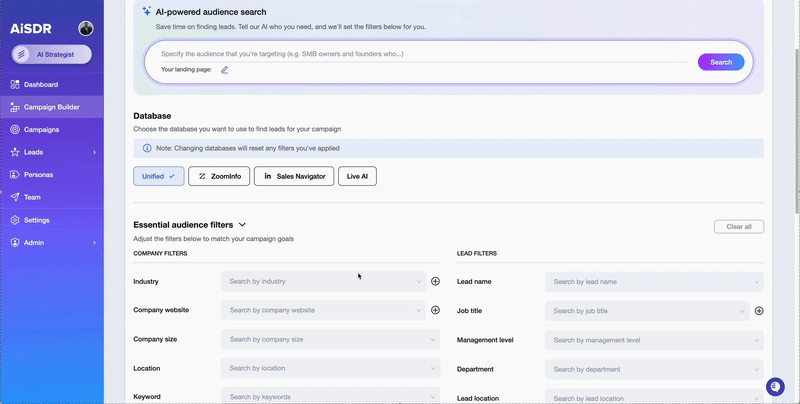
AiSDR’s Live AI Search finds leads based on simple descriptions of your ICP. You can search for “VPs of Growth at Series A SaaS companies hiring sales engineers,” and the platform will surface matching leads using fresh, real-time data.
Personalize based on live signals, not static data
Using someone’s first name and referencing a generic industry pain point won’t bring you many replies. In fact, most marketing emails today rely on this kind of surface-level personalization.
What works is personalization using live signals. That means shaping your message around real, up-to-date context and reaching out when a prospect is showing signs of a problem your solution can solve.
AiSDR helps you do exactly that. It pulls from the full web, your CRM history, and real-time intent signals to build context for every message. Personalization stays grounded in something real. Not superficial LinkedIn scrapes.
Balance automation and authenticity
Over-automating can result in bland, generic outreach with no clear strategy behind it and no replies. Going fully manual in the name of authenticity, on the other hand, slows your team down with research and drafting. The right balance, however, helps you launch outreach that preserves the human element while keeping processes efficient.
AiSDR automates the entire sales cycle, but no messages go out until there’s a clear intent signal.
The AI only reaches out to prospects who show real buying signals, so your messages arrive when the problem you solve is already on their radar. That’s a different category from tools that automate contact at scale with no regard for timing or readiness.
Test messaging tone and sequence cadence
Different audiences respond to different message styles. A founder may prefer a short, straight-to-the-point email, while an enterprise leader might expect more structure and credibility.
The same applies to cadence. Follow up too aggressively, and it feels pushy. Wait too long, and the conversation fades.
If you want to improve reply rates, you need to test both. Start by measuring what drives replies, then adjust your tone or follow-up timing accordingly.
Building an outreach dashboard that tells the truth
As the focus shifts away from cold email open rates, your reporting needs to change as well. A dashboard should highlight metrics that impact your bottom line.
How to structure outreach KPIs by funnel stage
A result-focused dashboard mirrors how outbound works as a funnel. Each stage should answer a specific question.
| Goal | Question | What to track |
| Visibility | Are emails reaching inboxes? | Delivery rate |
| Engagement | Are people replying? | Reply rate & positive reply rate |
| Commitment | Are replies turning into messages? | Meetings booked & show-up rate |
| Qualification | Are meetings becoming real sales opportunities? | Opportunities created |
| Revenue | Is outreach creating pipeline and closed-won deals? | Pipeline value & revenue |
When you structure sales KPIs by funnel stage, you can clearly see where performance drops and fix the right problem to improve outcomes.
What a healthy outbound dashboard looks like
A healthy dashboard isn’t about high numbers everywhere. It shows steady movement through the funnel.
This means:
- No single metric is inflated while the rest stay flat
- The focus follows a reverse pyramid: qualified opportunities at the top, reply rates below, and cold email open rates nowhere in sight
- Outreach contribution to opportunity value and revenue is clearly visible
Connecting your outreach results to business impact in a logical way turns your report into a real decision-making tool.
Integrating CRM and email data for full-funnel visibility
Email platforms show opens, replies, and meetings. Your CRM shows opportunities, pipeline value, and closed-won revenue.
For full-funnel visibility, you need to connect the two.
Connecting them lets you track the journey from email to opportunity to revenue and clearly see which outreach efforts generate business impact.
Future of outbound metrics: AI, intent, & true personalization
The era of measuring success by cold email open rates and send volume is fading, while a new standard is coming in its place.
Why intent signals will replace open rate tracking
Intent signals reflect real behavior, such as visiting relevant pages, researching your category, hiring for related roles, raising funding, or engaging with content tied to your solution. These actions suggest that a prospect may be moving toward a decision.
When you optimize campaigns around these signals instead of focusing on cold email open rates, meaningful engagement becomes more likely.
Conversion rates can increase by up to 3x, sales cycles speed up by 40%, and lead quality improves by 25% when businesses adopt intent-driven strategies.
The rise of AI SDRs optimizing for human outcomes
AI SDRs are rapidly gaining traction. The market is already worth over $4 billion and will likely grow significantly in the coming years.
And the reason is clear. Unlike traditional SDR tools that optimize for emails sent and open rates, AI-driven SDRs operate more like real salespeople. They research leads, detect intent signals, and personalize outreach in real time.
All of this shifts the focus from measuring prospect activity to moving real pipeline.
How modern teams measure what truly matters
Even the most experienced, high-performing teams can’t realistically track all meaningful metrics manually. Gathering and connecting relevant prospect data alone would require dozens of people and hundreds of hours. So, if you want sustained pipeline growth, you need the right technology.
AiSDR brings that infrastructure together.
The AI combines live intent data, real-time personalization, dynamic conversation handling, and CRM visibility in a single workflow. The result is outreach that’s automated, ethical, measurable, and aligned with real business outcomes.
What modern outbound looks like in practice
In modern outbound, cold email open rates shouldn’t be the main metric of success. Instead, teams need to focus on metrics that connect directly to revenue, from reply rate to meetings that show up, to qualified opportunities and closed-won deals.
Optimizing outbound around these metrics requires a few key elements:
- Identifying prospects who match your ICP and show real buying signals
- Personalizing outreach using live context
- Using automation to handle research and sequencing
- Adapting conversations dynamically to fit prospects’ replies
AiSDR connects these elements in one system, helping teams consistently move the pipeline forward.



FInd out why open rates mislead and which metrics are better
 Summarize with
 ChatGPT
 Claude
 Perplexity
 Grok
Grok 
 Google AI