





Personalized Email Outreach That Converts Conversations Into Pipeline

First name. Company name. A LinkedIn detail. Most cold emails stop there and call it personalization.
Prospects have seen this pattern so many times they delete on instinct.
Here’s the right way to personalize your messages.
Key takeaways
- Basic personalization like names, companies, and generic mentions no longer works.
- Real personalization starts with relevance to the prospect’s current problem.
- One strong, specific insight beats multiple shallow data points.
- Timing matters. Outreach works best when buyer intent is high.
- AI sales tools like AiSDR scale true personalization using real-time data and signals.
Why traditional personalization fails
Personalization used to mean you knew a person’s name, company, and job title.
The threshold’s much lower now. Not only do you still have to prove you did your homework, you need to show you own a place in the prospect’s inbox.
Prospects expect more relevance. But many outreach teams still do it the old way, evidenced by 53% of customers having negative experiences with personalization.
Feels disingenuous
When you drop in a single personalization token, such as a greeting, a mention of company news, or a compliment, it doesn’t make an otherwise generic message feel truly personalized.
What it does is make the prospect roll their eyes: “Yet another vendor trying to get my attention with the same old trick.”
Sounds like the same old song
Buyers who get a lot of cold emails per day recognize templated messages instantly because they’ve seen so many.
So when you paste data you found on the web into a cold email template and hit send, it more often than not fails to engage prospects. From the first lines, the prospect recognizes familiar words and structures, and they delete the message because they assume they won’t learn anything new from it.
Hurts credibility and reply rates
Shallow personalization fails to build trust. When you use a personalization beat that doesn’t resonate, prospects feel like you’re trying to get attention without earning it.
Even if the prospect could really benefit from your product, they might be too annoyed to get back to you and ask about it.
Overloads the reader and damages trust
A pile of facts isn’t necessarily context. When you dump irrelevant info on readers, they don’t admire your breadth of research.
Instead, they might think, “Why are you telling me this?”
This kind of outreach trains your market to ignore your messages over time. After your first email frustrated them, they’ll likely delete all subsequent messages without reading and may even block you, which will affect your domain reputation.
Psychology of real personalization
An email feels personal when it creates a specific internal reaction: “This is for me.”
It makes the buyer feel seen as a real person with a real problem you can solve for them, and not like a generic lead that you randomly selected based on their web profile.
Relevance creates emotional recognition
Real personalization starts with the buyer’s context:
- What problems are they dealing with right now?
- What constraints do they face?
- What goals are they striving to achieve?
- What software do they already use?
Your product should neatly fit into this picture. Reference the relevant context, then frame your product as the solution.
Relevance drives every interaction downstream. If your message references issues they’re currently dealing with, it lands. The prospect thinks, “They know me.” But if the email misses the mark, it becomes noise, even if beautifully written.
Specificity signals effort and credibility
A single deep observation beats any number of shallow ones. It signals that you did real work to better understand the person on the other end and their problem.
Examples of good specificity:
- 1 clear buyer intent trigger, like new legislation, a competitor’s move, or hiring news: “I see you’re hiring 10 SDRs across regions.”
- 1 focused hypothesis about the prospect’s problem: “Such rapid team expansion usually means longer and messier on-ramps.”
- 1 short, testable idea for improvement: “Our solution cuts on-ramp time for teams like yours by 40%.”
When your message shows you understand the prospect’s context, they feel they can trust you. That’s how credibility is born.
Timing increases perceived value
The same message can feel either helpful or annoying, depending on when it arrives. The best times to reach out to a prospect are:
- When the problem you solve shifts to the top of their priority list
- When an organizational change creates friction they can no longer ignore
- When their existing tech stack fails them
While you can’t predict with 100% certainty whether your message will land at the right moment, you can maximize the odds. With the help of specialized AI tools, you can track real-time buyer intent signals and send your email when the signals stack up.
Shifting to a truly personalized email outreach strategy might stretch your team at first, but in the long run, the outcome is worth it.
Data behind high-performing personalized outreach
High-performing personalized outreach delivers more positive replies, better subscriber retention, and keeps spending in check.
Here’s what the evidence shows and why a volume-first approach consistently underperforms a targeting-first one.
High-quality engagement and success rates
Email reply rate is a commonly used but tricky metric. On its own, raw reply rate tells you very little. Negative replies like “please remove me” and “wrong person” technically inflate the number while adding zero pipeline value.
Instead, the best outreach teams use more accurate metrics to gauge engagement and success:
- Positive reply rate
- Replies converted to attended meetings
- Revenue growth
- Customer acquisition cost (CAC)
- Marketing ROI
Relevant emails get more positive replies, strike up meaningful conversations, and make prospects more likely to become customers. McKinsey found that personalization done right can increase marketing ROI by 10% to 30%.
Relevance correlates with more meetings
Relevant emails lead to more meetings that show up. Just because a prospect books a meeting, it doesn’t mean they’ll attend.
When the lead is a real fit for your ideal customer profile, and the message offers a solution to a real, current problem they experience, buyers invest time more willingly. That investment shows up downstream as meetings they attend and conversations that progress.
Data-backed personalization reduces unsubscribe rates
When outreach doesn’t feel relevant, people unsubscribe from your newsletter. Even worse, they might remember your brand as “spammy” and ignore subsequent touches, even if they’re better timed.
Making each message relevant reduces unsubscribe rates and keeps your brand’s image clean.
Lower cost
Better personalization means you’re targeting the right people instead of spraying and praying. This reduces the volume of outreach needed to generate the same pipeline, and slashes customer acquisition costs.
Efficient email personalization begins even before you write the first word. A live AI-powered search locates people who are looking for your product right now.
This means you’re no longer sending tens of thousands of emails, hoping someone bites. You send fewer messages (and spend less), and the messages you do send hit the right target.
What true personalization looks like in practice
The most reliable sign that your messaging uses true personalization is strong pipeline movement. But there are smaller tells you can spot before sending a message.
Weak vs strong personalization examples
Weak personalization simply throws in random details. Strong personalization opens with a prospect’s relevant trigger and connects it to an offer.
| Element | Weak personalization | Strong personalization |
| Intro | “Hi Sarah, I loved your recent LinkedIn post.” | “Hi Sarah, I see you’re hiring your first RevOps lead. That usually means your outbound process is about to get rebuilt.” |
| Value proposition | “We help companies like yours drive more pipeline with AI.” | “When teams add RevOps, they often discover 4 different ‘sources of truth’ for targeting. We help unify targeting and sequencing so teams stop sending ‘close enough’ outreach and lift revenue by 15%.” |
| Next step | “Are you free for a quick call this week?” | “Worth a 12-minute comparison on how you’re choosing targets today vs how you want RevOps to run it next quarter?” |
The strong versions do 3 things:
- Use a relevant trigger to strike a conversation
- Position the product within the prospect’s context, citing a specific business outcome
- Ask for the next step that fits the context
Weak personalization often only changes a few lines, leaving the rest generic. In contrast, strong personalization should appear throughout the email.
Uses live data to guide message tone
Tone should follow context. When the trigger event is urgent and serious, the tone should be direct. For a celebratory event, such as a funding round or a new role, the tone can be lighter.
A quick rule of thumb:
- Growth signals like hiring, expansion, and funding can use a confident, forward-looking tone.
- Change signals like new leadership, reorganizations, and tool migrations call for a practical tone focused on risk and tradeoffs.
- Social signals like a post about a challenge, invite a warm, friendly tone that stays on-topic.
To spot the trigger event and then match its tone, you need to track each prospect’s context continuously. Even the best all-human team can’t track hundreds of accounts 24/7, which is where AI changes the equation.
AiSDR Live AI search keeps your context fresh so you don’t end up congratulating someone on a new role they started 6 months ago. AiSDR’s AI tracks real-time prospect signals like web searches, news mentions, hiring data, and LinkedIn activity, to guide both who you target and how your message sounds.
AI also makes it possible to sustain that relevance at scale, which is a problem human-only teams consistently run into.
Scales personalization without losing authenticity
Human-led personalization can be strong and authentic, but it scales badly.
A human salesperson can only write so many messages per day. And if they’re forced to do it all day, every day, they’ll quickly burn out.
AI can generate 100 personalized messages just as quickly as 10. And it can surface harder-to-find insights that humans might miss.
Removes human capacity as a bottleneck
A good salesperson can write a sharp, context-rich email when they have time, focus, and clean data. But outbound outreach rarely gives them all 3 at once. They juggle multiple tasks and face tough choices:
- Spend time researching or follow up on replies?
- Send more volume or keep messaging relevant?
- Try to nail both relevance and volume, but risk burning out?
Even if a salesperson is fast, manual research takes 10+ minutes per account. When multiplied by hundreds of accounts, the process eats up a lot of time.
Another problem is inconsistency. Humans get tired of monotonous work and resort to shortcuts. On Monday, your stellar salesperson might do their best work. By Thursday, they might cut corners.
Uses AI amplification through data context
When AI sits on top of live data, it can do things humans can’t do at scale:
- Spot patterns in a prospect’s online activity
- Gauge their current level of buyer intent from recent actions
- Keep each prospect’s context fresh 24/7, with no breaks or vacations
- Write personalized messages for each prospect that reference their current context
- Follow up consistently within minutes of a prospect’s reply
An AI tool doesn’t care whether it has to watch 15 or 1,500 prospects. It’ll monitor each prospect’s context online and trigger outreach the moment their buyer intent peaks.
Builds long-term trust by accounting for tone and preference
To build trust, personalized email outreach must respect 3 things:
- What the prospect cares about right now (priorities and pains)
- How they want to hear the message (direct vs exploratory tone, detailed vs high-level)
- What they don’t want (fluff, shallow compliments, info dumps)
Good AI-assisted personalization accounts for those preferences by matching messages to persona. It generates a message from scratch for every recipient, referencing their context. It creates emails that are relevant throughout rather than half-hearted.
Here’s a real-life example of how this works.
From template fatigue to true engagement
Medisafe, a medication management platform, onboarded AiSDR to fix its broken outbound outreach.
Their team was spending too much time juggling multiple automation tools and keeping data current in HubSpot. As a result, they had little time to craft their outreach and relied heavily on templates.
When they connected AiSDR to HubSpot, AiSDR identified contacts that scored high on buyer intent. For each of those prospects, AiSDR crafted a unique message that referenced their recent context, such as a plan to visit an industry event. Here’s one example email:
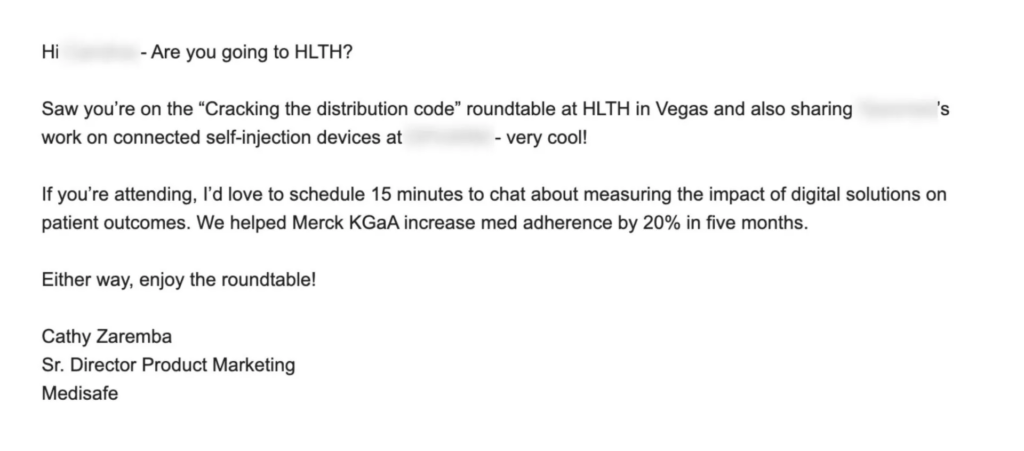
When this campaign hit prospects’ inboxes, Medisafe booked 29 meetings within 30 days, including some with pharma industry giants like Roche, AstraZeneca, Pfizer, GSK, and Alcon.
The secret behind this superior engagement was sending the right message to the right people at the right time and referencing the most relevant parts of their context throughout the message. Each email read like it was written by a thoughtful, competent human.
AiSDR-powered personalization went beyond the first email. It handled follow-ups with the same relevance and attention to detail, making the conversation feel human. Relevance was consistent because it’s in AiSDR’s DNA: It’s built around a personalization framework.
How to build a personalization framework that lasts
A durable personalization framework tells you who to target, when, why, what to say, and how to evaluate success. It makes relevance part of your strategy, rather than a one-time effort.
Segment by buyer intent
Demographics and firmographics are fine for filters but not really good at answering the question: “Should we approach this person now or not?”
Knowing a company sells “mid-market SaaS” doesn’t tell you if a prospect is looking to replace their current tool. Knowing someone has the role “VP Sales” doesn’t tell you what process they’re trying to fix right now.
Build segments around why prospects would care about your product right now:
- Teams showing signs of growth stress like hiring spikes or expanding territories
- Teams showing process change like RevOps buildout or tool consolidation
- Teams showing a current pain like posts about lead quality, pipeline, or conversion
Then match each segment to one pain point and one offer. Your AI tool will use these as the backbone of the message it crafts for each person.
Trigger outreach from real-time signals
Personalized email outreach begins with AI tracking real-time buyer intent signals. The AI tool sends the first message when a prospect’s intent peaks. This makes it likely that you’ll catch them while you’re still on their mind.
Check if your current AI tool can do that, rather than merely follow a schedule. It should also allow you to:
- Choose which buyer intent signals to track
- Set an intent threshold to trigger outreach
- See why each account was prioritized
Even better if the tool responds to the prospect’s moves during a conversation. If a prospect suddenly disengages, the AI should take a break and use pattern interruption in the next message.
Measure success by qualified meetings that show up
Messages sent and total reply rate are vanity metrics. Outgoing volume adds nothing to pipeline, and negative replies inflate the total replies.
Metrics that tell you if your personalization’s working include:
- Meetings booked (and attended!)
- Revenue growth
- Second-step actions, like referrals, intros, or forwarded threads
- Meeting-to-sale conversion by segment and trigger
A tool like AiSDR serves as a strategic partner because it can apply a personalization framework consistently over time. It helps teams target the right people, uses live signals to time outreach, and keeps relevance alive at scale.
Personalization that scales pipelines
Most personalization tools focus on giving you better inputs: cleaner data, more contact fields, more integrations, smarter filters.
AiSDR makes it easier to get the output you need, so that your messages land in inboxes, earn replies, and book qualified meetings that show up.
Outreach grounded in real buying signals
Real personalization starts before the first word is written.
Since AiSDR’s Live AI Search finds prospects showing active buying signals, the AI uses that context to write messages that cover what’s happening now, and not what was true last quarter.
This is what separates signal-based personalization from personalization theatrics like simply dropping a job title and company into a message.
Prospects notice the difference.
Quality that holds at scale
Scaling quality personalization is where most human teams hit a wall. There are only so many messages a person can realistically write from scratch.
AiSDR eliminates this capacity constraint by researching, writing, sequencing, and following up autonomously. The AI’s trained on your brand voice, ICP, and previous successes so output stays consistent regardless of volume.
Success measured in pipeline
Emails sent and raw reply rate tell you how busy your team is.
Positive replies, qualified meetings that show up, and pipeline sourced tell you if personalization is working. These are the numbers that AiSDR optimizes for.
Make every email feel truly personal



How to personalize email outreach using real signals and timing
 Summarize with
 ChatGPT
 Claude
 Perplexity
 Grok
Grok 
 Google AI