






Email Framework: Founder Outreach

Cold email is a founder’s not-so-secret secret weapon for building connections, gathering data, and collecting insights from target users. With the right approach and enough research, founders can reach out to target users and experienced professionals without sounding pushy.
Here’s a closer look at the Founder Outreach email framework and how founders can use it to start conversations while they prepare to launch their product.
What is the Founder Outreach email framework?
The Founder Outreach email framework is a structured way for founders to personalize high-impact cold emails. Like other email approaches, this framework helps founders quickly write and send emails for a specific purpose.
But what makes the Founder Outreach framework different from other classic email frameworks is its focus. Many frameworks like the AIDA model or the Justin Michael Method emphasize a problem-solution approach with a strong pitch.
For Founder Outreach emails, this isn’t the case. The Founder Outreach framework focuses more on forging relationships and building trust. This makes these emails feel less transactional, which in turn improves your chances of engagement.
What are the core elements of the Founder Outreach framework?
The Founder Outreach email framework has several core elements for effective sales emails.
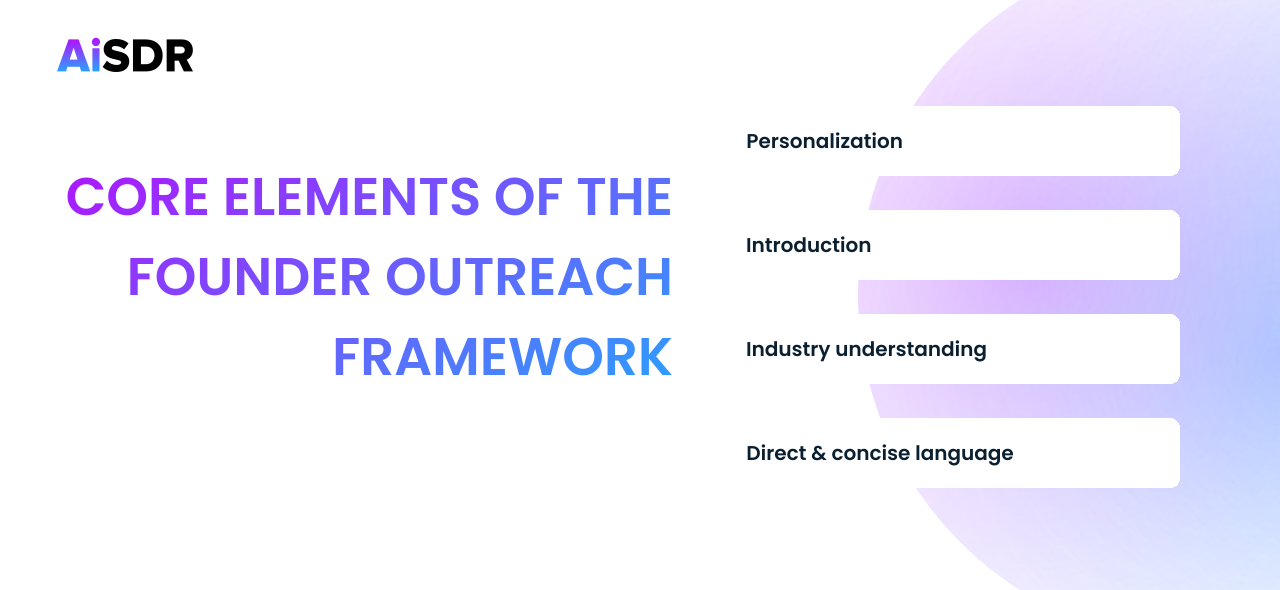
Personalization
Founder Outreach emails include personalization throughout the content, from the salutation to the postscript. The body of the email is tailored to their industry and pain, while the postscript features individual-level personalization.
Introduction
Unlike many other email frameworks, Founder Outreach emails have a brief introduction that shares who you are and why you’re worth listening to. Some good achievements to help you establish credibility are any notable partnerships with highly recognizable names or brands, successful ventures, and media recognition.
In a perfect world, your achievements will have some relation to your current goal. For instance, if you previously built and sold a business, and now you’re working on solving founder-led sales pains.
Industry understanding
In addition to highlighting the lead’s pain, Founder Outreach emails show you understand their industry and can either offer insights or a solution.
This can take the form of mentioning a common problem or pain they might be facing, such as improving efficiency or scaling operations. You should also ground this understanding within the context of their own business. After all, small & medium businesses don’t experience the same issues as enterprises (though they might share a few).
To soften your approach, you can pose a question to bring up the topic.
Direct & concise language
While the Founder Outreach approach includes a few elements that many other sales emails don’t (e.g. introduction), your email should avoid beating around the bush.
Keep your intro as short as possible – just enough to say your name, your company, and your credibility. Then get into the meat of the email, which is stating what you want, what value you can offer, and your call to action.
Everything should be clear and concise.
When to use the Founder Outreach framework in sales outreach
Here are some instances when the Founder Outreach framework is preferable to other approaches:
- Starting conversations – Founder outreach encourages engagement and discussions, and experienced professionals are frequently open to speaking with founders.
- Building trust and connections – Founder outreach helps founders create and foster a network of people and companies that they can use in the future for references, knowledge-sharing, and even sales.
- Gathering feedback and insights – Founder outreach offers a channel for founders to ask questions, get expert feedback, and use the data collected to build and refine their solution, as well as craft their buyer personas and sales personas.
- Leveraging your background – Founder-led sales relies on the founder for success, and your background can become a conversation starter if you don’t have enough insights for your solution or you need more time to build an MVP.
Founder Outreach emails can also be used to support the creation of a waitlist of people who want to try and test your solution.
Test drive our AiSDR 🧠

Founder Outreach framework example
Here’s an example of an email you might write according to the Founder Outreach framework.
You can also find this framework in AiSDR’s framework library. All you need to do is tell the AI about your ideal customer, and AiSDR will handle all the prospecting, research, and email writing and personalization for you using this framework.
General framework
Founder outreach doesn’t rely on standard email templates. Instead, they follow a general structure.
This is how the email structure typically breaks down.
[Lead name],
[Introduction]
[Establishment of credibility]
[Demonstration of industry understanding]
[Statement of what you want]
[Offer value]
[Call to action]
[Personalization of postscript]
[Sign-off],
[Your name]
Email example
Here is a possible email based on the Founder Outreach email framework.
Jason,
I’m Yuriy Zaremba from AiSDR. Known for selling AXDRAFT to Onit Inc. and being featured on Forbes twice. I’m researching challenges like limited resources for scaling, particularly in expanding market reach and prospecting, which may be relevant for BB Insurance Marketing.
I’m curious how you’re addressing these. Up for a short chat? I’d love to share insights from my past experiences that might be useful.
P.S. Heard BBIMI expanded to North Carolina, congrats!
Thanks,
Yuriy
Subject line best practices for Founder Outreach emails
A punchy subject line gives your email a greater chance of getting opened. It should grab attention instantly and prompt a click.
Use sentence case and 3-5 words at most. Think getting your foot in the door, not a quick pitch. You can provide more context in the preheader – the first 80-120 symbols of your email that your recipient can see before opening.
Always personalize your subject line to avoid coming across as spammy. Use a name, a metric, or a recent event as a tiny hook like:
- [Your First Name] × [Lead’s Company Name]
- [Lead’s First Name], congrats on Series A!
- Faster onboarding for [Lead’s Company Name]
- [Lead’s First Name], want more sales?
- [Lead’s First Name], hire your next star!
These subject lines work because:
- They’re short and look clean on mobile
- They spark curiosity or tease value (faster onboarding, more sales, hiring a stellar employee) without spoiling the pitch
- They anchor to something unique for the person: name, company news, or current goal
Beyond long or generic subject lines, there are other common mistakes you’ll want to avoid in founder outreach.
Common mistakes to avoid in Founder Outreach emails
In a cold email, you only have 50-120 words to hook the person before they get bored. That’s why you should make each word count and skip anything that can ruin your pitch.
Overused buzz words
There are certain words and phrases that used to be in style once, but now they trigger an eye roll:
- Circle back
- Synergy
- Win-win
- Just checking in
- Pick your brain
- Transform
- Empower
Swap them for plain language: “Want to compare notes on {topic}?” or “Open to a two-minute sanity check on {X}?”
Being too vague
“We help companies like yours,” says nothing. State right away what you can help them with, like sales, hiring, or teamwork. The more specific you are, the likelier you’ll get a response.
Making it all about you
You should get the intro done and over with as fast as possible. Just your name and key credential. Then shift to their problem and highlight how you can help and the value they’ll get.
No clear CTA
Don’t leave the person guessing what the next step is. Wrap your offer up with a clear call to action: “Open for a quick chat on this?” or “Should I send a 60-sec Loom?”
How to personalize Founder Outreach at scale (with AI tools)
You don’t have to personalize each message by hand when you can have AI tools tackle that.
For example, you can use:
- Clay for building and enriching lead lists
- ChatGPT for rough drafts
- Lavender for copy editing and a more human-like tone
Your workflow can run like this:
- Pull and enrich the prospects’ data with Clay, forming a lead list.
- Feed the list and your founder outreach template into ChatGPT to have it produce a personalized email draft for each lead.
- Paste each draft into Lavender for trimming suggestions.
- Paste the revised copy into your email.
There’s still a lot of repetitive manual work in this.
Or you can roll with AiSDR, which does all of this for you:
- Find publicly available lead data and intent signals on any prospect
- Warm up your mailboxes automatically to avoid triggering spam filters
- Run multichannel outreach personalized for each lead with actions that trigger for specific activity or delays
In AiSDR, you can configure the brand voice and train the AI to sound like you, or pull from one of the many email frameworks.
Founder outreach for different goals: partnerships, sales, hiring
You’ll want to use different structures for your outreach emails when seeking business partners, customers, or stellar employees. Here are quick frameworks for each situation.
Partnerships
Founder outreach can help you find partners for either a long-term collaboration or just a one-time audience swap.
Framework 1: Mission, Fit, Offer
Open with your prospect’s long-term objective or mission that you can help them achieve.
Example: “I see you’re seeking {mission}. We can help you with {specific gap}. Up for a 2-week micro-pilot to validate?”
Framework 2: Audience, Value, CTA
This framework is for the situation when you’re looking to do a joint promotion with another company as their audience might be interested in your product.
Example: “Our {audience} overlaps with yours on {segment}. We can bring {asset}, you bring {asset}. Test a joint webinar next Thursday?”
Sales
Sales are the most common reason for email outreach. By launching a strong campaign, you can fill your sales pipeline with new deals.
Framework 1: Trigger, Pain, Proof, CTA
You reference the recent or upcoming event in the company, point to a problem they’re likely to face next, then offer a solution, backing it with social proof.
Example: “Saw you’re rolling out {tool}. Teams hit {pain} then. Helped {peer} cut {metric}. Worth exploring on a quick 10-minute chat?”
Framework 2: Problem, Agitation, Solution
Here you open with the prospect’s current problem, show your understanding of their pain, then offer a solution.
Example: “Hiring ramp is slow as new reps stall on email, slowing pipeline. We coach within the inbox, so ramp shortens. Want the 60-sec version?”
Framework 3: Observation, Insight, Credibility, CTA
This framework is similar to the first one, but instead of pain, you share an insight that provides immediate value to the prospect. That helps establish credibility and trust before you make an offer.
Example: “Saw your plan to go live with [product]. When teams roll that out, signups jump but activation often lags because [insight]. I’m a co-founder at [company]. We’ve helped 100+ companies in [industry] increase conversions by 30-50%. Open to a quick 10-minute compare-notes?”
Hiring
Selling an open spot in your company to a stellar pro is not much different from selling a product to a picky customer. In both cases, a great first impression goes a long way.
Framework 1: Mission, Role Hook, Fast Path
When you believe your company’s mission will resonate with this person, lead with it and continue with a role hook.
Example: “We’re fixing {mission}. Your {skill} work at {Company} stood out. How about a 10-minute chat to see if we’re a great match?”
Framework 2: Proof, Why You, Why Now
When the candidate is more of a pragmatic type, show that you can offer a stable income and growth prospects.
Example: “We’re a startup backed by {investor}. Your {experience} fits our {stage}. Here’s more about the job: [link]. Would you like to help us with this?”
Whatever framework you go for, you’ll need to test it on real people to find out what works best. Time to talk about how to do this part.
A/B testing your founder outreach emails: what to test and why
A/B testing means creating two slightly different versions of your email, then sending Version A to some leads and Version B to others. The point is to see which version delivers more replies and incorporate it into your template.
For an A/B test, you need to tweak only one high-impact element at a time, such as:
- Subject line: curiosity ([Your First Name] × [Lead’s Company Name]) vs. specificity ([Lead’s First Name], want more sales?)
- CTA wording: “Worth exploring during a 9-minute chat?” vs.“Open to a 9-minute chat?”
- Intro line: trigger-based (“Congrats on the {launch}”) vs. proof-based (“We helped {peer} to {outcome}”)
- Send time: late-morning local vs. late-afternoon local
As a result, you’ll see which version performs better and stick to it.
Outreach that doesn’t sound “salesy” 📬
More on the topic:



Learn how founders can use the Founder Outreach email framework to spark their outreach
 Summarize with
 ChatGPT
 Claude
 Perplexity
 Grok
Grok 
 Google AI