










7 Words That Seem Like AI Content (But Might Not Be)

Delve. Tapestry. Testament.
These are a few of the words and phrases that ChatGPT tends to overuse.
Since its launch, ChatGPT’s writing tics and quirks have helped many create an internal AI detector.
But not all words that seem like generative AI are a sign of ChatGPT at work. Sometimes words just appear more often in other languages or dialects.
That’s why it’s important to remember this age-old rule – “Context matters.”
In this guide, we’ll go beyond word choice, unpacking overused vocabulary, sentence structures, pacing patterns, and subtle red flags that separate human writing from machine-generated content.
How do people perceive AI-generated text?
People are getting better at identifying AI-written content, and their reactions vary. Some still find it impressive, especially when it’s clean, clear, and grammatically sound. Others pick up on a certain stiffness. The tone feels neutral, the structure too neat, and the voice is missing.
That’s where AI often falls short. It gets the form right but misses the feeling. And in content that depends on trust or emotional pull, like sales emails, thought pieces, or brand messaging, that disconnect can be costly.
What used to pass as professional now risks coming off as soulless. Readers are more aware, and when something feels “off,” it’s harder to build real engagement.
Why certain words make writing sound like AI
Certain words trip alarms, not because they’re wrong, but because they sound like they came from a textbook.
That’s no surprise. AI tools are trained on formal content: academic papers, news sites, and business docs. So when they write, they often default to stiff phrasing.
Words like “commence” or “albeit” rarely show up in casual writing. When they do, they stick out. Throw in overly polite transitions like “nevertheless” or “furthermore,” and readers start squinting.
Unusual word choices may seem smart, but they become a red flag when there are too many in one place.
Key differences between AI-generated and human-generated text
Let’s break it down side by side:
| Feature | Human writing | AI writing |
| Tone | Varies by mood, personality, or intent | Often neutral, formal, or overly polite |
| Mistakes | Typos, weird phrasing, uneven flow | Polished, but lacks spontaneity |
| Flow | Natural, messy, or emotional | Balanced, structured, sometimes stiff |
| Voice | Has quirks, humor, or edge | Clean, generic, sometimes bland |
| Word choice | Slang, idioms, bold statements | Proper, safe, sometimes outdated |
In short, humans break rules, while AI follows them. That difference is easy to feel, even if it’s hard to describe.
7 words that look AI, but maybe aren’t
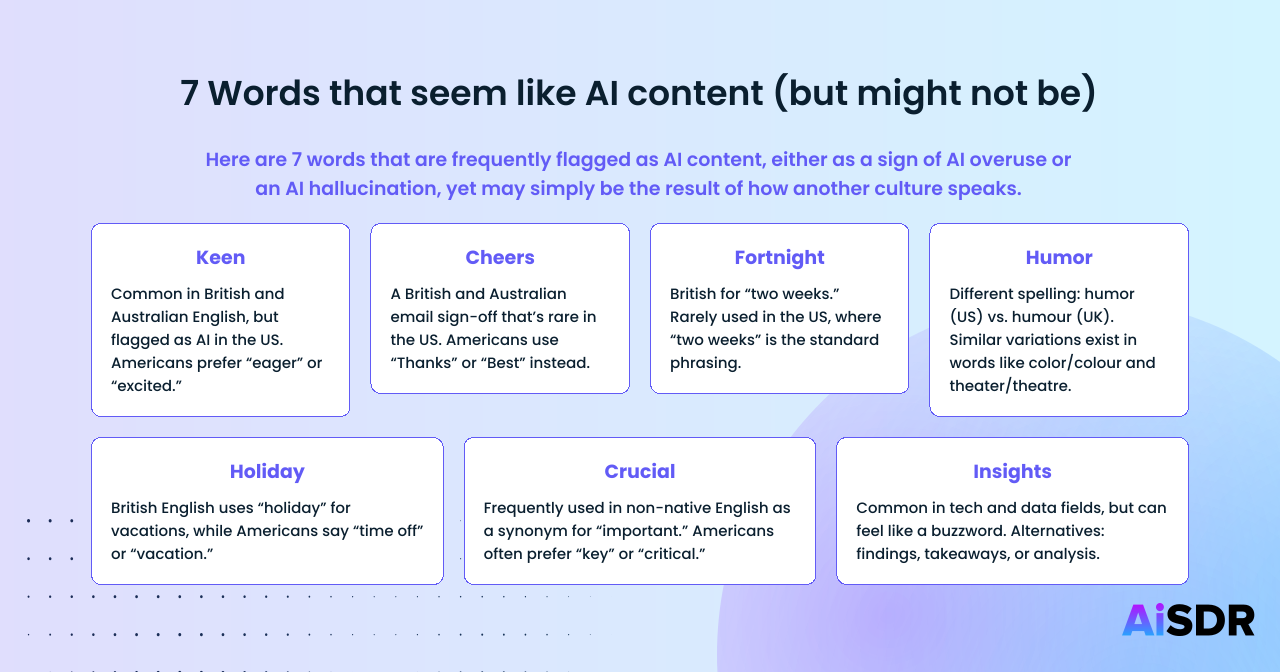
Here are 7 words that are frequently flagged as AI content, either as a sign of AI overuse or an AI hallucination, yet may simply be the result of how another culture speaks.
Keen
Context: “I’m keen to get the project started.”
Keen is the best example of this phenomenon where internal AI detectors signal a false positive.
When we first launched the email feedback feature for AiSDR, several of our American users flagged keen as an AI word to remove from future emails. Consequently, we updated many American sales personas to include a rule that prohibited the use of keen.
At the same time, several of our European users preferred to keep the word.
Long story short, keen is commonly used in British and Australian English and a lot less in American.
(On a side note, this aligns with my own experience as a former English teacher. Many of the textbooks I used were published by Cambridge, and let’s just say that keen was very enthusiastically taught early on.)
Cheers
Context: “Cheers, John”
There are many ways to sign off an email, especially in non-formal English:
- Regards
- Best
- Thanks
- Thanks in advance
- Talk soon
The list goes on. You can even omit a sign-off, opting instead just to use your name.
But one sign-off you’re unlikely to encounter from Americans is Cheers. That’s because Cheers is typically reserved for toasts, which is why it’s sometimes flagged as AI when it crops up in emails.
This can easily be a false positive as Australians and Brits frequently use Cheers to say “thank you” or “goodbye”. And if you think about it, this dual meaning makes it perfect for signing off an email.
Fortnight
Context: “Let’s reconnect in a fortnight.”
I was torn between the terms fortnight and score, but the former has a likelier chance of appearing in sales emails.
In case you’re unfamiliar with either term, fortnight means “14 days” while score means “set of 20”.
(If you want a bit of linguistic trivia for your upcoming quiz night, once upon a time, the British used to say sennight as an alternative to weekly.)
In the US, two weeks is the standard most people use while in the UK, fortnight is still reasonably common. However, it’s supposedly falling slowly out of use in favor of the American two weeks.
Next time you see the word fortnight appear in your email, take a look at who sent it. If it’s a Brit, it’s probably not AI. If it’s an American, well… you get the idea 🙂
Humor
Context: “I like the sense of humor.”
Just to prevent any misunderstanding, there’s no issue with the word humor itself.
Its place on this list is more about the spelling – humor vs humour.
Although there’s a lot of content available on the internet about the many spelling, usage, and terminology differences between American and British English, this doesn’t stop people from flagging unfamiliar spellings as AI hallucinations.
Here’s a quick recap of some of the key spelling differences.
| American English | British English |
| Humor | Color | Honor | Humour | Colour | Honour |
| Theater | Center | Theatre | Centre |
| Personalize | Standardize | Personalise | Standardise |
| Traveling | Travelling |
| Defense | License | Defence | Licence |
| Dialogue or dialog | Dialogue |
Aside from alternative spellings, there are plenty of words that vary between the main dialects, such as chips and fries in the US to crisps and chips in the UK.
My favorite?
Barbie – A famous doll (and movie!) in the US but slang for barbecue in Australia.
Did you know…?
Apparently Shakespeare used both honor and honour in his works, buuut he seems to have had a slight preference for honor.

Holiday
Context: “I’ll be on holiday next week.”
In British English, holiday is frequently used to describe vacations and other days off, not just special days of the year.
In comparison, Americans usually reserve holiday for occasions like Christmas and Thanksgiving. Instead, Americans would use terms like days off, time off, leave, or vacation.
Although it’s easily understood from the context, some flag the use of holiday as an AI hallucination when they see someone describing upcoming time off.
Crucial
Context: “This new feature is crucial for our success.”
For better or worse, Crucial is seen as another indicator of AI because it feels like whenever AI wants to say something is important, it uses the word crucial.
I can’t disagree. After all, Americans would use words like important, key, and critical or expressions like make or break, crux, and holds the key over crucial any day.
However, Americans aren’t the only people who speak English. 😅
Pulling from my English teaching experience, a lot of textbooks teach non-native speakers that crucial is simply a stronger synonym for the word important. So whenever you want to say “very important”, you say crucial.
(Oddly enough, those same textbooks rarely offer the word critical as an alternative, which Americans would probably use more frequently.)
In the end, this leads many non-native speakers to rely on the word crucial whenever they want to emphasize that something is essential. And as a result, their content is flagged as AI.
Insights
Context: “You can check your dashboard for valuable insights.”
Insights is a peculiar case that is equal parts buzzword, everyday word, and AI content indicator.
How?
In today’s ever-evolving world (see what I did there?), people are drowning in data and information.
With so much at peoples’ disposal, they latched onto a word that could describe specific data within data, which just so happened to be insight.
Fluctuations in the stock market from 1929 to 2020? A financial insight.
How customers make purchase decisions at grocery stores? A shopper insight.
And how do you describe an article or blog about recent trends in marketing? Insightful.
This is where we run into the challenge of AI content. Most models are trained on a huge set of data that mirrors how people speak and write. And if a buzzword like insights is frequently used, you can be certain that AI will start using it.
For this exact same reason, other buzzwords like gamechanger could easily have made this list.
Still, I have found that while the everyday use of insights might not be huge among Americans, it is heavily relied on in the tech sector and the international English-speaking world.
If you want to avoid the word insights out of concern that it’ll be flagged as AI, here are some possible alternatives:
- Findings
- Key takeaways
- Conclusions
- Analysis
- Observations
Of course, none of these are 1-to-1 synonyms of the current use of insights, so you should consider the context when making your choice.
Honorable mentions: Other cases that caught our attention
The list above mainly focuses on words that people often flag as signs of AI writing. Still, a few scenarios stood out as too interesting to leave out, so here’s a quick set of honorable mentions.
I hope this email finds you well
I remember in the early days of my professional career, we were always taught and told to include a sentence like this at the start of an email.
Even textbooks I used for teaching material taught the same.
Nowadays though, people who are in the business of sending emails want the text to be under 50 words and to get to the point asap. As a result, when they see an empty line like this, their first impression is “AI content”.
Some habits can be hard to break though. I still regularly see email intros like this in many incoming emails that I know aren’t AI-generated.
Oxford commas
In case you need a refresher, the Oxford comma is the comma that appears before the conjunction in a list of three or more items (e.g. bacon, lettuce, and tomato).
However, the English-speaking world is fiercely split about whether or not to use the Oxford comma (for the record, I’m in the camp that uses the Oxford comma).
By default, ChatGPT uses the Oxford comma, which has led some who don’t use it to assume that when they see it, the content must have been generated by AI.
This is why it’s important to consider the writer and where they’re from. It might even be that their organization has a specific policy for using or omitting the comma.
Subscribe to our Newsletter
Sentence structures that give away AI text
- Even when the ideas are solid, the way a sentence is built can raise eyebrows. A few common signs:
- Overuse of transitions. Words like “However,” “Moreover,” and “Thus” pop up a lot in AI writing. People tend to skip them or keep them more casual.
- Stiff intros. Openers like “It is important to note that…” or “This highlights the fact that…” feel overly formal and kind of lifeless.
- Too perfect. Impeccable grammar and punctuation might look professional, but it can also come off as robotic. Real humans make the occasional slip or throw in a quirk.
- Em dash overload. AI often leans on em dashes to string thoughts together — a lot. Humans do use them, but sparingly. Overusing them makes text feel like it’s trying too hard to be conversational.
- Balanced arguments. AI loves a balanced take. Humans usually pick a side and go with it.
Example of AI-ish line:
“While this approach has its challenges, it is crucial to consider the benefits as well.”
A human might just say:
“Sure, it’s tricky, but the upsides are worth it.”
Bonus section: More things common for AI content
Some words just scream “written by AI.” Not because they’re fancy, but because people don’t usually talk this way. Watch for these:
- Nevertheless – Formal, unnecessary. Just say “but.”
- Furthermore – Sounds like a lawyer’s memo.
- Commence – Nobody says this at a party. Use “start.”
- Albeit – An old-school twist that feels forced.
- Intriguing – A favorite AI filler when trying to sound clever.
- Ponder – Feels more like a philosophy class than a product review.
Sprinkle them too often, and your writing feels more like a research paper than a real person.
Phrases that sound like AI but might be natural
Some lines walk the line (pun intended); they’re common in both human and AI writing. Used well, they’re fine. But overuse makes your copy feel templated.
- “In today’s fast-paced world…” – True, but way overdone.
- “Unlock the power of…” – A favorite in pitch decks.
- “It is worth noting that…” – Unnecessarily formal.
- “Seamless integration of…” – Typical tech-speak.
Individually, they’re not a problem. But stack a few together, and your writing starts sounding like it was spit out by an email generator.
At this point, you’ve seen the words, phrases, and quirks that make text feel a little too polished to be human. But what if you want a more systematic way to tell the difference?
No better way to wrap up this guide than with a few reliable ways to spot AI writing in the wild.
How to distinguish AI-generated text from human-written one
Spotting AI-written text isn’t just about what’s said, but also how it’s said.
1. Pay attention to style
Human writing has personality. It’s messy, biased, or emotional. AI tends to play it safe. If the voice is flat, it probably isn’t human.
2. Look for rhythm
Humans vary sentence length and pacing while AI often delivers a steady beat, which is perfect for robots but boring for readers.
3. Use detection tools
Try platforms like GPTZero, Copyleaks, or Originality.ai. They analyze word patterns and sentence structure to flag likely AI content. Not foolproof, but useful.
The trick is in spotting patterns. AI is good at sounding correct, but it struggles to sound real, unless prompted with care.
PROSPECTS DON’T GRADE YOUR PROSE
FAQs
Will AI eventually write like humans?
We’re getting closer. Each generation of AI gets smoother, smarter, and more nuanced. Some tools can even mirror a specific person’s style. In fact, with certain types of copy, such as cold emails, AI is already pulling ahead. But that is less about perfect phrasing and more about the research muscle behind it. True human-level creativity, though, is something we have not cracked just yet.
What’s changing in AI writing right now?
AI writing is evolving beyond just being correct, it’s becoming more flexible and personal. Key developments include:
- Tone tuning: Adjusts style, humor, or formality on command
- Voice replication: Mimics specific people’s writing or speaking style
- Co-writing tools: Helps humans write, rather than replaces them
- AI tags: These are watermarks or signals embedded to identify machine-generated text
Will AI writing become indistinguishable from human writing?
For casual content, yes, and soon. But it’s still a challenge for emotional storytelling, opinion writing, or anything that relies on timing, personality, or subtlety. The human touch remains hard to fake.
How does AI-generated content affect SEO?
AI-written content can boost SEO when used thoughtfully, helping scale production, cover more keywords, and stay consistent. But search engines are getting better at spotting low-effort, generic content. If it lacks originality, depth, or human insight, it risks ranking poorly or being filtered out entirely. Quality still matters more than quantity.
Subscribe to our Newsletter



Find out which 7 words are often flagged as AI content but are actually just how another culture writes.
 Summarize with
 ChatGPT
 Claude
 Perplexity
 Grok
Grok 
 Google AI