





7 Best AI Sales Enablement Platforms: Features, Benefits, & ROI

Sales teams don’t struggle with sourcing data anymore. They struggle with figuring out what’s capable of moving a deal forward.
That’s where AI sales enablement comes in to help teams engage the right prospects, avoid wrong leads, say what matters, and close deals faster.
Moving a deal forward requires AI that lives where the work happens: within calls, sequences, and active engagement. By moving beyond simple content libraries and training modules, sales teams can use AI to trigger the specific business outcomes that move the needle on ROI.
But achieving that level of impact requires a shift in how we define the category itself.
What does AI sales enablement mean today?
AI sales enablement is using AI to give sales reps real-time insights, recommendations, and automation to engage the right prospects, communicate effectively, and close deals with less hassle.
A sales enablement tool is best defined by its core components. Strong AI sales enablement platforms focus on one or more of these four key areas:
- Training & coaching: Courses, role-plays, and live feedback to help reps build their skills. AI can analyze your calls or messages, detect when a rep struggles with objections, and suggest responses or a micro-practice module after a call.
- Content management: Updating slides, one-pagers, and case studies, and keeping them organized and easy to find and share. AI can recommend the most relevant content for each lead or detect recurring issues, propose article or blog post ideas, and even help draft content.
- Outreach & engagement: Prospecting sequences, follow-ups, call/email workflows that help reps engage buyers. AI can find leads that fit your ICP, score and prioritize them, research their pain points and interests, and build sequencing campaigns.
- Knowledge surfacing: Mining internal and external data from calls, emails, and CRM so reps have the right insights at the right time. AI finds patterns and delivers them in real time or on demand.
With AI in your toolkit, sales enablement shifts from a pull to a push model. Instead of reps hunting for content or training, the system monitors activity and delivers the right asset, cue, or insight exactly when it’s needed.
Best AI sales enablement platforms in 2025
When you’re ready to pick the right AI SDR platform for your team, here are 7 AI sales enablement tools to put at the top of your list. They stand out for helping reps work smarter, close faster, and make the most of every interaction.
AiSDR
AiSDR is a full-stack AI sales platform built for teams that want personalized outreach without spending days on setup or engaging leads who won’t convert.
Key features
- AI Strategist that creates five ready-to-run GTM plays based on your offer and conversion data
- Live AI Search to find and research ideal leads from a simple text prompt
- Campaign Builder for hands-on control of timing, channels, and outreach campaign experiments
- Signal capture for inbound and outbound prospects, flagging leads when intent peaks
- Personalization engine powered by 320+ data sources and adaptive messaging
- Multichannel outreach covering email, LinkedIn, and call scripts with multimedia support
Use-case fit: Ideal for teams that want a high-quality AI assistant to handle prospecting, enrichment, and outreach all in one place.
Pros
- Top-quality, hyper-personalized campaigns with flexible multichannel outreach
- Inbound and outbound lead capturing and outreach for complete visibility into prospect intent
AiSDR’s broad feature set may require some initial testing to fine-tune automations across your sales flow.
User reviews
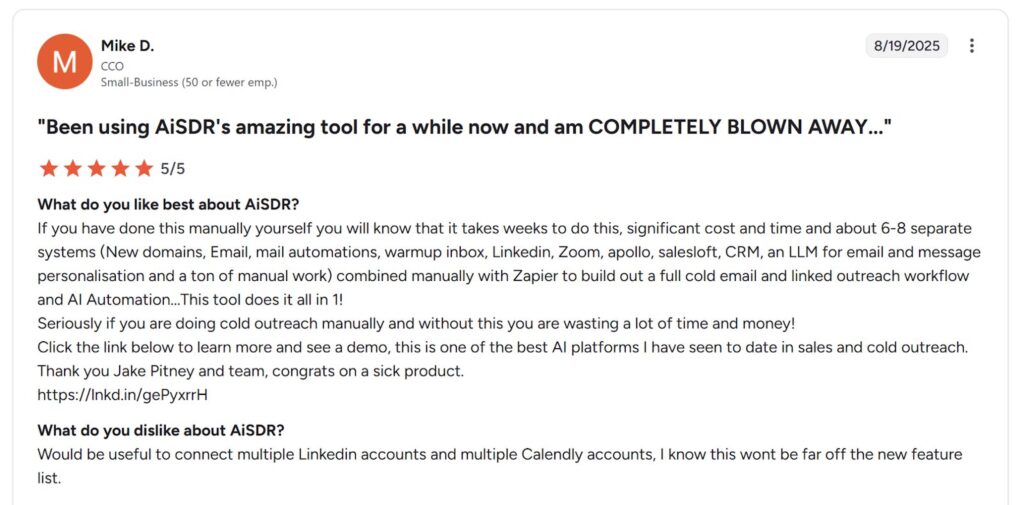
Alt text: AiSDR review by Mike D., CCO. Source
Breeze
Breeze is a HubSpot-native AI platform that makes CRM data sharper and more useful. It focuses on contacts you already have, enriching profiles and helping convert leads who are ready to listen.
Key features
- Data enrichment with 40+ firmographic, demographic, and technographic data points
- Real-time syncing and updates through HubSpot-first integration
- Lead intelligence that tracks engagement across content, website, and forms
- Intent tracking to spot high-interest visitors and add them directly to HubSpot
- Breeze Copilot to draft emails, summarize contacts, prepare meetings, and do CRM tasks on command
- Breeze Agents acting as AI teammates for prospecting, research, outreach, and customer communication
Use-case fit: Ideal for HubSpot users who want smarter lead insights and automated prospecting without depending on bulky external databases.
Pros
- AI agents for every sales and marketing need
- Built fully inside HubSpot, keeping data synced and clean
- High-quality data enrichment
The downside is that Breeze is HubSpot-native, so teams using other CRMs or multiple platforms may find its utility limited. And with if you don’t watch your credits closely, costs can add up faster than you expect.
User reviews
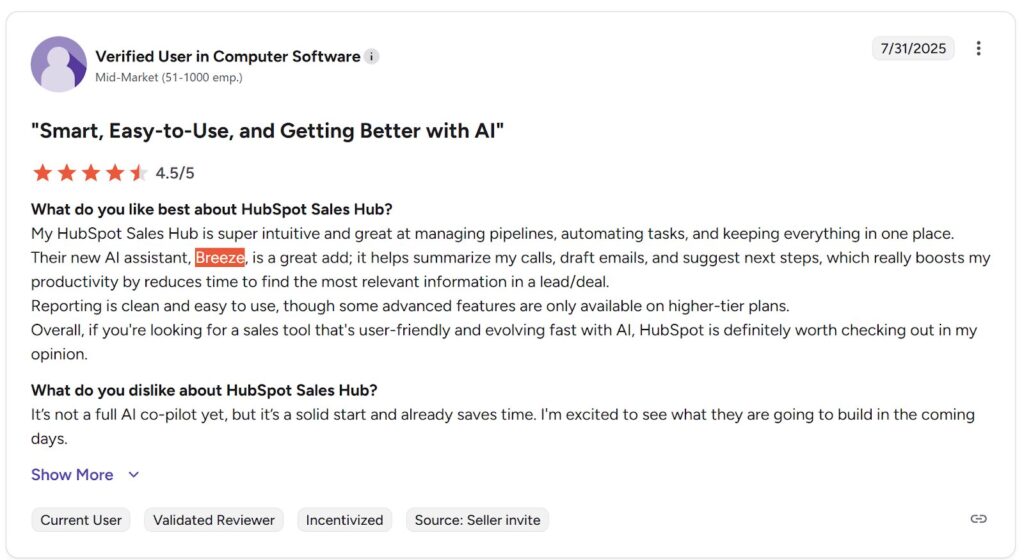
Alt text: Breeze review from a verified user in the computer software industry. Source
Lavender
Lavender helps SDRs turn mediocre outreach into messages that get replies with real-time coaching on email clarity, tone, and personalization.
Key features
- Email scoring system that grades messages and suggests instant edits
- Personalization assistant that surfaces prospect insights and ideas for custom touches
- “Start email” option to generate drafts from simple bullet points
- Sentiment analysis to fine-tune tone and drive engagement
Use-case fit: Best for SDRs and sales teams who care about writing better emails, not just sending more. Works smoothly with HubSpot, Apollo, and Salesloft.
Pros
- Real-time feedback improves clarity and tone instantly
- Strong personalization boosts reply rates
- Easy to use with smooth HubSpot and Apollo integrations
That said, Lavender falls short for bulk outreach since it doesn’t automate sending or sequencing.
User reviews
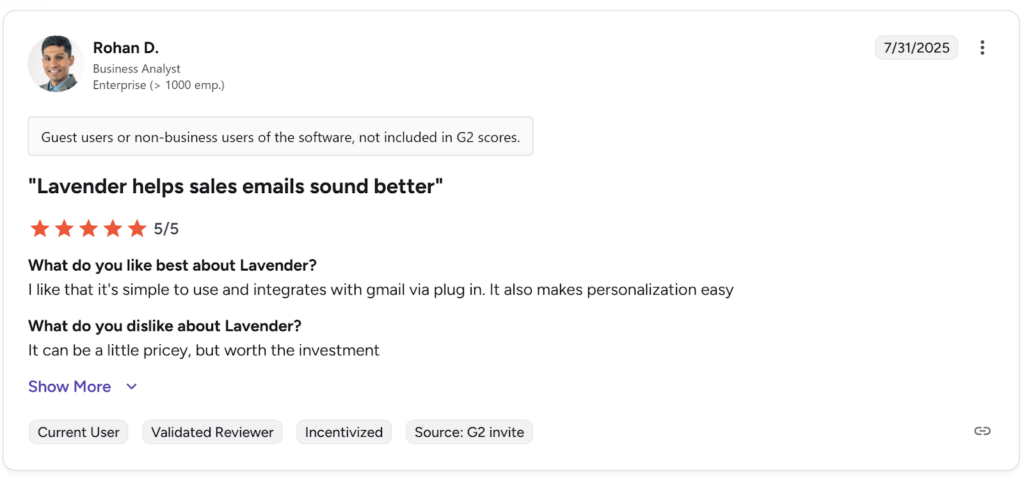
Alt text: Lavender review by Rohan D., business analyst. Source
Aircall
Aircall is a cloud-based phone system that uses AI to make sales and support calls more insightful and reduce manual input.
Key features
- AI-powered call summaries that save reps time and capture key details automatically
- Real-time coaching to improve performance during live calls
- AI Voice Agent that qualifies inbound calls 24/7
- AI Assist for smarter call prep, follow-ups, and workflow automation
- WhatsApp integration to manage calls, texts, and messages from one hub
Use-case fit: Great for sales and support teams with call-heavy workflows who want instant insights without extra admin work.
Pros
- Reduces post-call manual work
- Reliable integrations
- Excellent sound quality for smooth daily use
Still, Aircall is built for phone-based selling and is not the best fit for multichannel outreach.
User reviews
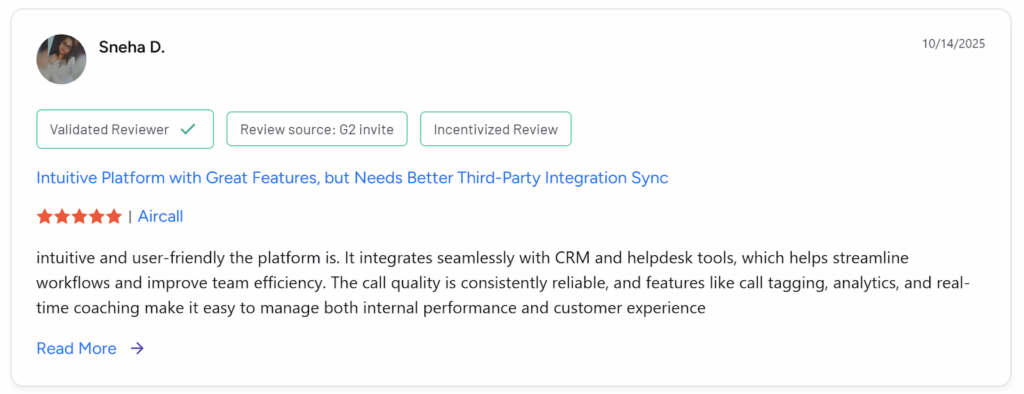
Alt text: Aircall review by Sneba D., manager in product sales. Source
Autobound
Autobound helps outbound sales teams write personalized emails fast, without the research grind, by pulling real-time prospect data and tailoring outreach.
Key features
- AI-driven research that scans 350+ real-time signals and data points
- Copilot mode for manual review and editing
- One-click integrations with Outreach, LinkedIn, Gmail, and major CRMs
- Real-time email suggestions to boost engagement and replies
Use-case fit: Perfect for SDRs and small teams that want to personalize outreach without paying enterprise prices.
Pros
- Highly personalized outreach
- Strong AI research engine that finds deep, relevant insights
- Smooth integration with major sales tools and CRMs
Autobound excels at crafting tailored messages, but it can feel slower for bulk campaigns since personalization is done per prospect.
User reviews
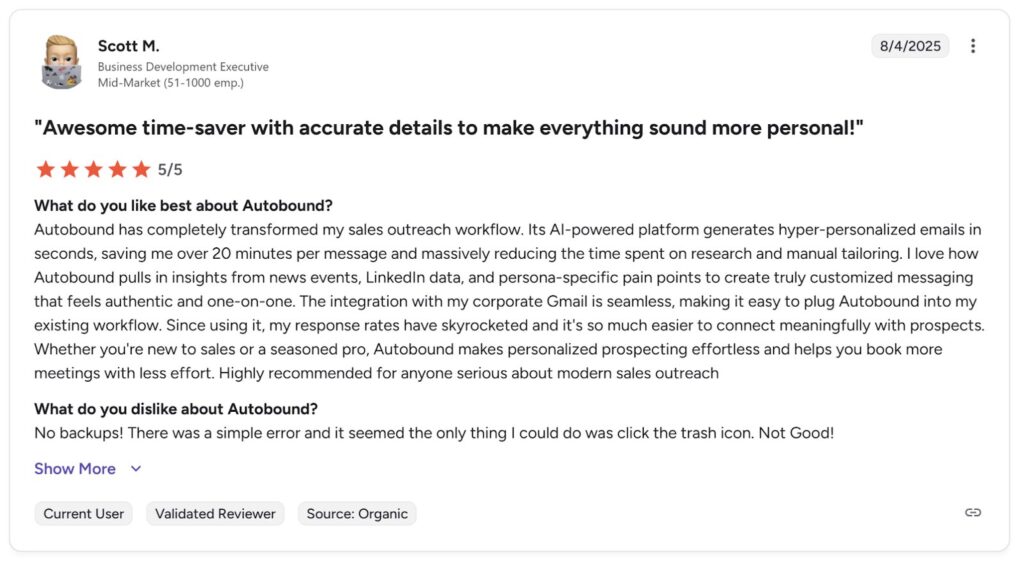
Alt text: Autobound review by Scott M., business development executive. Source
Gong
Gong is a revenue intelligence platform that records and analyzes every customer interaction to show what really drives deals forward.
Key features
- Call recording and transcription that turns conversations into searchable, structured data
- Conversation intelligence to pinpoint what top performers do differently
- One-click follow-up emails generated from call content
- Market intelligence that spots emerging themes and trends in customer discussions
Use-case fit: Best for sales teams that want to learn from real conversations and improve performance using hard data, especially when selling over the phone or video.
Pros
- Easy follow-up and post-call admin
- Accurate call transcription and searchable data
- Excellent CRM integration keeps deal records automatically updated
Gong’s setup and analytics dashboards may feel complex at first, requiring time to master all features.
User reviews
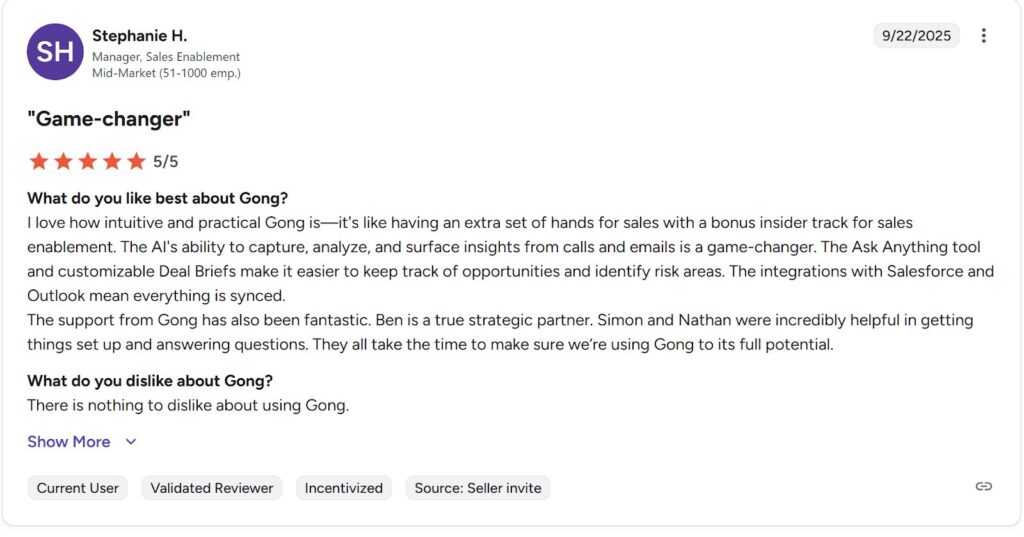
Alt text: Gong review by Stephanie H., manager in sales enablement. Source
Canva
Canva is a design tool that helps sales teams create visuals for eye-catching outreach.
Key features
- Drag-and-drop interface that makes design easy for non-designers
- Thousands of templates for social posts, presentations, and sales materials
- Brand kit to keep logos, fonts, and colors consistent
- Real-time collaboration tools for team projects
- AI features to generate full designs or individual elements
Use-case fit: Great for SDRs, marketers, and founders seeking professional visuals without waiting on a design team.
Pros
- Intuitive, easy-to-use interface
- Free basic features
- Strong collaboration tools and brand management features
Canva is versatile but not ideal for teams that need data-driven content personalization or integration with advanced sales automation tools.
User reviews
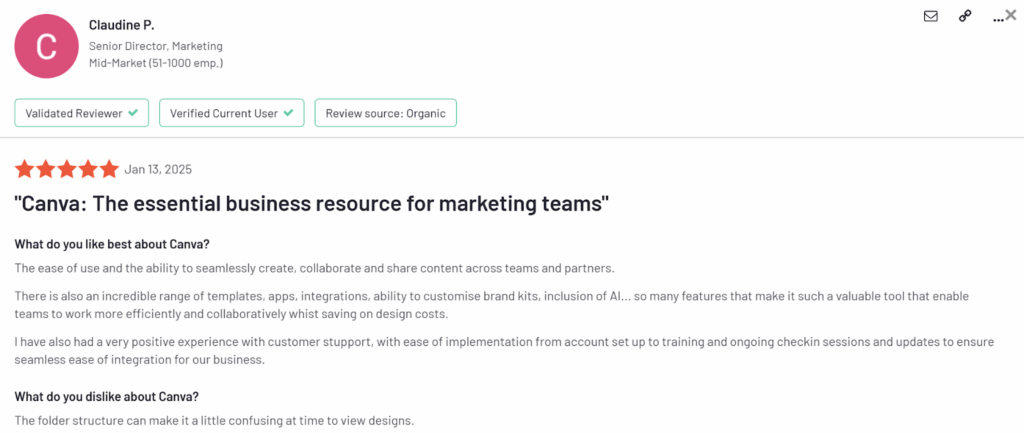
Alt text: Canva review by Clausine P., senior director. Source
Key benefits of AI sales enablement (for reps & GTM teams)
It’s exciting to know what your new software promises to deliver. But instead of just listing AI benefits, let’s highlight the features a strong sales enablement tool must have to drive measurable business results.
| Business impact | Feature examples |
| Faster ramp / onboarding | – Timely coaching (in-flow prompts, micro-lessons) – Contextual playbooks embedded inside the CRM or calling UI – Native CRM integrations to avoid switching tools – Support agents that are always in touch and ready to help |
| Higher win rates / lower churn | – Accurate lead search and qualification – Personalized outreach campaigns designed around your company and your offer- Conversation intelligence (call transcription + top-performer play extraction) – Adaptive outreach that A/B tests messaging and learns what converts – Relevant asset recommendation tied to deal stage (case studies, ROI sheets) |
| Lower CAC / better efficiency | – Automated lead sourcing & intent scoring – Multichannel outreach with sequencing and personalization at scale – Auto follow-ups and workflow automation |
| Predictable pipeline / scalability | – AI forecasting and deal-risk signals at the opportunity level – Intuitive UI and clear pipeline visibility – Flexible plans to scale activities like email campaigns |
| Higher meeting booking / conversion rates | – Intent detection (hiring, funding, tech changes) and ICP matching – Personalized message generation with adaptive learning – Reply management – Nurturing campaigns – Calendar & inbox sync for reply tracking and auto-scheduling |
| Better content performance / faster buyer traction | – Contextual content surfacing based on buyer profile and conversation cues – Usage analytics to retire underperforming assets and promote high-impact content |
Features and promised business outcomes can look great on a landing page, but to know if a tool truly delivers, ask vendors for proof. Request customer-specific before-and-after metrics, such as improved ramp time or higher reply rates, and ask for references you can contact.
For pipeline and forecasting claims, clarify the methodology, measurement window, and whether results were replicated across clients.
Of course, metrics aren’t the only way to evaluate a platform. The next step is to consider a broader framework for selecting AI sales enablement tools.
How to evaluate AI sales enablement platforms
Choosing the right AI sales enablement platform means picking a tool that truly supports teams as they engage prospects and drive revenue.
Keep these aspects in mind when deciding.
Integrations & tech stack fit
The platform should plug seamlessly into your existing CRM, email sequences, and data sources. If you use Salesforce, the platform should connect to Salesforce. Same if you use HubSpot, Pipedrive, or any other critical software.
That way, AI that works inside your stack will ensure that insights, leads, and content recommendations appear exactly where reps need them, without extra clicks or manual syncing.
AI maturity & model explainability
A mature AI tool provides accurate, context-aware recommendations, continuously learns from new data, and delivers insights directly in the sales workflow. It should clearly show how it makes recommendations, so teams can trust it and act on the guidance.
For example, with AiSDR’s Live AI search, you can see how exactly the tool finds the right lead, what sources it checks, and why it fits your needs.
In-flow coaching & content surfacing
The best tool delivers guidance in the moment. It can suggest the next message, show relevant assets, or handle objections in real time to keep reps focused on deals instead of searching for the right playbook. This timely support drives higher win rates and more efficient outreach.
Flexibility, modularity & contract terms
Teams evolve, and so should the platform. Modular tools let you adopt only the features you need, scale functionality over time, or swap out components without a complete overhaul. Flexible contract terms reduce risk and make it easier to experiment with AI in your sales stack.
Scalability, support & customer success
A tool may work for a few reps but struggle at scale. Choose platforms with proven scalability, strong onboarding, and ongoing support to ensure full adoption. Vendors that just sell software and walk away make success unlikely.
Risk & ethical considerations
Finally, consider bias, privacy, and compliance. AI systems that recommend outreach or scoring must handle data ethically and respect privacy regulations. Transparency, bias testing, and robust security practices are essential to avoid legal and reputational risks.
Proof, adoption constraints & change management
Even the most advanced AI fails if reps don’t use it. Ask vendors for case studies, performance metrics, and adoption strategies that show measurable impact. Understanding common blockers, like workflow disruption or training gaps, helps plan internal change management.
Many of these aspects, such as support quality or learning curve, can be verified through case studies, reviews, and customer feedback. Here’s an example of how customer reviews on AiSDR sales enablement validate its impact.
AI sales enablement tool reviews & evidence of impact
AiSDR’s case studies show gains in core sales metrics: response rate, reply-to-demo rate, meetings booked, and revenue.
For instance, Metal achieved a 3.5% response rate, a 1.92% conversion rate, and 1.8x revenue:
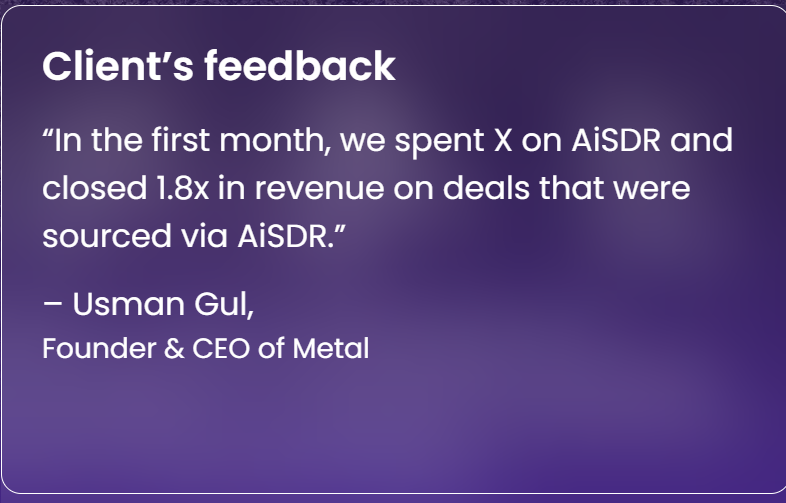
Alt text: AiSDR review by Usman Gul, Metal’s founder and CEO. Source
Another customer reported 4% response rate after only 306 emails, which proves the high quality of AiSDR outreach:
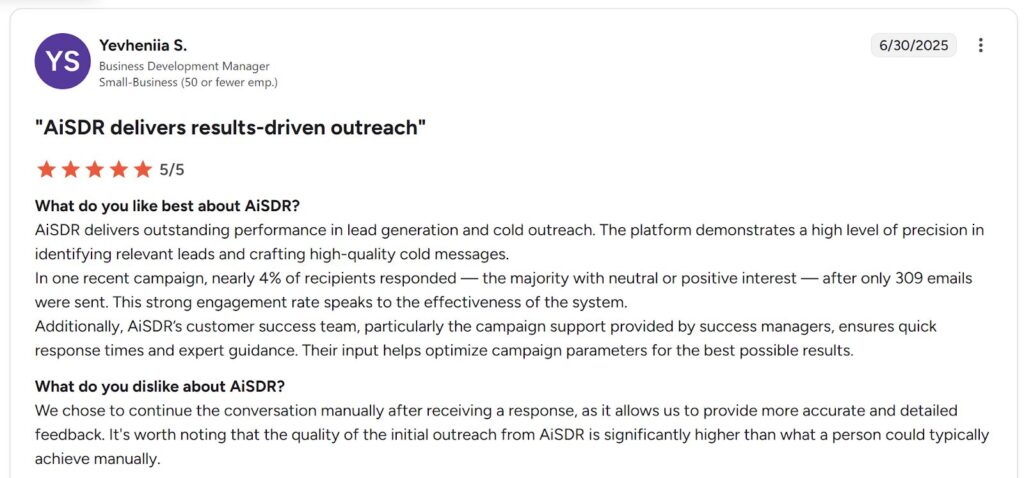
Alt text: AiSDR review by Yevheniia S., business development manager. Source
Users often highlight AiSDR’s ease of use and how much time its autopilot mode saves.
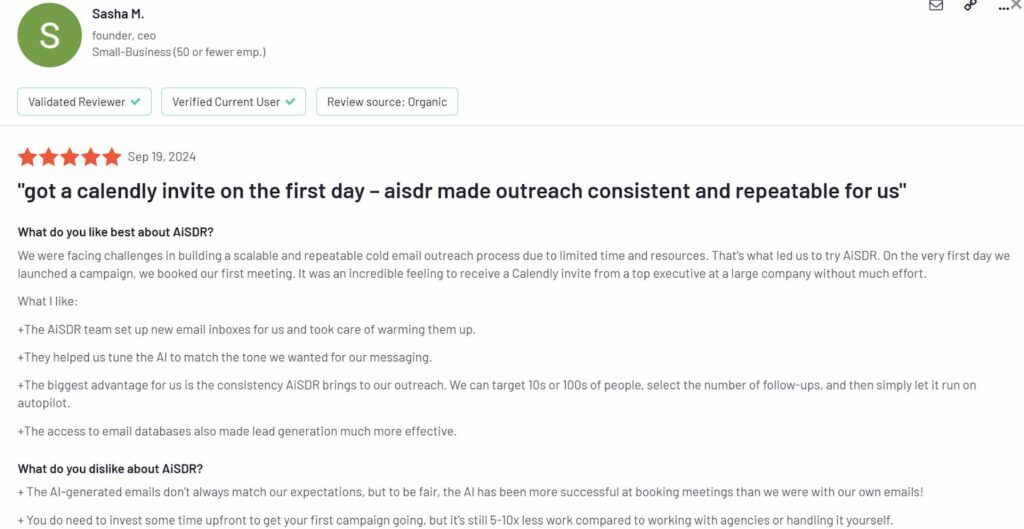
Alt text: AiSDR review by Sasha M., founder and CEO. Source

Alt text: AiSDR review by Harry Raworth, co-founder of Mary Technology. Source
Customers praise AiSDR’s easy onboarding and excellent support, which help them achieve results fast:
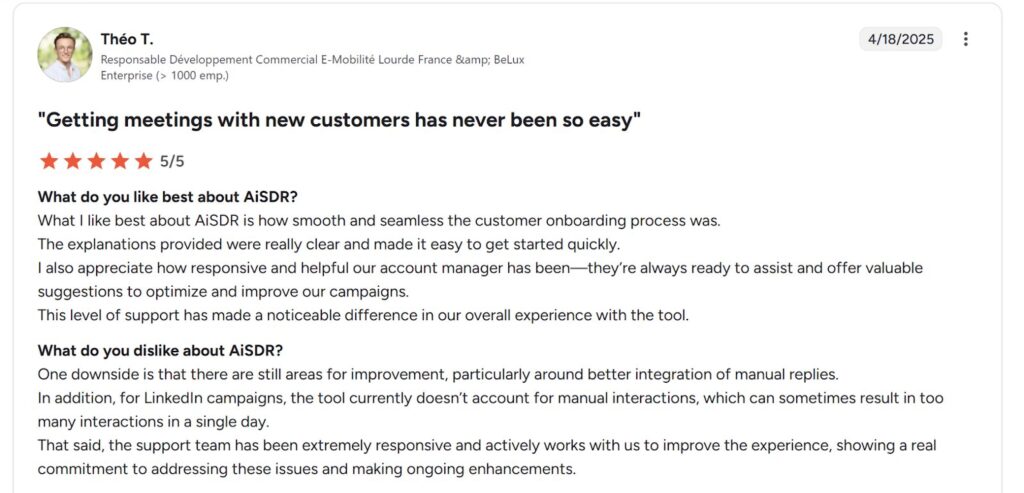
Alt text: AiSDR review by Theo T., Responsable Développement Commercial. Source
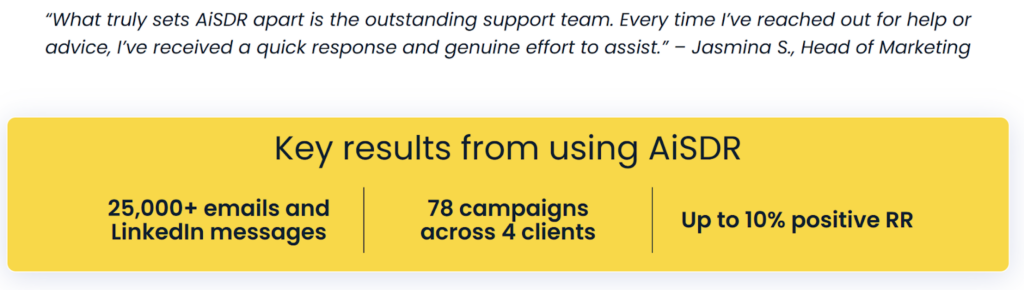
Alt text: AiSDR review by Jasmina S, head of marketing at SDR. Source
This shows how important quality support is for using an AI sales enablement platform at full capacity.
Why AI is essential for sales enablement in 2025
You’ve seen how AI enhances the whole sales process. But why does this matter now?
According to the 2025 State of Sales Enablement Report, 90% of companies have implemented or plan to implement AI this year. AI is no longer optional. It’s becoming a core part of modern enablement strategies.
This shift is driven by the need to meet evolving buyer expectations. Buyers move fast, research independently, and expect instant, personalized answers. Traditional enablement just can’t keep up.
But AI can. It offers guidance, relevant content, and next-step recommendations exactly when reps need them. It reduces the cost of hiring additional SDRs, increases ROI, and turns enablement into a proactive, in-flow assistant that helps meet customer expectations and keeps deals moving.
AI sales enablement is actively transforming sales. Where can it go next?
What’s next for AI sales enablement
AI-powered tools are expected to evolve from simple automation to full autonomy. AI agents will handle more and more outreach and feedback tasks, freeing reps to focus on strategy and relationships. Coaching will become even richer, with multimodal systems providing real-time guidance, not after-the-fact feedback. AI will also connect sales, marketing, and customer success teams with shared insights to boost retention and upsells.
As AI assistance becomes central to daily sales work, leaders of the next wave of enablement will be those who pair intelligence and accountability with transparency and ethical governance.



See which AI tools power sales enablement according to real user feedback
 Summarize with
 ChatGPT
 Claude
 Perplexity
 Grok
Grok 
 Google AI