











How to Reach Small Business Owners (Without Getting Ignored)

Small business owners are hard to reach for a reason: Their inbox is crowded, their calendar is packed, and most cold messages sound the same.
But then can do you reach small business owners?
The answer’s yes. SMB owners do reply when a message is timely, relevant, and connected to a real problem they’re dealing with right now.
Key takeaways
- Relevance beats volume. SMB owners reply when outreach clearly connects to a real problem they’re facing right now.
- Targeting and timing matter most. Firmographics, intent signals, and business triggers dramatically improve reply rates.
- Short, problem-focused messages work best. Emails around 50–90 words are easier for busy owners to read and respond to.
- Use multiple channels. Email, LinkedIn, and calls work best when combined in a simple sequence.
- Follow-ups win replies. A thoughtful 5-touch sequence with new angles and value significantly improves response rates.
Why SMB owners are harder to reach than other buyers
Outreach tactics that work for managers, team leads, or even enterprise buyers often fall flat when the person on the other side actually runs a small business. SMB owners operate and make decisions in a very specific context, and your outbound campaigns have to adapt to that reality.
They wear multiple hats and guard their time aggressively
SMB owners are responsible for sales, operations, hiring, finances, and customer issues, often all in the same day. On average, 80% of small businesses run with staffing shortages of five employees. In many cases, this gap falls directly on the owner.
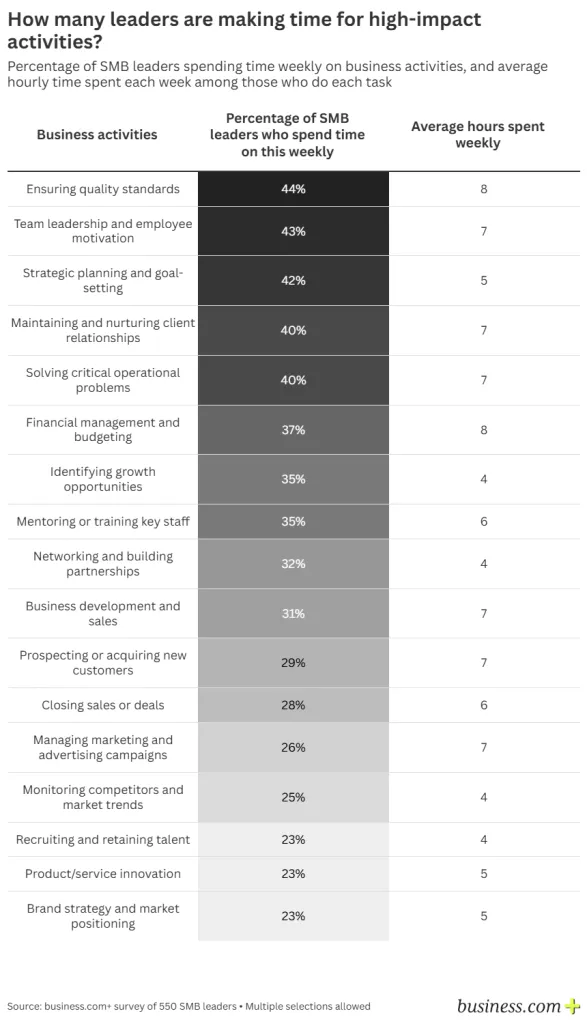
With no buffer of teams, assistants, or approval layers, your message is never “just an email.” For SMB owners, it’s an interruption. If the value isn’t obvious right away, they won’t dig deeper to figure it out. They’ll move on to the work that already matters.
They receive a lot of outbound noise
SMB owners are high-impact decision-makers, which makes them prime targets for sales teams. While the average person might get around 15 cold emails a week, many SMB owners get 50–100+ daily.
At that volume, messages start to blur together. If your email doesn’t catch attention, starting with the subject line, it’s likely to be ignored without a second thought.
They respond only to hyper-relevant, practical value
SMB owners aren’t the easiest audience to connect with, but that doesn’t mean they’re completely unreachable. They respond when a cold email feels clearly useful. In other words, they filter messages through one question:
“Is this immediately relevant to something I care about?”
That’s why broad thought leadership or generic industry updates rarely land. To get attention, your outreach needs to connect to a visible business trigger, like hiring challenges or accounting bottlenecks, and point to a practical outcome, such as time saved or increased profit.
How to identify the right SMB owners to contact
If relevance drives replies, the next logical question is this: How to reach small business owners in a way that makes that relevance possible?
The answer starts with targeting. Before sending any messages, you need to build an accurate list of SMB owners whose current needs match what you offer.
Use firmographic filters
Not every SMB owner operates in the same context. A retail owner faces different challenges than a SaaS founder or a logistics operator. And someone running a five-person team thinks differently from an owner leading a 40-person company.
That’s why firmographic filters come first. Narrow your list by:
- Industry and location
- Company size
- Tech stack
- ARR
- Buyer role
This will help you remove obvious mismatches and focus on SMB owners who are more likely to face the challenges your solution actually solves.
Validate contact data before outreach
Outdated titles, inactive LinkedIn profiles, generic inboxes, or bounced emails can quietly derail your outreach. Even the most relevant, timely message won’t help if it never reaches the right person.
And accuracy matters beyond the contact itself. If you reference the wrong company size or mention something the business no longer does, credibility drops instantly.
That’s why validating your contact data before launching a campaign is essential. While it’s tempting to skip this step, it’s one of the simplest ways to protect your outreach and improve your chances of getting a response from SMB owners.
Look for buyer readiness signals
SMB owners don’t take calls out of curiosity. They respond when something is changing inside the business, and they need to adjust.
Look for buying signals like:
- Hiring pushes
- Product launches
- Expansions into a new market
- Funding announcements
- Leadership changes
At these moments, a business faces new challenges. And that’s when SMB owners are most open to solutions that might ease the pressure.
Instead of saying, “We help SMBs improve operations,” you can say, “Noticed you’re hiring three ops roles. Many owners at this stage struggle with process visibility.”
That context alone can be the difference between silence and a reply.
Use social engagement signals to prioritize in-market owners
SMB owners often signal what’s on their mind through their social activity, especially LinkedIn engagement.
You can spot their current focus by looking at:
- Comments on posts
- Shared articles
- Their own posts
- Interactions with competitors’ content
- Reactions to industry discussions
These actions suggest a topic is already on their radar. They might be looking for a way to meet a specific need, which makes them more open to a relevant solution.
If you prioritize SMB owners who show visible buying intent, your message is more likely to resonate, and you’re far more likely to hear back.
Best channels for reaching SMB owners
Once you’ve clarified who to target, the next part of the answer to how to reach small business owners is choosing the channels they actually pay attention to.
In most cases, that doesn’t mean picking just one. It means combining a few touchpoints into a simple, coordinated outreach flow.
Email remains one of the most reliable channels for lead generation. SMB owners may ignore unknown calls or skip cold connection requests, but they almost always check their inbox. The average open rate for B2B services and SaaS emails is close to 40%.
Still, using email doesn’t guarantee attention. SMB owners scan quickly, so your message needs to respect their time. It should be brief, but meaningful, which means clear context, a relevant outcome, and a simple next step.
LinkedIn can also be a strong channel for reaching SMB owners. It gives you direct access to a person, shows real-time activity, and allows for light-touch engagement before you send a message. In fact, 34% of SMB decision-makers say LinkedIn helped them find new suppliers.
In a multi-channel campaign, LinkedIn works best alongside email. If an owner doesn’t reply to your email, LinkedIn can serve as a second touch. And if they engage with you on LinkedIn first, your email becomes much warmer.
But there’s one catch: LinkedIn only works if the owners on your list are actually active. If they created an account years ago and rarely log in, your message may simply disappear without a response.
Phone & voicemail
Phone outreach may feel old-school, but it can still work for SMBs. Unlike enterprise buyers, small business owners often answer their own phones or at least listen to voicemails themselves.
That said, a generic cold call almost always feels like a disruption. That’s why it’s better to use this channel only if you rely on strong context behind it, ideally triggered by a readiness signal. For example, if the company recently announced funding, a call focused on supporting growth at that stage is far more likely to land than a broad “we help businesses scale” pitch.
Events, groups, and community platforms
Not every conversation needs to start with a cold message. Sometimes the easiest way to reach small business owners is to show up where they’re already active.
That might be industry meetups, founder groups, Slack communities, local business associations, or niche online forums. When you answer questions or share helpful insights, you build trust first. And that makes any future outreach feel much more natural.
How to craft messages SMB owners will actually reply to
Choosing the right channel gets you visibility. But what earns a reply is how you frame the message. Without figuring out the right approach, you’re only halfway to answering how to reach small business owners.
Lead with the problem you’re solving, not your product
SMB owners don’t wake up thinking: “I need a new tool.” They wake up thinking about hiring chaos, tight cash flow, and hours wasted on manual work.
That’s why messages that start with a product introduction like “We provide…” or “Our platform helps…” rarely grab attention. Owners shouldn’t have to figure out whether your solution applies to them. That extra step takes time they simply don’t have.
Instead, lead with the problem they are likely experiencing. For example, if you’re in HR SaaS, you might say, “Noticed you recently hired five people. Many owners at this stage struggle with process visibility.”
When an owner recognizes their situation right away, the message feels instantly relevant. Just don’t over-explain it. One or two sharp sentences are enough.
Keep messages 50-90 words
Industry studies reviewed by HubSpot suggest that emails between 50 and 200 words or under about 20 lines tend to get the most replies. But those averages apply to a wide audience. For SMB outreach, it’s usually smarter to stay closer to the lower end and aim for 50-90 words.
If a message looks long, it feels like work. Short messages signal clarity and respect for time. At a glance, SMB owners can see it won’t take much effort to read, which increases the chances they go through the whole thing.
That said, short doesn’t mean vague. Even in 50-90 words, you can still include the essentials: a clear problem reference, a bit of context or a trigger, an implied outcome, and a simple CTA.
Use pattern interrupts to stand out
SMB owners move quickly through their inbox. If your message looks like every other cold email, it’s easy to ignore. A small pattern interrupt can help you break that pattern.
Depending on your offer and audience, this could be something grounded in insight or context, for example:
- “Most owners scaling past 20 employees start feeling strain in their ops.”
- “Many founders at this stage hit the same bottleneck.”
- “Quick observation after seeing your recent expansion.”
Openings like these signal awareness and relevance. In a crowded inbox, that alone can set you apart.
Make the CTA a low-effort question
If the ask feels like a commitment, SMB owners will likely skip it. Even a question like “Can we schedule a 30-minute demo?” might carry too much weight because it requires opening a calendar, setting aside time, and making a decision.
At this point, your goal is simply to start a conversation. Once that’s in motion, you can move forward. So ask something that can be answered in seconds, like “Should I send a short overview?” or “Is this relevant right now?”
Follow-up strategy for SMB outreach
Most replies don’t come from the first message. Even relevant, well-timed outreach can get buried under daily priorities. That’s why follow-ups matter. The key is doing them the right way, which usually means staying persistent without becoming annoying.
Use a simple 5-touch follow-up sequence
Most sales reps send 2-3 follow-ups. But that number may be too low if you want to reach small business owners. In most cases, it’s reasonable to go up to five, following a simple structure:
- Initial message: Clear problem, clear context, low-effort CTA
- Light follow-up: A brief check-in that stays respectful and concise
- Add value: Share a relevant insight, example, or observation
- Different angle: Reframe the problem or highlight another related pain point
- Soft close: Offer to reconnect later or ask if it makes sense to pause for now
Timing matters, too. Leave a few days between early follow-ups, and give more space before the later ones so the outreach feels steady, not aggressive.
Change angles with each touch
A common follow-up mistake is repeating the same message. It just adds noise instead of helping you reach small business owners. In a five-touch sequence, each message should shift the angle slightly. For instance, if one focused on the potential outcome, the next might share a short example.
When you change angles, you give SMB owners a clearer picture of what’s possible, build trust, and make your outreach feel grounded in real expertise.
Ensure unique value with each message
Changing the angle is important. But just as important is making sure each follow-up introduces a new piece of value. That could mean highlighting a different benefit, such as leading with growth and following up with cost savings, or even pointing out the cost of inaction.
The goal is to give SMB owners a fresh reason to engage with each touch. Sometimes, it’s that third or fourth message that finally clicks and earns a reply.
Pause or re-open the conversation at the right moment
No outreach sequence should run forever. Pause when you’ve completed your planned touches and received no response, or when the timing clearly isn’t right. A simple “Happy to reconnect later this year” keeps the door open without pressure.
Re-open the conversation when something changes. That could be a new hiring push, funding announcement, leadership shift, or visible social engagement. A fresh trigger gives you a natural reason to reach out again.
How AiSDR helps you reach and engage SMB owners automatically
If it feels like the answer to how to reach small business owners involves a lot of work, you’re not wrong. The good news is that AiSDR can automate the heavy lifting.
Finds and validates SMB owner contacts automatically
With AiSDR, you don’t have to spend hours building prospect lists from scratch. The platform taps into a database of over 700 million contacts and uses LinkedIn engagement, website activity, and live AI searches to surface relevant prospects.
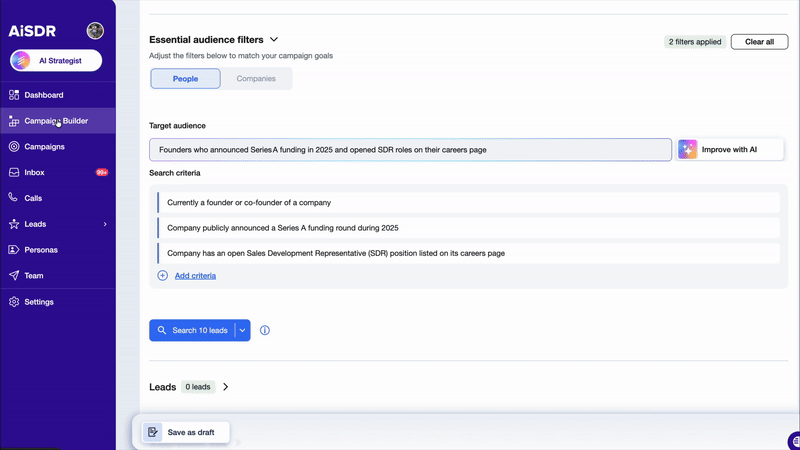
But AiSDR doesn’t just dump contacts into a campaign.
AiSDR first filters them against your ideal customer profile, then enriches and validates every record before outreach begins. As a result, you get a clean, targeted list of SMB owners who actually match your criteria, without the manual work.
Times outreach using intent signals
AiSDR doesn’t just automate lead generation by finding the right SMB owners. It also ensures you reach them when the timing actually makes sense.
Instead of relying solely on a fixed schedule, AiSDR monitors high-intent behavior, such as LinkedIn engagement, visits to key pages on your site like pricing or demo sections, funding events, hiring activity, and more.
When such signals appear, AiSDR flags those leads as more likely to be in-market and routes them into your outreach sequence. That way, your message arrives while interest is still fresh and relevant.
Writes concise, relevant messages built for busy owners
AiSDR creates outreach that actually sounds human and relevant to each SMB owner. Here’s what that looks like in practice:
- You define your voice and persona. The platform uses that input to generate messages that align with your tone instead of sounding like a generic template.
- AiSDR finds publicly available lead data on demand. This includes LinkedIn bios, recent activity, and behavioral signals.
- AiSDR builds an enriched profile for each lead. This means every message is grounded in real context, not just your standard pitch.
- Follow-ups adapt to behavior. If someone engages, the messaging shifts. If they don’t, the cadence adjusts. You can schedule LinkedIn messages to trigger after N days once a connection request is accepted.
In short, AiSDR runs the entire outreach sequence for you. You don’t have to write every email, manage every follow-up, or track every signal yourself.



Get practical outreach insights to engage small business owners and earn replies
 Summarize with
 ChatGPT
 Claude
 Perplexity
 Grok
Grok 
 Google AI