






3 Expert Insights About the Power of Words (November 2024)

Words are powerful tools. Especially in sales emails.
The right words will grab your leads’ attention and get them to take the action you want. The wrong ones will make you sound pushy, dull, desperate, and even dastardly.
Knowing how to choose your words wisely will make all the difference in building positive dialogues with prospects.
Here are 3 expert insights about how small changes to your writing can lead to big sales results.
The power of “You”
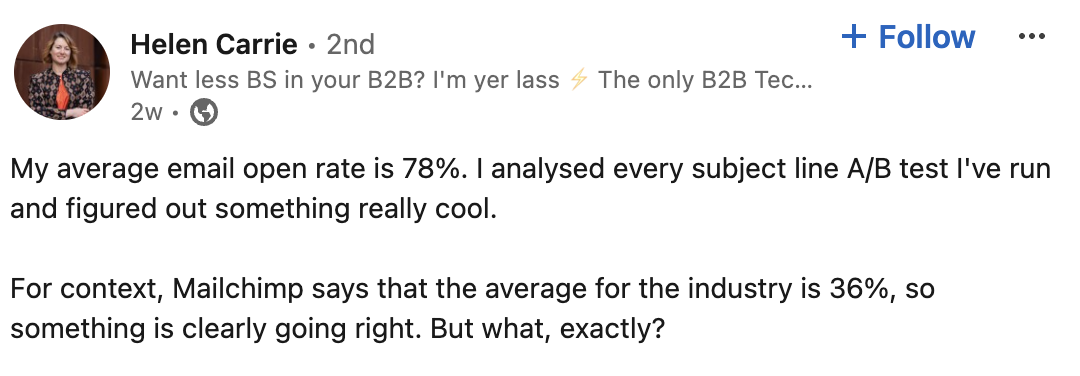
After A/B testing several subject lines, Helen Carrie found that using the word “you” within the first 4 words grew open rates over 2x compared to no “you”.
And so long as the subject line was still user-centric, such emails continued to outperform emails that didn’t have a user-focus.
Some examples include:
- “Here’s what you’ll get”
- “Get your advance peek”
- “Are you curious…”
And as a bonus insight, ban the word “I” from your subject lines.
More on the topic:
How you can apply this
Applying this to your sales emails is fairly straightforward:
- Prioritize “You” over “I”. Users don’t usually care about what you’ve done. What they care about is how you can help them solve their problem. Only once you’ve reliably solved their problem will they give you the bandwidth to use a few “I”-centric messages (within reason!).
- Personalize from the subject line. A lot of people focus on personalization within the main email body, forgetting that people need to open the email first. The best way to get that open? A short, user-focused subject line.
- Make the email about their needs. Subject lines are important for getting that precious open. But for real results, don’t forget to be clear and explicit in the main email about how you’ll solve their pain. Even if the subject line is well-personalized, if the email body loses its user-centricity, people will stop reading.
- Add this as a rule to your AI persona. If you’re using AI to create and send sales emails, you should be able to quickly reconfigure the persona to follow this rule and eliminate any undesirable words.
Convince or understand?
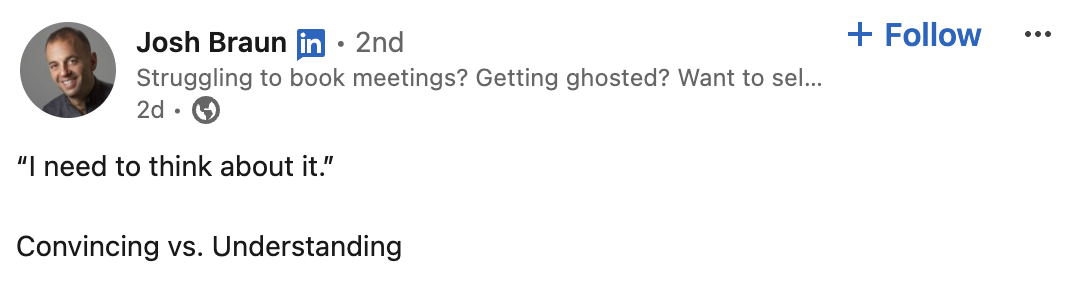
According to Josh Braun, this is what each one means:
- Convincing = “You need information, not time, to make a decision. I’ll give you the information you need.”
- Understanding = “It seems you have some concerns or you’re unsure about…”
People become resistant if you try to convince them. But if they feel understood, they’re more likely to open up and engage in a meaningful conversation.
How you can apply this
Here are a few ways you can apply this insight to sales emails:
- Avoid pushy language. Don’t tell your leads what they need. Instead, highlight that you’re there ready and willing to help. Ask a question and keep your tone collaborative, not forceful.
- Acknowledge their situation or concern. While direct, active voice is advised in most sales emails, this is a situation where an impersonal construction (e.g. It seems…, It sounds…) is preferable. If you dislike impersonals, try using a question with a softer tone. Acknowledging their issue shows that you’re listening and you get them, which builds trust.
Beware of filler and weasel words
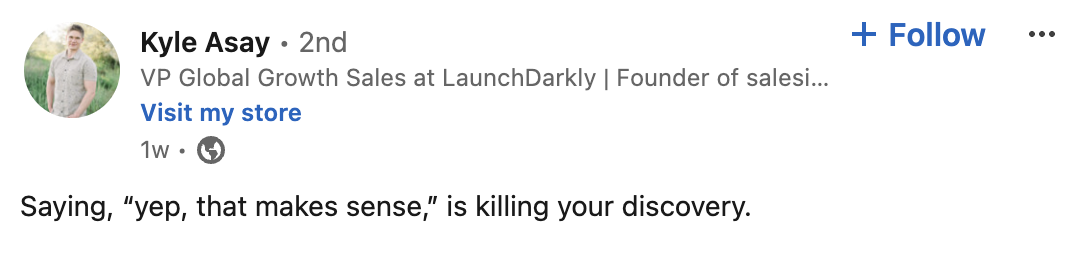
In Kyle Asay’s experience, whenever a sales rep says, “That makes sense”, 9 times out of 10 it didn’t make sense.
Instead of trying to push through and understand the buyer, the rep found it more comfortable to move on than admit confusion.
While it’s convenient for the rep to just move on, it’s offputting to buyers. And when buyers aren’t satisfied or feel uncomfortable, they won’t buy (which is the entire purpose of sales, right?).
Emails that hold attention 📖
How you can apply this
While Kyle’s story deals with phone calls, it’s a lesson that can be easily applied to sales emails:
- Although “That makes sense” is arguably less common in sales emails, you’ll find many equivalents, such as “gotcha”, “got it”, or “understood”. These are just as ambiguous and don’t make it clear that you understood. If you’re tempted to use one of these terms, try:
- “I’m not sure I follow. Can you explain…” (if you don’t understand)
- “In other words, you mean…” (if you want to confirm your understanding)
- Ask a question (questions are always good for digging deeper)
- Phrases like “That makes sense” are filler or weasel words that don’t add extra value. If anything, they obscure the situation. In sales emails, it’s better to be clear and direct without any equivocation or beating around the bush. When you’re straightforward, people trust you and become more willing to work with you. Try to eliminate fillers and weasels from your writing.
Subscribe to our Newsletter



Get 3 expert insights into how to improve your sales emails
 Summarize with
 ChatGPT
 Claude
 Perplexity
 Grok
Grok 
 Google AI