






Email Framework #5: Yurii Veremchuk

Bio
Yurii Veremchuk is a Top IT Sales Voice on LinkedIn who’s spent the last 9 years at Woodpecker.co, advancing from inbound sales rep to Head of Business Growth (Outbound Sales). He’s also the co-founder of Swipely, and a product advisor for Winn.AI and Twain.
Predicting the doom of cold email is a trendy topic for 2025. But here’s the catch – people have been making this claim since the early days of the Covid era (and even earlier!).
Sure, the difficulty level of cold email is definitely higher, but it’s not impossible. With the right email framework, sending and warm-up infrastructure, and other best practices, you can still book meetings using cold outreach.
Frameworks help you cut through the noise and stay structured. But before we get to Yurii Veremchuk’s approach directly, here’s a quick look at why it matters at all.
Benefits and pitfalls of using email frameworks
Email frameworks help you structure your message fast, stay consistent across your team, and avoid blank-page syndrome.
That said, not every framework fits every campaign. Here’s what to keep in mind:
Why frameworks help:
- Save time and reduce overthinking — you’re not starting from zero
- Keep messaging consistent across SDRs and sequences
- Make it easier to test, tweak, and scale what works
What to watch for:
- Too much structure can sound robotic or template-y
- Frameworks can hide weak research or lazy targeting
- Overused formats = inbox fatigue (you’re not the only one using PAS this week)
The moment you start sounding like everyone else in your outreach, it’s time to personalize or switch things up. That’s where the Yurii Veremchuk framework is worth a look.
Core elements of the Yurii Veremchuk framework
The first rule of any Yurii Veremchuk email is to not start with “Hi, My name is…”
Unless you’re the real slim shady (or another A-list celebrity), people won’t care. If anything, they’ll trash the email in seconds.
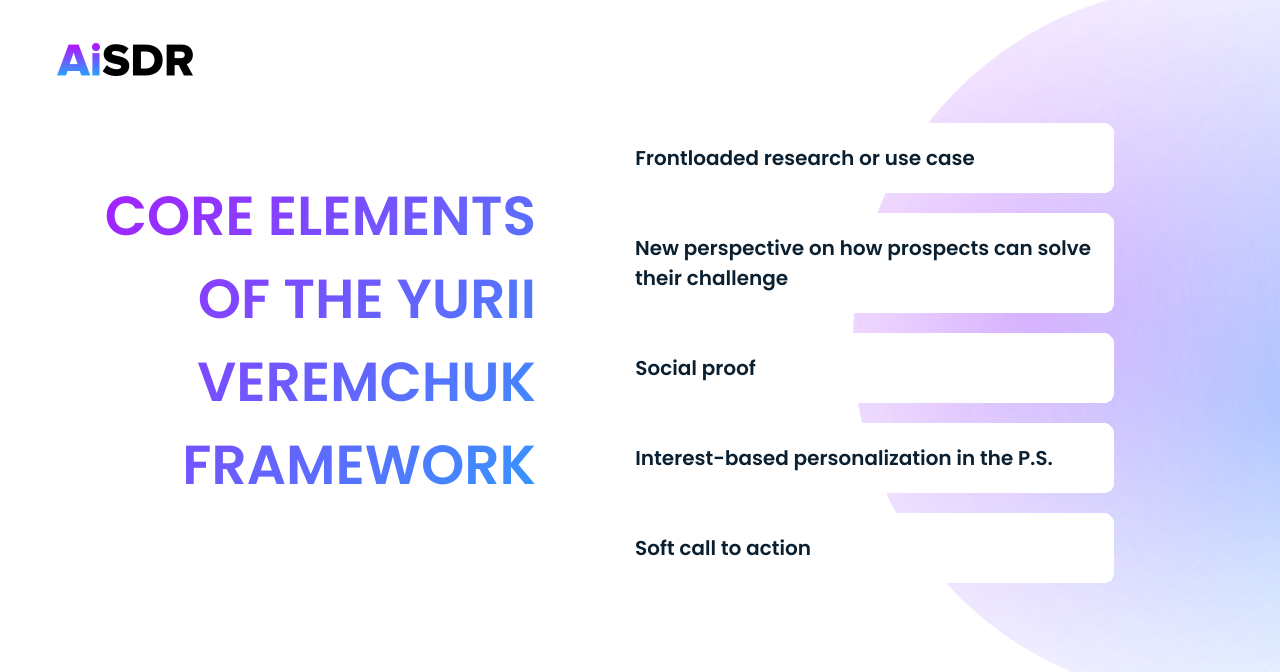
Your emails should get to the point asap as your first line is your greatest real estate. Emails that follow Yurii Veremchuk’s framework typically have:
- Frontloaded research or use case – High-level roles prefer company-based personalization and research. Use intent data and signals strategically for this.
- New perspective on how prospects can solve their challenge – Try to avoid your first idea. Chances are it’s been done before, so look for a new perspective, show the benefit gained, and add the cost of inaction.
- Social proof – Provide evidence of how a company solved the main challenge. For best results, the company should be similarly sized and in a similar industry to show relevance. If you’re targeting start-ups, don’t talk about how Apple solved N problem (and vice versa).
- Interest-based personalization in the P.S. – Yurii’s approach assumes that people don’t care if you know where they went to college or what they recently posted on LinkedIn. That’s why any person-level tailoring should go into the P.S. and not the main body.
- Soft call to action – Don’t push for a meeting in the CTA. Instead, look for content or use a sentence that invites the prospect to continue the conversation without applying pressure.
If you want your emails to get a response, you’ll need to “beat the status quo”. This means proving to the prospect that it’s in their best interest to write back.
Prospects will also respond if you can show them something new (which is why you try to share a new perspective) or demonstrate you know how to solve their pain.
Book more, stress less with AiSDR
How Veremchuk’s framework compares to other frameworks
We’re discussing and suggesting that you try the Yurii Veremchuk framework because it’s sharp, relevant, and built for outbound that actually works. But to stay objective, it’s worth comparing it to other well-known frameworks. This gives you a clearer view of when to use it, how it stacks up, and what trade-offs come with each approach.
AIDA: Emotional build, delayed value
AIDA (Attention–Interest–Desire–Action) is a classic. It starts wide with a hook, builds curiosity, stokes desire, and ends in a CTA. It’s great for storytelling or nurturing flows.
But in cold outreach, AIDA can be too slow. Veremchuk’s structure skips straight to relevance. He trades drama for business logic: “Here’s the situation → Here’s a better way → Here’s proof.”
Where AIDA may lag a little bit, Veremchuk’s seems to land fast.
PAS: Stirring pain, driving action
PAS (Problem–Agitate–Solution) thrives on emotional urgency. It starts by naming a pain point, intensifies it, and then offers relief.
Veremchuk takes a calmer path. Instead of agitating pain, he reframes the problem with a new perspective and quantifies the cost of inaction. Less drama, more business case.
Both aim to move the prospect, but PAS pushes where Veremchuk invites.
4-T: Quick logic, no filler
4-T stands for Target, Trigger, Third-party, Tactic. It’s a framework designed to hit hard and early, with one sentence each for who you’re targeting, why now, who else has done this, and what you suggest.
It’s fast. It’s efficient. Great when attention spans are short (which is always).
Veremchuk’s framework follows a similar logic — relevance, insight, proof, soft ask — but adds more nuance. It’s less formulaic and allows for a bit more context and voice.
4-T works when you have signals but no time. Veremchuk works when you have signals and want a response.
Justin Michael Method: Systems first, message second
The Justin Michael Method is built around scalability. It uses tech stacks, sequencing logic, and AI tools to send messages at volume, with personalization layered in programmatically.
Veremchuk flips the formula. He starts with manual research and relevance, then writes the message. No templates, no heavy automation. It’s slower, but more human.
If you’re optimizing for throughput, JMM wins. If you’re chasing meaningful replies in niche markets, Veremchuk may be the better bet.
Each email framework does something well. The key is matching the tool to the job.
Here’s a quick side-by-side to help you choose:
| Framework | What it focuses on | Tone & style | Strengths | Where it falls short |
| Veremchuk | Relevance, insight, proof, soft CTA | Rational, low-pressure | Human, personalized, easy to adapt | Slower, needs research upfront |
| AIDA | Emotional flow from hook to action | Narrative, persuasive | Great for storytelling, nurturing | Too slow for cold outreach |
| PAS | Pain-focused persuasion | Urgent, high-stakes | Good for quick attention grabs | Can feel pushy if not handled carefully |
| 4-T | One-liners: target, trigger, third-party proof, and tactic | Blunt, efficient | Fast, great for short attention spans | Can feel robotic or template-like |
| Justin Michael Method | Automation-first scaling with personalization logic | Engineered, optimized | High volume, data-driven personalization | Sacrifices tone and depth at smaller scales |
How to use the Yurii Veremchuk framework in sales outreach
Yurii’s approach is heavy on the prospecting and research. In fact, he believes you’ll need to dedicate 80% of your time to these two tasks.
On the bright side, the remaining 20% is simply writing up what you found in an email that follows the framework’s structure (more on that below).
But before you hit “Send” on your new email, you need to ask yourself these questions:
- Does your email include…
- Company-level personalization (e.g. use case, intent)?
- New perspective?
- Cost of inaction?
- Are you using a hard or soft CTA?
- Does your email explain “Why” you’re writing?
When it comes to continuing the conversation, Yurii advocates pushing the conversation from emails to text messages or WhatsApp. There are a few reasons why:
- Text/WhatsApp is usually less crowded than a person’s email or LinkedIn inbox
- People are usually more open to sharing information about their actual buying process over text
- Text makes it easier to focus the conversation on understanding what decision-makers want
Of course, this is if the prospect agrees to be contacted via text. If they want to keep the conversation on email, it’s best to acquiesce to their wish.
Adapting the framework to your audience
The Veremchuk framework is flexible by design, so you can tailor it based on who you’re writing to, what they care about, and where they are in the buying process.
You wouldn’t send the same message to
- A fintech founder and an operations lead
- A Series A startup and a Fortune 500
- Someone with budget authority and someone still gathering info
Here’s how to adapt it smartly:
- Social proof should reflect their world. Selling to a startup? Mention other early-stage wins. Talking to a CISO at an enterprise? Use a security use case from a recognizable peer.
- Tone matters. Founders often respond to confident, casual language. Senior execs expect you to be sharp and direct.
- CTA style can make or break the reply. Use open-ended questions with early-stage prospects. Be more specific when outreach follows clear buying signals.
The bones of the message stay the same. The tone, proof, and CTA flex depending on the reader. That’s what makes it work.
Using AI to scale frameworks like Veremchuk’s
If the Veremchuk framework is delivering results, the next step is scale. But how do you run it across dozens of leads without sounding scripted?
AI-powered platforms, like AiSDR, can help in this case. It takes the logic of the framework and applies it across your outbound, using real-time data.
Here’s how it works:
- Define your ICP and feed in context (firmographics, buyer intent, tech stack)
- Build a persona using the Veremchuk framework.
- AiSDR builds well-structured emails and LinkedIn messages with multimedia that follow the framework: intro, insight, social proof, CTA, all tailored to each contact.
This framework-based approach frees your team from rewriting the same message 30 times and lets them focus on what matters, like real conversations. On top of that, AiSDR pulls intent signals and researches helpful data for each prospect you can act on, so every message hits home and makes sense.
Yurii Veremchuk framework example
Here’s an example of a possible email you might create using the Yurii Veremchuk framework.
You can also find the Yurii Veremchuk framework in AiSDR’s framework library. To use this framework, just tell AiSDR who your ideal customer is, and AiSDR will handle all the prospecting, research, and email writing and personalization for you.
General framework
The Yurii Veremchuk framework doesn’t use a standard email template. Instead, emails follow a general structure.
Here is an example of this structure.
Hey [name],
[Sentence #1: Company-level personalization or use case featuring intent data]
[Sentence #2: A new perspective on how a prospect can solve their problem]
[Sentence #3: Social proof of how a similar company solved the same problem]
[Sentence #4: Cost of inaction]
[Soft CTA]
Thanks,
[sender name]
(Optional) [P.S. Interest-based personalization]
Example email
Following the Yurii Veremchuk framework structure, here is a possible email.
Hey [name],
I saw [company] is growing quickly and starting to build out its sales team, but that will take at least ~3 months minimum. Templates were the easy way to stay afloat with high demand, but now they’re more trouble than they’re worth – they get your accounts blocked, and people don’t write back.
Metal used AI to scale its outreach, scoring 1.8x more revenue along the way. So here’s the hard question: Without a fast fix, how many deals are leaking from your pipeline?
Would you be up for a quick chat?
Thanks,
Yurii
P.S. Saw you just got back from Greece. Loved it there. Rhodes is my go-to vacation spot.
Measuring framework performance (KPIs)
A great email framework still needs proof that it’s working. The first thing you should count on in terms of performance tracking is KPI.
Start with these benchmarks.
Reply rate
- What it shows: Are your emails prompting any response at all?
- How to measure: Track total replies divided by total delivered emails. In AiSDR, this is shown in the campaign summary.
- What to tweak: First line, CTA, and how tightly the message matches their ICP and use case.
Positive reply rate
- What it shows: Are people showing interest or just opting out?
- How to measure: AiSDR tags positive replies automatically (e.g., “Interested,” “Send more info”), allowing you to filter by intent.
- What to tweak: Social proof and insight: Are you showing clear value for companies like theirs?
Meeting booked rate
- What it shows: Final outcome: Is your messaging driving real sales conversations?
- How to measure: Total meetings booked divided by total emails sent. Use your CRM or sync data from AiSDR.
- What to tweak: Follow-up timing, cadence, and CTA specificity.
Open rate (optional)
- What it shows: Whether your subject line and preview text spark enough interest to get the email opened.
- How to track: Tracking opens can impact deliverability, so by default we recommend not enabling it.
- What’s normal: Most cold campaigns fall between 15 and 25%. If you’re above 25%, that’s strong. If below 15%, maybe it’s time to check your subject lines or sender reputation.
- What to tweak: If you decide to enable this tracking, test subject line clarity vs. curiosity, add relevant signals (e.g., recent hire, funding), and avoid spammy language.
Review weekly. Spot the patterns. If something’s falling flat, adjust the angle, CTA, or proof point. Frameworks aren’t fixed assets since they also evolve. The ones that keep winning are the ones you keep sharpening.
Have a conversation with our AI




Learn about the Yurii Veremchuk email framework and how to use it
 Summarize with
 ChatGPT
 Claude
 Perplexity
 Grok
Grok 
 Google AI