











How Long Should a Cold Email Be? Practical Guide for Sales Teams

Most sales teams struggle to find the “perfect” word count for cold emails. Long messages get ignored as “walls of text,” while tiny ones feel like low-effort spam. Every wasted word is a lost opportunity to book a meeting.
Reps tweak, cut, and expand messages, trying to land on something that feels “just right.”
The truth is there’s no single “perfect” word count to how long a cold email should be. But that doesn’t mean teams are doomed to overthink it forever.
Why cold email length matters
When building cold email campaigns, length is one piece of the puzzle that teams have to figure out. The others are the hook, content, and ask.
While it’s arguably the least important of the four, it can be the difference between an email getting read or sent straight to the bin.
Prospects skim on mobile
About 41% of email views happen on mobile, which is nearly half of any audience you might target.
When people read messages on their phones, it’s usually in short bursts, such as between meetings or during a commute. In those moments, they’re scanning for the main point, not reading every word.
With this kind of reading behavior, long paragraphs work against you. And they’re surprisingly easy to miss during campaign creation. What looks like 5 lines on a laptop can turn into 10 on a phone.
Prospects won’t make the effort to read your email. They’ll simply skip it.
Overly long emails bury the actual ask
Even on a desktop, cold emails are rarely read line by line. Most people receive around 15 of them each week (roughly 3 per business day).
This number is much higher for executives. When they open an email, they’re trying to quickly understand what you want from them.
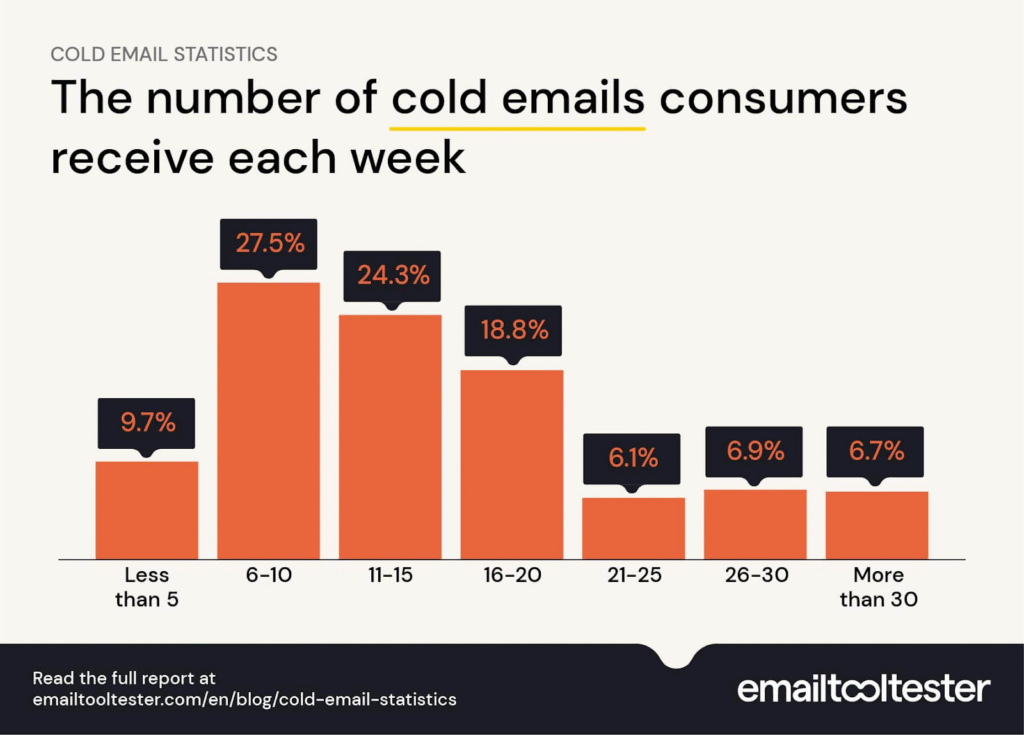
If the ask is pushed too far down or buried under background, most prospects won’t stick around to find it. They’ll move on. And on your end, that means no reply, no meeting booked, and no next step at all.
Very short emails can feel thin or low effort
At this point, it might seem like the safest answer to “How long should a cold email be?” is as short as possible.
But that’s not quite right.
While there are cases where one or two lines can work (we’ll get to those later), ultra-short emails struggle to get responses too.
A cold email is still an interruption. When it lands in an inbox, the natural question is: Why is this worth my time?
Very short emails rarely leave room for that explanation. When this context is missing, the email can feel rushed, lazy, or mass-sent, and most recipients decide not to engage with it.
What the data says about ideal cold email length
If long emails are easy to skim past, and very short ones often don’t explain enough to earn attention, how long should a cold email be?
That’s where data adds some clarity.
The typical sweet spot
To get a clearer picture of ideal sales email length, HubSpot reviewed several large-scale studies.
One analysis of more than 40 million emails found that messages in the 50-200 word range got the most replies, at roughly 48-51%. This range seems to be the sweet spot where emails are long enough to be clear, but still short and easy enough to scan.
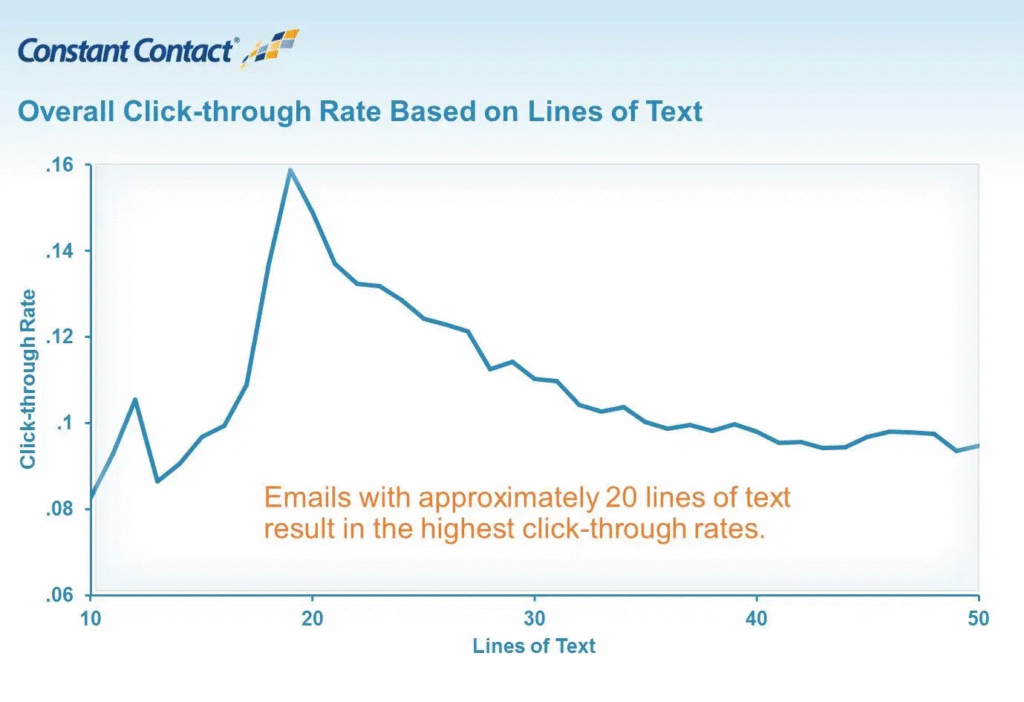
More recent data from Constant Contact, based on over 2 million customers, points in the same direction. Their research showed that emails with around 20 lines of text (which is often under 200 words) drove the most clicks.
When ultra-short emails can still work
As the studies above show, emails tend to perform worse when they get too short. One or two lines usually aren’t enough to explain why a message matters.
But ultra-short emails can still work, but it’s a high-risk, high-reward tactic. The Justin Michael Method is one good example, leveraging its hyper-shortness as a pattern interrupt.
When the recipient already has context, there’s less need to explain the “why.” Other cases where short emails are likely to get responses are when a prospect has:
- Visited your website
- Interacted with your LinkedIn content
- Knows your brand (and you know they do) already
- Engaged with something related to your offer recently
In these cases, brevity can feel efficient rather than thin.
When it’s okay to go longer
Some email studies suggest people spend about 13 seconds reading an email on a desktop and under 10 seconds on mobile. That’s not much time, which further underscores why long emails usually don’t land well.
Still, there are situations where adding a few more words makes sense:
- The offer needs explanation: If what you’re selling isn’t obvious, such as a multi-step solution or a category-creating product, extra context can help prospects understand whether it’s relevant.
- You’re sharing a strong insight: If you’re introducing a new angle on a problem or highlighting something the prospect may not have considered, a slightly longer email with clear, evidence-based points can help build trust.
- There’s already some warm context: If the email isn’t truly cold, such as from a referral or past interaction, you’ve already earned more room to explain.
You’ll definitely need to nail the look and reason for reaching out if you want to send longer emails.
How to structure a cold email within the right word count
Knowing roughly how long a cold email should be is one thing. Writing a clear, effective email that actually fits into that range is another.
Here are a few simple rules of thumb to help bridge that gap.
Keep the subject line to 3-5 words and outcome-focused
The subject line has one job: Get the email opened.
Short subject lines between three to five words are easier to scan and far less likely to be cut off, especially on mobile.
Making them outcome-focused matters just as much. A good subject line quickly signals why the email is worth opening, like hinting at a clear improvement or result, e.g. “Automate follow-ups,” “Faster quote reviews,” or “Cut sales handoffs.”
Use a 3-part body: context → value → clear ask
This 3-part structure gives your email a natural flow that matches how people actually read. As they scan a cold email, they’re asking three questions:
- Why am I getting this? – Open with one or two lines of context. Explain who you are, why you’re reaching out, and why this person, right now. This helps the email feel intentional rather than random.
- Why should I care? – Highlight the value. Focus on the outcome you help with, such as saving time, reducing effort, or improving results. Briefly hint at how you do it, whether it’s through automation or a better workflow.
- What do you want me to do? – Close with a clear, obvious ask. Keep it simple and low-friction, like suggesting a short conversation to see if it’s worth going further.
This structure helps you stay within the right word count while making emails clear and easy to follow.
You can experiment with different email frameworks to make the body more varied.
Make it skimmable with short paragraphs and line breaks
Prospects often decide whether to engage before reading a single word, based on how the email looks on the screen.
Your job is to make the message look easy to read:
- Keeping paragraphs to one or two lines max (no walls of text, especially at the top of the email)
- Sticking to one idea per paragraph
- Using line breaks to separate ideas and guide the eye
- Making sure the core point and the ask are easy to spot
When an email feels light and organized, prospects are far more likely to actually read it.
Adapting length to different email types
While there is a generally preferred length, different types of cold emails serve different purposes. That means they need different levels of detail, and the word count should adapt to the use case.
First-touch cold emails
For first-touch cold emails, the sweet spot of about 50-200 words tends to work best. This length gives you enough space to explain why you’re reaching out and why it’s relevant, without asking for more attention than a cold reader is willing to give.
Using the context-value-clear ask structure helps keep that balance. Go longer, and the email starts to feel heavy. Go shorter, and there’s often not enough context to justify the interruption.
Follow-up emails
Sales reps usually send two or three follow-ups, which raises a natural question: How long should a cold email be when it’s not the first message?
A follow-up email doesn’t begin from zero. Even if there was no reply, you’ve already introduced yourself, shared the context, and made an initial ask. At this point, the goal is just to resurface the message. Repeating the full pitch would feel redundant.
In practice, 30-75 words work well for most follow-ups. For simple nudges or check-ins, 15-30 words are often enough.
Breakup emails and re-engagement messages
Breakup emails aim to close the loop, while re-engagement messages try to reopen it. In both cases, the context is already there, and attention is very limited.
That’s why these emails work best when they’re short. You’re not explaining the offer again or adding new details. You only need to provide enough context for the message to make sense and not feel abrupt. Usually, a 75-125 word range is enough for that.
Debunking common myths about cold email length
The web is full of advice about the length of cold emails. Some of it doesn’t work at all. Some of it works only in very specific situations, but gets passed around as a universal rule. And most of it ignores context.
“Shorter is always better” isn’t always true
Brevity can win in some cases, like follow-up messages, re-engagement emails, or when the prospect already has context. But in most cold emails, being too short leaves out the explanation needed to give the reader a reason to care.
There are also situations where going longer makes sense, such as when the offer is complex. Treating “short” as a universal rule, without considering the prospect, the offer, or the email type, usually does more harm than good.
Adding more value doesn’t mean adding more words
Many reps think they can only add value to a cold email by making it longer. That’s not quite true. Value comes from relevance and clarity, not word count.
Instead of adding more words, focus on adding more specifics. A well-placed insight or a clearly stated outcome goes a long way.
You don’t need to explain everything. The goal is to say the right thing, in the amount of space the situation actually calls for.
One universal word count doesn’t exist
Email benchmarks are useful, but they’re only averages. Different segments read differently. A hands-on operator may prefer a shorter, more direct message. An executive evaluating a complex enterprise solution may need more detail to reduce uncertainty.
That’s why it’s best to define an optimal length based on how your own audience responds, then adjust it over time based on performance.
How AiSDR helps your team send emails that are the right length and message
There’s no one-size-fits-all answer to how long a cold email should be. Every message needs a slightly different approach, and that’s exactly where AiSDR helps.
Generating concise drafts based on live prospect research
Length is never the goal on its own. Relevance, clarity, and replies are.
AiSDR builds each email using live prospect data and intent signals: recent LinkedIn activity, company news, behavior across channels, and role-specific insights.
The result is concise, highly relevant messages that are tailored to each prospect’s situation and are likely to resonate. That keeps emails the right length, without cutting out what matters.
Adapting length to touchpoint type and channel
Different channels and touchpoints call for different lengths. A first-touch email, a follow-up, and a re-engagement message don’t need the same amount of detail. And what works in email doesn’t always work on LinkedIn, and vice versa.
AiSDR knows where each message sits in an outreach sequence and which channel it’s going through, then adjusts content and structure automatically. This saves teams from guessing how long a cold email should be or rewriting everything from scratch.
Optimizing through data-backed experimentation
AiSDR turns sales copy into a science rather than a guessing game. Instead of a “set and forget” approach, AiSDR provides you with the visibility and infrastructure needed for constant iteration.
By tracking replies and meetings across every campaign, you can see exactly which messaging angles and frameworks are performing. This makes your copy a living part of your GTM strategy.



What’s the ideal length for cold emails? Find out in this blog
 Summarize with
 ChatGPT
 Claude
 Perplexity
 Grok
Grok 
 Google AI