










Essential Guide to Effective Follow-ups

Most follow-up emails crash and burn because they’re either too vague, pop up after you’ve lost interest, or come across as way too pushy.
The ones that work? They keep the conversation alive without making you want to hit “delete.”
Here’s a close look at how you can write follow-ups that score replies and don’t get ignored.
Why most follow-ups fall flat
Too many follow-up emails get ignored since they seem to be written in autopilot mode or just copied and pasted from some 2016 guidebook. If you’ve ever sent one that opened with “Just checking in,” you’re not alone… but you’re also not getting replies.
Here are some usual suspects behind bad follow-ups.
Too generic
If your email sounds like it could be sent to anyone, don’t expect anyone to bother replying.
People can smell mass outreach from a mile away, and they don’t owe generic messages a response. These kinds of emails are equivalent to small talk at a networking event: forgettable and easy to ignore.
No context
When someone gets a follow-up out of nowhere, their first reaction is often: “Who are you again?”
If your message doesn’t remind them what you talked about or why you’re reaching out, they won’t waste time figuring it out. You make people do mental labor before you’ve earned it, and nobody likes it.
Bad timing
Following up too soon makes you look desperate (think the old-school 3-day rule before calling your date).
Following up too late makes it feel like you forgot about your leads, so they forget about you. Timing affects tone more than most people realize.
One-size-fits-all
Using the same message for everyone ignores what stage people are at and what they actually care about.
You don’t talk to a curious lead the same way you talk to someone who ghosted you after a proposal. When it’s not tailored, it’s not relevant.
No CTA or next step
If your email ends with no clear ask, it goes nowhere.
People won’t bother figuring out what you want and will just move on. And “Let me know if you have any questions” is not a call to action. It’s a low-effort shrug.
How to write a great follow-up email
Good follow-ups don’t shout for attention or bury prospects in fluff.
They respect the reader’s time. They show you’ve done your homework. And they feel like they were written by a real person.
Here are some tips on writing follow-ups that are relevant and get replies.
Personalize with context
Follow‑ups should nod to specific moments, like details of your last conversation or a shared connection, so they feel human and relevant. Even referencing the exact day you last reached out shows that you cared enough to remember you already talked.
This makes your message feel less random. You remind them you’re a real person, and they aren’t just another lead lined up in your automation tool.
Keep it short and direct
Prospects skim rather than read, so shoot for 3–5 sentences, max. This is usually enough to get your point across and show respect for their time. One clear idea per message works better than desperately trying to cover everything at once, and for a follow-up, you don’t need more.
Add a reason to reply
Give them a context changer: a new insight, benefit, or urgency trigger. For example, “Thought you’d be interested. We just launched X, and it solves the issue you mentioned about Y.” A follow-up with new information gives them a reason to reconsider.
Encourage replies with a low-friction CTA
The easier it is to say yes, the more likely they’ll reply. Instead of “Let me know when you’re free,” say “Would a quick 10-minute call this Tuesday or Wednesday work?” A small change like that reduces the effort on their end and increases your chances.
Vary your format
If you’re sending a sequence, don’t make every message look and sound the same. Include a GIF, a meme, a short AI‑generated clip (AiSDR can do it for you), or even a voice note to humanize your message and break the pattern. Just don’t overdo it. Use this technique only when it fits your tone.
Space your messages
Sending follow-ups every day, or worse, multiple times a day, will get you muted or blocked. A gap of 2–3 business days is a good rule of thumb. And don’t send follow-ups on weekends unless you’re 100% sure your lead checks their inbox on Sundays.
Be persistent and respectful
One follow-up is rarely enough. If people don’t respond right away, it doesn’t mean they’re not interested. They could just be busy.
Two to five follow-ups, spaced out and value-packed, will keep you in their mind without being a pest.
Types of follow-up messages
Even if you’re new to sales, it’s usually clear what kind of follow-up fits the moment. The key is to let the prospect’s journey shape your timing, tone, and message.
Pay attention to:
- Where they came from
- What they’ve seen
- How they’ve engaged so far
- What you’ve already said
Here’s how to approach different types of follow-ups without sounding like you’re stuck on repeat.
Cold outreach follow‑ups
Don’t just resend your original email or ask a lead, “Have you seen my message?” Instead, add a new angle, such as a stat, a customer quote, or a relevant case study.
Show them you’re not just spamming, and that you’re paying attention: “I thought this might be more relevant based on what [Company X] recently did.”
Post‑event follow‑ups
Mention the specific event and what the lead showed interest in. Then personalize: “You mentioned automation during our chat at [Event]. Here’s a 90-second video showing how we handle that.”
This is a strong case for using AI automation since events usually attract dozens, if not hundreds, of people. AiSDR, for example, can scale post-event follow-up without losing quality by customizing outreach to each contact and suggesting timing and messaging based on event type.
Post‑demo follow‑ups
Reinforce the key takeaways, answer any open questions, and suggest a clear next step. “You asked about integrations, so here’s a breakdown. Happy to jump on a 15-min call if it’s still top of mind.” Here, CRM or tools like AiSDR can help keep track of each demo by collecting information and triggering smart replies tied to demo objections and buyer needs.
Stalled deal follow‑ups
When a deal stalls or a prospect ghosts mid‑pipeline, there’s still a chance for a gentle revival.
Start by acknowledging the silence without guilt-tripping. Then offer a helpful update: “I totally understand if priorities shifted. Just wanted to share this updated pricing sheet in case it’s still on your radar.” You want to keep it casual, useful, and open-ended.
You can use this same tactic for reactivating any closed-lost prospects. For even better results, you might hint at any new features you released since you last spoke.
Content‑value follow‑ups
These lead off with a handy resource: a guide, article, tool, or tip relevant to the lead. “I found this guide on optimizing [topic] and thought of your team, especially after what you said about [specific challenge].”
An effective message is short, timely, and useful, and can turn a lead from a passive recipient to an active responder.
Break‑up follow‑ups
This one is used when even decent outreach gets no response, or you clearly see a lead doesn’t need your product right now.
You’re basically saying: “This is my last try. Want to talk or not?”
Be polite, direct, and brief: “It sounds like this might not be a priority right now, and it’s totally fair. If things change, I’ll be here.”
You’re giving them an easy out while keeping the door open.
High‑intent web visitor follow‑ups
This type of follow-up works best when a lead has already shown clear interest by visiting key pages like your demo, pricing, or case study pages.
Instead of pointing out the exact click, use it as a natural reason to reach out. For example, “Happy to walk you through our platform or answer any questions as you explore options.”
Keep the tone helpful, not pushy, and frame the message around support rather than surveillance. No one likes to feel like they’re being watched.
The exception to this might be if they visited content specific to website visitor tracking, in which case, you might want to showcase that you can successfully track, identify, and engage visitors.
LinkedIn engagement follow‑ups
When someone likes or comments on your post, that’s engagement you can build on.
Reach out with context: “Saw your like on our post about [topic]. I’m curious if that’s something you’re working on right now, too?”
It should feel like a natural continuation of the social thread. Then it can lead to a conversation that converts.
Top follow-up frameworks
Email frameworks give you a scalable way to shape your message so it stands out, catches attention, and drives a response. Here are some of the most effective, field-tested frameworks used by top sales leaders and sales teams.
Justin Michael method
The Justin Michael method (JMM) is built for attention spans that barely survive a scroll. It relies on short, punchy, almost ugly emails that act like a slap to the inbox.
You write “spears”: 2–3 sentence emails that poke at a prospect’s fear or goal, offer a hint of a solution, and end with a quick CTA (yes/no works best). These are also called “pattern interrupts,” and they are created to catch a lead’s attention and get replies.
With this framework, forget intros, pleasantries, or fluffy segues. The format is intentionally jagged, with subject lines like “growth” or “revenue drop?” plus a message that looks nothing like the usual sales pitch or follow-up email.
And it works. AiSDR even runs full outbound campaigns using JMM-style clusters to boost replies. This is your go-to if you want your follow-ups, especially for cold outreach, to get answered.
Mike Gallardo approach
Mike Gallardo’s take on follow-up messages is simple: if your message doesn’t add value, it’s not a follow-up but a spam with a friendly face. He’s against the “Any thoughts?” or “Just checking in” routine because they’re lazy reminders that give the prospect no reason to care.
Instead, every follow-up should bring something new to the table: a short case study, a relevant article, a quick video, or a reframing of the lead’s problem that makes the cost of inaction feel real.
Mind: this approach doesn’t contradict the Justin Michael Method since short, punchy emails must still bring value. One high-quality, purposeful follow-up email beats five weak nudges, because persistence without relevance just blends into inbox noise.
3-B framework (brevity–bluntness–benefit)
If you can’t say it in a few lines, you’re probably saying too much. The 3-B framework forces you to strip your message down to what actually matters: keep it brief so the prospect reads it in one glance, be blunt so they instantly know why you’re reaching out, and make the benefit crystal-clear so they realize why they should care.
This approach works especially well in follow-ups, event invites, and time-sensitive offers where attention is scarce. Instead of warm-up lines or backstory, you lead with purpose (“Inviting you to…” / “Following up on…”), connect it to value for them (“You’ll walk away with…”), and close with a direct CTA.
“Show me you know me” framework
”Show me you know me” is all about personalizing your follow-up and showing you care about the lead. Instead of a generic message, you reference a specific detail about the person, their role, or their company and tie it directly to why you’re reaching out. It instantly separates you from the “spray and pray” crowd.
The biggest mistake here is overdoing it. Dumping every fact you found makes the email long, unfocused, and a little creepy. Pick one sharp insight, connect it to a relevant pain, and show how you can solve it. For example:
“Last week, you mentioned hiring was slowing your rollout in the UK. I see your careers page is still packed. Want me to send over a case study on how [similar company] filled 12 roles in 6 weeks?”
That’s enough to make the recipient feel seen and understood without crossing into over-personalization.
Follow-up breakdown mini-clinic
Here’s a closer look at 3 real follow-ups I’ve received. 2 landed in my AiSDR inbox, while 1 was sent over LinkedIn.
Example 1
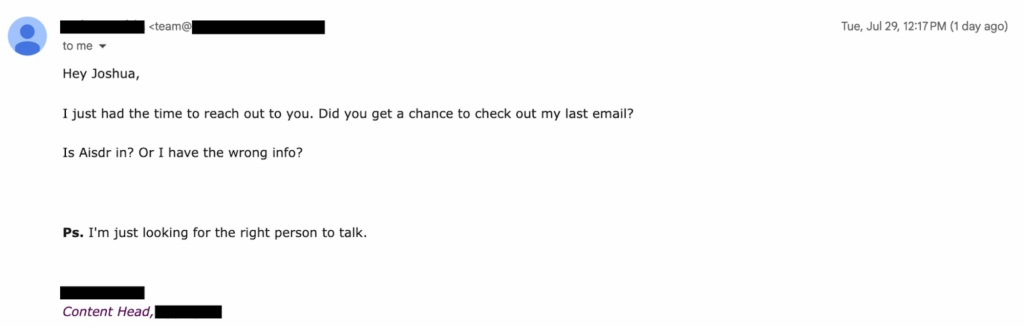
Here’s what works well:
- It’s short: It’s easy to skim and doesn’t overwhelm.
- It has a question to answer: It gives me a low-friction opening to respond and clarify expectations.
- The tone feels human: It doesn’t feel still or templated.
Here’s what could improve:
- No value: It’s a pure nudge without offering anything useful, which risks falling into the “lazy follow-up” trap.
- No context: Without a quick reminder of what this is about, I have to scroll back to figure it out.
- Unclear CTA: 3 questions feel a bit overwhelming, almost like it’s a mini-interview. On top of that, the person’s a bit blunt about what they’re looking for. If I’m not the right person, I get the feeling they’ll ignore whatever I say.
- No photo: It might seem minor, but the lack of a photo doesn’t inspire trust. I want to see who I’m going to be talking with.
Overall, this follow-up risks being ignored (and to be frank, it was ignored up until I started searching my inbox for examples of follow-ups). A few small changes like adding a context-based hook or delivering value would make it more engaging.
But as it stands now, it’s just a low-effort nudge.
Example 2
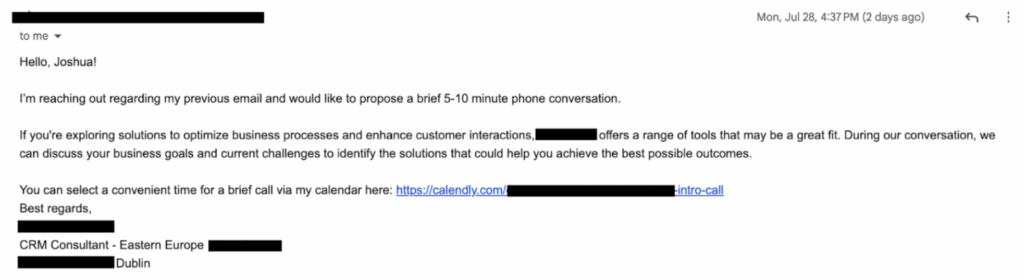
Here’s what’s good:
- Clear CTA: A Calendly link makes it easy to book a call if I’m interested without back-and-forthing “Is this time good for you?”
- Clear purpose: The person offers to set up a call.
- Outcome-oriented: The email does highlight benefits like optimizing processes or enhancing interactions, which show an attempt to tie the message to value.
Here’s what could improve:
- Generic opening: “I’m reaching out regarding my previous email” tells me nothing and doesn’t give me a reason to care.
- Vague value props: Although they try to show what’s in it for me, “optimize business processes” could mean a hundred different things, and I’m forced to connect the dots myself.
- Recyclable feel: Aside from the name, the rest of the email could be copy-pasted since it can apply to anyone.
Overall, the structure is solid, but the copy is held back by the lack of specificity. Leading with a sharper hook and replacing vague phrases with concrete details would immediately make it stronger. More importantly, it should indicate how this relates to my specific role.
Example 3
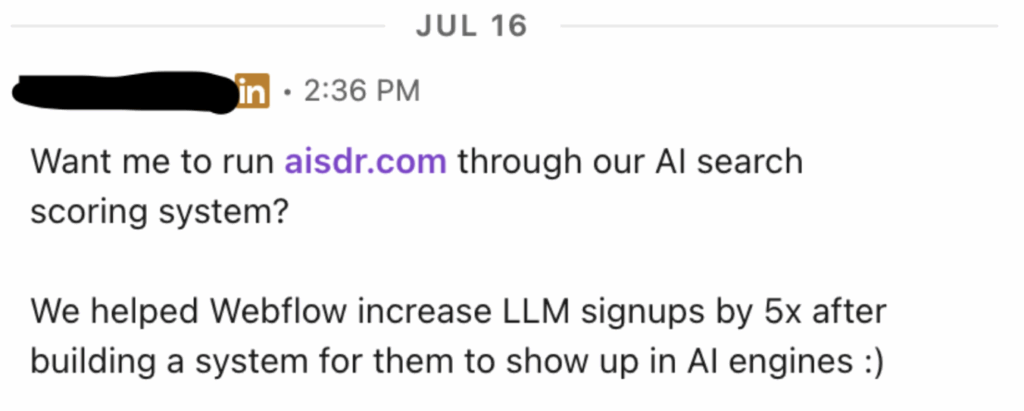
Here’s what’s good:
- It’s super short and to the point: There’s no fluff here, which fits LinkedIn’s more casual style.
- It has value and social proof: The mention of a specific success story adds credibility and possible relevance.
- It has a clear and easy-to-answer ask: The question is low-friction with no effort on my side, so it’s easy to say “yes.”
Here’s what could improve:
- No context: Without much of a reminder, the message feels a bit too abrupt, almost like a cold email follow-up. I’m also not sure why I should be interested in Webflow’s LLM signups.
- Unclear CTA: A short line on ‘what happens next’ if I give a yes would give a bit more confidence in replying.
Overall, this is still a good follow-up as it encourages a reply while offering free value that needs no effort on my part. A touch more context and clarity would turn it into an ideal LinkedIn follow-up.



Find out how to write follow-up messages that feel relevant and human
 Summarize with
 ChatGPT
 Claude
 Perplexity
 Grok
Grok 
 Google AI