










LinkedIn Outreach: 11 Battle-Tested Strategies That Get Replies

“Hi {{Name}}! I help businesses like yours achieve {{goal}}”
Sound familiar?
It’s the classic LinkedIn cold message. And the fastest way to signal mass outreach at scale.
If your team is stuck recycling templates or hesitating at a blank message box, here’s how to approach LinkedIn outreach.
Key takeaways
- LinkedIn outreach works when you focus on quality conversations over volume.
- Generic, template-heavy messages get ignored and hurt your brand.
- Strong LinkedIn messages use real signals, context, and timing to show relevance.
- LinkedIn outreach sees best results when paired with other channels like email and calls.
- Consistent testing and measurements are key to improving results.
What is LinkedIn outreach (for sales teams)?
LinkedIn outreach is a targeted, relationship-focused approach to starting sales conversations with the right buyers. It’s not about blasting generic DMs or chasing vanity metrics. The focus is on creating relevant, timely touchpoints that support pipeline growth and revenue.
When it’s done well, LinkedIn outreach improves response rates across outbound, opens doors to target accounts, and helps teams convert conversations into qualified opportunities.
Outreach vs spray-and-pray messaging
Spray-and-pray messaging relies on volume and templates with little context. Effective LinkedIn outreach relies on intent, relevance, and clear positioning. The difference shows up quickly in reply rates and brand perception.
How LinkedIn fits into your outbound
LinkedIn works best as part of a coordinated outreach motion. It adds visibility and context to cold emails, makes call follow-ups warmer, and helps reps time their outreach based on real buyer activity. Instead of competing, it strengthens other channels.
Why LinkedIn outreach is about conversations, not just connection counts
Connections don’t create a pipeline, but meaningful, relevant conversations do. Effective LinkedIn outreach focuses on exchanges that build trust and make meetings the next logical action. It avoids a hard pitch upfront, so leads don’t feel valued only for their wallet.
Why LinkedIn outreach is so challenging today
LinkedIn is a strong B2B prospecting channel. It’s also brutally competitive. Buyers are guarded, inboxes are crowded, and poor execution gets punished fast. Here’s what sales teams are really up against.
Message fatigue
Most buyers see dozens of LinkedIn messages that sound almost identical. AI-assisted copy and cheap automation have created an “automation fingerprint”: same phrasing, same structure, same empty personalization. Once prospects spot it, they stop reading.
Lesson: Messages must feel truly 1:1, not 1:many. Standing out means investing time in relevance and context, not swapping variables in a template.
Inbox overload
Spray-and-pray outreach floods inboxes and burns through your total addressable market (TAM) fast. Sloppy targeting wastes time on poor fits, hurts brand perception, and complicates future outreach across connected channels.
Lesson: Precision beats volume. Clear ICPs and disciplined targeting protect your TAM and improve long-term response rates.
Results take time
LinkedIn outreach doesn’t deliver instant wins. It rewards consistency, patience, and iteration. Teams expecting quick spikes often quit too early or double down on volume instead of learning what works.
Lesson: Sustainable results come from experimentation and measurement. Tracking replies, conversations, and downstream impact is how ROI improves (we’ll break this down later).
A practical framework for LinkedIn outreach success
LinkedIn outreach works best when it follows a clear flow. Instead of treating each message as a one-off, a structured framework is what turns LinkedIn outreach into consistent revenue and pipeline growth.
Optimize your profile so prospects take you seriously
Your profile is your first impression, and most prospects check it before replying. Think of it as a landing page answering one question: “Is this person relevant to me?”
Use a clear photo and purposeful header image
Your profile photo should be high-quality, well-lit, and clearly show your face. Casual selfies or cropped group photos weaken trust.
Your header image is a high-visibility space. Skip generic backgrounds and use it to show what you do: logos, a short value statement, social proof, or customer quotes all work well.
Write a headline that speaks your prospect’s language
Your headline is usually the second thing people read. Make it specific, outcome-focused, and rooted in your prospect’s world. Include your role, area of expertise, and the value you bring. Emojis are fine if they fit your audience.
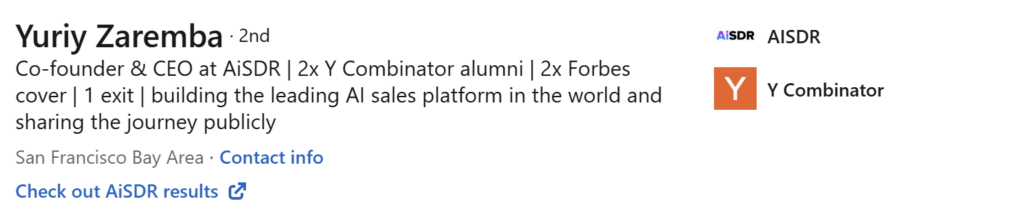
Here’s the LinkedIn headline that AiSDR CEO Yuriy Zaremba uses to cover all the bases:
Co-founder & CEO at AiSDR | 2x Y Combinator alumni | 2x Forbes cover | 1 exit | Building the leading AI sales platform in the world and sharing the journey publicly
Make your About section outcome-driven
Use the About section to explain who you help and how. Show results, not a résumé.
Example
“In my role as {{role}} at {{company}}, I’ve helped teams increase reply rates by {{%}} and reduce manual outreach time by {{number}} hours per week. I focus on practical, data-backed outbound strategies that scale.”
Build a relevant network before you pitch
Without prior exposure, outreach feels cold. A relevant network creates familiarity and trust even before the first message is sent. There are a few ways to build it right:
- Connect with people matching your ICP: Avoid random requests. Let your ICP or buyer persona guide who you connect with and who you ignore.
- Use tools: Sales tools like LinkedIn Sales Navigator or ZoomInfo filter by role, industry, company size, and activity. AI tools like AiSDR can go further by finding and engaging relevant leads automatically.
- Leverage other networks: Speed up growth by engaging with people who interact with your competitor’s content. AiSDR can identify these leads, filter by ICP, and support efficient outreach.
- Lead with curiosity: Keep connection requests light and contextual.
Example
“Hi {{Name}}, I saw we’re both connected with {{Mutual Connection}}, who also works on {{project/area/service}} similar to what we do. I thought it would be great to connect to talk {{topic}}.
Choose the right outreach type for each stage
The right LinkedIn outreach type depends on where the relationship stands:
- Comments: Engage publicly on posts through post comments to show expertise and build familiarity before messaging directly.
Fits: Awareness, early consideration - Connection requests: Introduce yourself and open a direct line. Most effective after prior exposure: content views, engagement, or mutual connections.
Fits: Awareness, early consideration - Direct messages (DMs): Use for one-on-one conversations with connections. Follow up on engagement, share ideas, or discuss challenges in a personalized way.
Fits: Consideration, active engagement - InMail & message requests: Reach prospects outside your network. Keep messages targeted, concise, and context-driven to start a conversation, not push a sale.
Fits: Awareness, consideration
Use content and engagement to warm your audience
Content builds familiarity at scale and lowers friction in every outreach message.
Prioritize first-hand, experience-based content that outperforms generic advice. Share lessons learned, quick insights and tips, or practical observations. Polls and simple questions also invite interaction.
Consistency matters. A content plan mixing original posts with thoughtful comments on other users’ content keeps you visible. When prospects recognize your name from their feed, your messages feel natural, not disruptive.
Play the long game with steady, respectful touchpoints
Most conversions don’t happen after the first message. They come after several well-timed interactions and follow-ups with value that give a reason to engage, such as:
- Relevant post
- Short insight
- Role-specific question
This is where LinkedIn message automation helps: Spacing messages out and staying respectful builds trust and keeps conversations open.
Using signals and research to personalize outreach
Generic outreach gets ignored. The more context you bring into your message, the more likely it is to resonate and get a reply. AiSDR can make this process faster and smarter.
Combine firmographic data with social and engagement signals
Start with fundamentals: industry, company size, role, or recent growth. Then layer on social and engagement signals: posts the prospect liked, shared, or commented on, plus job changes or promotions.
AiSDR converts LinkedIn engagement into qualified leads in a few clicks. Track likes and comments from any profile, filter by ICP, and automatically enrich contacts with emails, LinkedIn URLs, and key data. Engaged leads flow in continuously, keeping social signals on autopilot.
Turn engagement into a conversation
Use simple frameworks like CCQ (compliment, commonality, question)
With the right context in place, work on structure. The CCQ framework keeps outreach warm and human-friendly:
- Compliment: Reference a recent post, article, event, or achievement.
- Commonality: Highlight a shared group, interest, connection, or experience.
- Question: Ask a thoughtful question related to their role, company, or pain point.
Example
{{Prospect’s name}}, thanks for your insights on my post in {{common group name}}. I was wondering how your company handles {{pain point}}. We support teams with {{solution}}, and customers typically see {{benefit}}. Mind if we connect so I can share what works for them?
AiSDR lets you choose any messaging framework from its library, or you can add your own to write context-based messages automatically.
Turn LinkedIn activity into relevant talking points
Posts, comments, job changes, and group activity all signal what prospects care about. If someone comments on a post about onboarding challenges, skip a generic pitch and reference that context.
AiSDR consolidates the signals, turning engagement data into talking points. You show up informed, relevant, and worth replying to.
Once you know who to reach out to and how, the next decision is which LinkedIn channel to use.
LinkedIn outreach channels and when to use them
LinkedIn offers several messaging channels to support different types of professional interactions. For sales teams, choosing the right channel and writing appropriate outreach is critical.
Direct messages (DMs)
DMs are for first-degree connections. Keep them personal, conversational, and focused on the prospect’s needs, not your pitch. Context is key: reference their recent post, update, or shared engagement to make your message feel relevant and timely.
Connection requests
Connection requests open the door. Tie them to something current: a new project, post, or question. Keep the note short, friendly, and context-specific.
Message requests
They let you reach people in the same LinkedIn group or event without sending a connection request. Review their group activity to understand their priorities, then write a tailored opener.
InMail messages
InMail allows you to reach anyone on LinkedIn, even outside your network, but requires LinkedIn Premium or Sales Navigator. Use it sparingly. Targeted, context-driven messages outperform mass outreach.
Profile visits
Not all outreach requires you to send a message. By strategically visiting prospects’ profiles, you can compel them to check yours and engage, especially if your profile is optimized and the timing is right.
When to pair LinkedIn with email in the same sequence
LinkedIn outreach works best as part of a multi-channel strategy, with email as a natural complement. Use LinkedIn for awareness, engagement, and relationship-building. Use email for longer-form content, proposals, and follow-ups that need more detail.
Pairing the two adds touchpoints without overwhelming a single channel. You can start with a LinkedIn comment or connection request to introduce yourself, follow with a short, personalized DM or InMail, and then share a case study, guide, or specific offer via email.
Content and engagement plays that support outreach
Before reaching out, make prospects more receptive through content and engagement. Thoughtful content shows expertise, builds familiarity, and makes outreach feel like a natural conversation. Here’s what you can do.
Share first-hand experience to attract your ICP
Teach something your ICP can apply immediately. For SaaS marketing managers, that might mean breaking down why personalized video content lifts LinkedIn engagement by 25–30% over static posts, and how to implement it in their own campaigns.
Use polls and hand-raiser posts to identify interested buyers
Polls are an easy way to engage your audience and surface interested prospects. Ask about common challenges in the industry, then follow up with voters to start a conversation.
Hand-raiser posts take this further. Add a clear CTA that encourages readers to opt in: “Comment ‘interested’, and I’ll send you a guide.” The goal isn’t to sell, but to engage people who are actively interested in your offer.
Comment strategically on your buyers’ posts
Set aside time each week to comment meaningfully on posts from your target audience. Avoid generic comments. Add value by sharing ideas, asking smart questions, or offering perspective. Strategic commenting builds familiarity and credibility, making later outreach feel natural instead of cold.
Create low-friction CTAs that start conversations
Make it easy to respond. Avoid heavy asks like demos or long calls. Instead, offer something lightweight and useful: a quick video tip, a resource, or a simple question that invites a reply.
11 tips for writing LinkedIn messages that cut through the noise
Even the best LinkedIn outreach strategy only works if individual messages grab attention. These tips will help you stand out in crowded inboxes and get replies.
Know your goal (one message, one ask)
Before you write, ask yourself what you want to achieve with your message. Then build everything around that. Multiple questions and offers dilute focus.
Personalize beyond name and company
Mass blasts feel like spam. Go past variables and reference a recent post, a market shift, or a real signal that explains why this message makes sense to your prospect right now.
Engage before dropping into DMs
Don’t show up cold. Like posts and leave comments before sending a connection request, let alone a message. Familiarity changes how your DM is received.
Keep it brief and mobile-friendly
LinkedIn isn’t email. Most messages are read quickly on a phone. Short paragraphs, plain language, and one clear point make replies easier.
Hook them fast with a sharp first and last line
Attention is limited, always.
Your opening line has to earn the read, and your closing line should guide the response. Every word needs a job, so start off with the hook and get straight to the value you offer.
Write how you speak (don’t overcomplicate)
If it sounds stiff or scripted, it won’t land. Use short sentences, plain language, and a natural tone. If you wouldn’t say it out loud, don’t write it.
Show the cost of inaction (only after real research)
Benefits matter, but so does risk. When you’ve done the homework, highlight what they stand to lose by doing nothing. FOMO and a sense of urgency can improve the success of LinkedIn cold outreach, but only when it’s grounded in real pain points.
Use pattern interrupts to avoid sounding like everyone else
Prospects skim past expected phrases and structures. A clever pattern interrupt, like a thoughtful question or a surprising observation, can break their autopilot and invite engagement.
A voice note or an offbeat question (“Do you believe in serendipity?”) is far more engaging than standard openers like “I’d like to connect” or “I’m reaching out because…”
Use social proof without bragging
Credibility builds trust, but subtlety matters. Briefly reference similar companies or outcomes without turning the message into a highlight reel. The goal is reassurance, not self-promotion.
Avoid feature dumps and focus on outcomes
Nobody cares about features. They care about outcomes.
Go customer-first. Anchor your message in what improves for the buyer, not how your product works under the hood.
Test a 15-word pitch to sharpen your value
If you had only 15 words, what would you say? This exercise forces clarity. Even if you never use this pitch verbatim, it will sharpen every reach-out.
Measuring and improving LinkedIn outreach performance
LinkedIn outreach only improves when you measure it. The goal is to understand what moves conversations toward the pipeline and revenue. That takes a small set of clear metrics and disciplined testing.
Key metrics to track
You don’t need bloated dashboards. A few metrics tell you almost everything:
- Acceptance rate: Shows whether your targeting and connection messaging resonate. Low acceptance usually means poor fit or weak positioning.
- Response rate: Measures whether your outreach earns engagement at all. If it’s low, start with messaging and relevance.
- Positive reply rate: Tracks reply quality, not just volume. Strong results usually signal good targeting and clear value.
- Deals influenced: Ties LinkedIn activity to pipeline and revenue, so you can judge real ROI, not vanity metrics.
If your metrics show your LinkedIn outreach is off, diagnose first, then experiment.
How to A/B test message structure, hooks, and timing
Improvement comes from controlled experimentation. While keeping targeting consistent, test one variable at a time: opening line, message length, CTA, or send timing. Even small tweaks to hooks or structure can produce meaningful lifts when applied across a team.
Make sure to run tests long enough to spot patterns.
When to change targeting vs messaging
Metrics tell you what to fix:
- Low acceptance + low positive replies: targeting is off.
- High acceptance + weak replies: messaging isn’t landing.
- Strong engagement + no pipeline impact: unclear next steps or misaligned ICPs.
Knowing the difference prevents wasted effort: rewriting messages when the real issue is the recipient or pushing volume instead of precision. Pause, analyze, then adjust.
150+ companies use AiSDR to power their sales approach

How AiSDR removes the busywork from LinkedIn outreach
Effective LinkedIn outreach depends on timing and relevance, yet too many teams are slowed by manual research and coordination. AiSDR removes that friction with automation built around advanced features.
Prospecting with LinkedIn intent signals
AiSDR tracks engagement on posts from any personal LinkedIn profile, including executives, industry voices, or competitors with active audiences. It captures everyone who visits a profile or leaves a like or comment, then qualifies them by ICP criteria like role, seniority, company size, industry, and location.
It goes deeper with keyword tracking and comment sentiment analysis. Teams can monitor posts, comments, and reactions tied to topics buyers actively discuss and even filter for negative sentiment to reach prospects frustrated with existing solutions.
Automatic data enrichment and validation
Once prospects are identified, AiSDR enriches and validates each record automatically. Emails, LinkedIn URLs, firmographics, tech stack, and behavioral context are added before a message is sent. This reduces bounce rates, prevents wasted touches, and keeps CRM data clean.
Context-aware messaging and sequencing
AiSDR uses LinkedIn activity, engagement signals, and CRM data to draft messages grounded in real context. Teams can then run coordinated email and LinkedIn sequences in a single workflow. Follow-ups, replies, and handoffs stay aligned, with all activity synced to HubSpot for visibility and reporting.

 Meet Ami
 TRAINED ON 14,000 REAL CAMPAIGNS



Get 11 actionable LinkedIn outreach tips for driving better results
 Summarize with
 ChatGPT
 Claude
 Perplexity
 Grok
Grok 
 Google AI