






How to End a Cold Email Without Sounding Pushy or Generic

Most sales teams obsess over the first line of a cold email. It’s true that a strong opener can get a message read. But if the ending feels off, a weak close can undo everything the first line earned.
Many salespeople either close with pressure (“Are you free for 15 minutes tomorrow?”) or with a line so vague it creates friction (“Let me know your thoughts!”).
Thoughts about what, exactly?
That kind of vague ask puts all the thinking on the prospect. So here’s a deeper look into the mechanics of strong endings and a framework you can reuse across campaigns.
Key takeaways
- The ending of a cold email often decides whether you get a reply.
- Strong closes reduce friction with one clear, simple next step.
- Generic CTAs like “let me know your thoughts” lower response rates.
- The best endings match timing, signals, and the buyer’s level of interest.
- AiSDR structures and tests closing lines automatically to improve replies and meetings.
Why the email ending matters more than you think
In cold outreach, the ending is where you earn a reply or create a reason to ignore you. This part of the email is small, yet it shapes how your messaging feels and informs what your prospect should do next.
There are several reasons why the final line decides whether the reader responds now, later, or never.
It shapes the reader’s emotional response
The close sets the tone. A hard meeting ask can feel like pressure. A vague “thoughts?” comes across as hesitant.
A strong ending feels calm and deliberate. It signals that you understand the timing and the context.
It determines the level of friction in your ask
Most cold emails won’t get a reply. That’s a cold reality.
If responding requires too much thinking, scheduling, or decision-making, many prospects just won’t engage.
Strong endings reduce effort. They suggest a small, clear next step instead of demanding commitment upfront. This is why signal-based outreach performs better. When the ask matches what the prospect just did or cares about, replying feels logical.
It signals whether your outreach is thoughtful or generic
Generic endings sound like bulk outreach. Contextual endings sound intentional.
Mentioning even one real-world detail like a hiring move, funding round, role change, LinkedIn activity, or pricing-page visit can turn your close from “another sales spam” into a message worth answering.
What a strong cold email ending looks like
For a high-performing finish, cut friction and spell out the next move.
The best cold email closings share a few consistent traits. Here’s what each one looks like in practice.
One clear, low-friction ask
Instead of jumping straight to a calendar invite for a 30-minute meeting, the close should invite a small, easy action. A yes or no, a quick confirmation, or a simple redirect if you happened to reach the wrong person. The goal is to lower the effort required to respond.
A reason for reaching out now
If the company is hiring, raising funding, rolling out a product change, or actively discussing a relevant issue, reflect that context in the closing line. When the ask is anchored in what’s happening now, it feels intentional and not a random request.
A tone that respects the prospect
Cold outreach is an introduction, not a negotiation. Avoid inflated claims, artificial urgency, or assumptions about fit. When the close matches the scale of a first interaction, it’s far more likely to land well.
A CTA that fits the campaign goal
Not every sequence is meant to book a meeting from the first touchpoint. If the objective is qualification, the close should filter for intent. If the goal is conversation, it should invite a reply. And if it’s a meeting, then a more direct ask makes sense.
Escalation across the sequence
The first message can stay light and exploratory. Follow-ups can raise the level of commitment as familiarity grows. Push too hard too early, and you create unnecessary resistance.
Pattern interrupt (optional)
A short reframe, a routing question, or even a small pilot suggestion can shift the dynamic just enough to feel thoughtful. The point is to sound like someone who considered the situation before hitting send.
Examples of effective cold email endings
Campaigns that generate booked calls and warm-interest replies usually have strong endings that:
- Are one sentence
- Ask for a small action
- Tie directly to the trigger driving the outreach
- Stay specific and concrete
The best-performing closes feel like a natural continuation of the conversation.
Here are real patterns pulled from high-performing outreach for different scenarios.
Soft-close endings
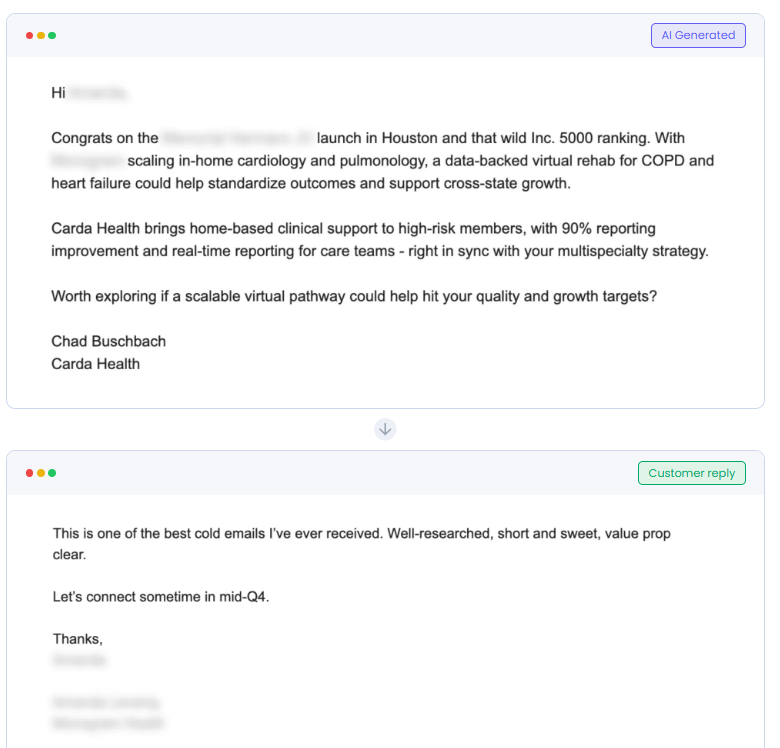
Soft closes lower pressure. They invite a small “yes” instead of a full commitment.
Examples pulled from converting emails:
- “Worth exploring?”
- “Open to a quick look?”
- “Would it be worth a short chat?”
- “Curious if this ever comes up at [company]?”
- “Open to swapping thoughts on this?”
- “Would it make sense to compare notes?”
Why they work
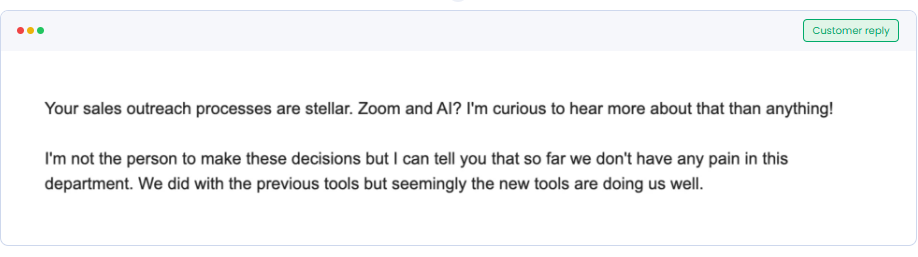
They don’t corner the reader. They offer space. In several “Booked a call” examples, the ask was simply a light question tied to the pain described earlier.
Reusable formula
Low-pressure question + direct link to the problem you just described.
Timing-based endings
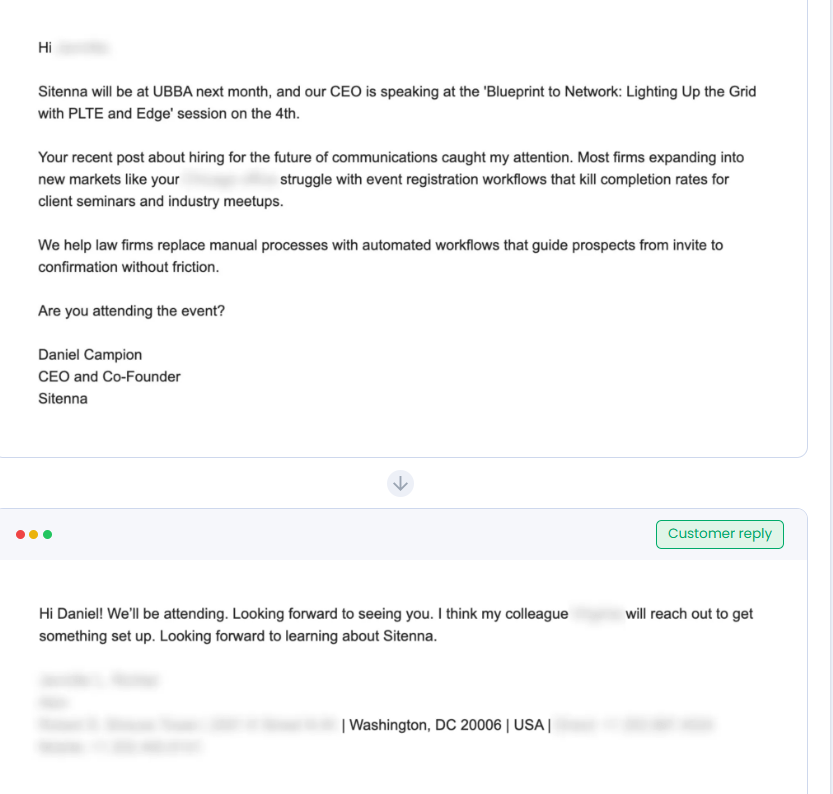
These closes anchor the ask to what’s happening now: a funding round, a hiring push, an upcoming event, or a recent product launch.
You’re being specific and referencing the details you discovered while doing your homework. When the timing reflects a real development inside the company, the outreach feels intentional, rather than generic.
Prospects usually appreciate it, giving them a clear reason to engage.
Examples
- “Given your expansion across 14 states, would it be worth comparing approaches?”
- “With the Storage API switch rolling out, is this on your radar?”
- “Ahead of HLTH next month, are you attending?”
- “Will you be at [event]? Happy to grab 10 minutes there.”
- “Is this still a priority given the compliance mandate?”
Why they work
They explain why you’re reaching out at this particular moment. The timing makes the message feel purposeful.
Reusable formula
Given [specific trigger], does it make sense to [small next step]?
Curiosity-driven endings
These lean into intrigue without hype. They perform especially well when paired with strong personalization.
Examples
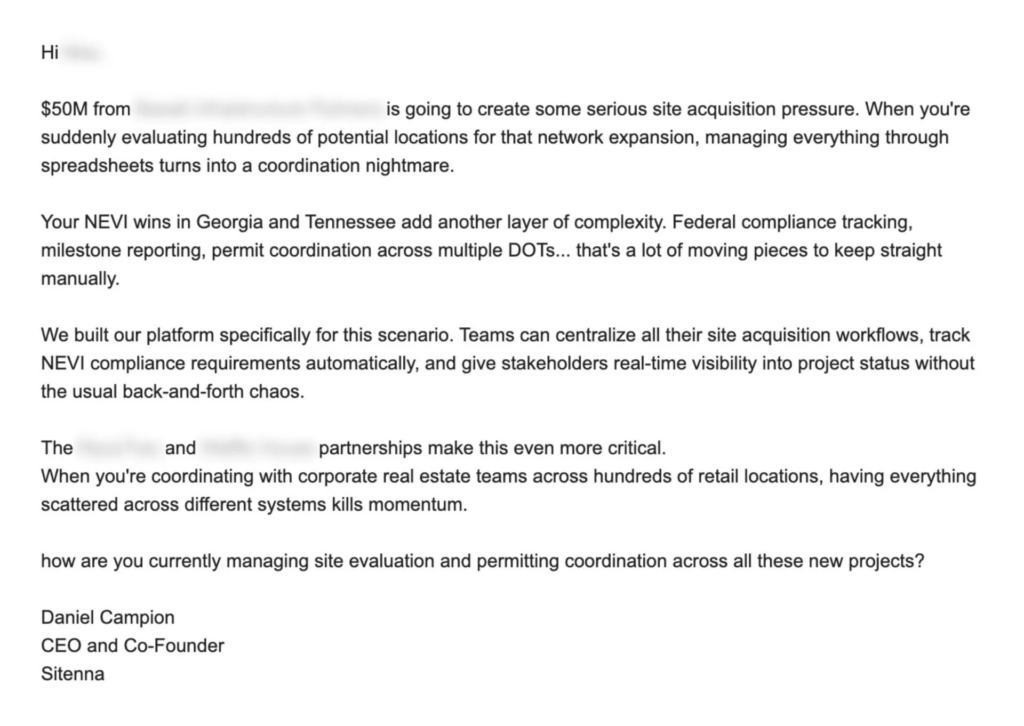
- “How are you managing this across all those projects?”
- “How do you spot when someone’s ready to talk today?”
- “Would it be crazy if this could cut resolution time by 30%?”
- “What would make this worth a closer look for you?”
Why they work
These endings shift the dynamic. Instead of pushing for a meeting, they ask for perspective. This lowers resistance and encourages engagement.
Reusable formula
Smart question that reveals a gap, without sounding confrontational.
Permission-based endings
These are subtle but powerful. Instead of pushing for a meeting, they ask for consent to send more or continue the conversation.
Examples
- “Mind if I share how that worked?”
- “Want me to send a quick overview?”
- “Happy to share a short breakdown if useful.”
- “Should I loop in [relevant teammate]?”
Why they work
One reply even said:
“I’m not interested in meeting, but if you have a short video explaining your platform, I’m willing to view it.”
That’s what permission-based CTAs unlock. Even when the meeting is a no, the conversation continues.
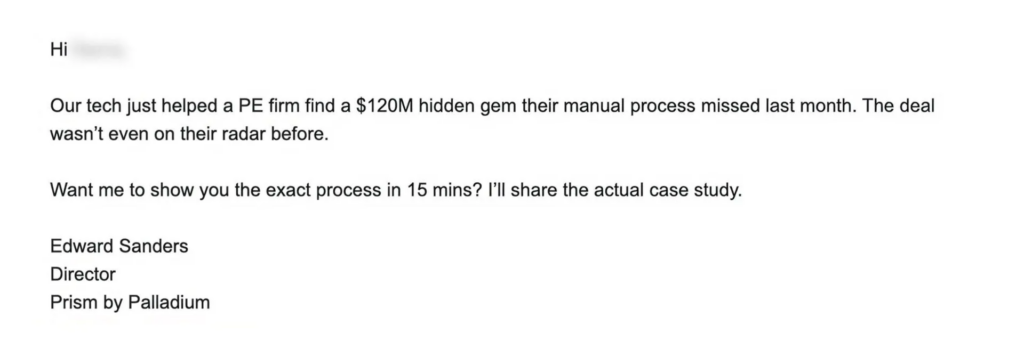
Reusable formula
Mind if I send / share / show you X?
Endings to avoid (and what to use instead)
Most weak closes fail because they’re miscalibrated. They’re forgettable and give the reader no direction or reason to reply.
Here’s what quietly kills response rates.
“Let me know if you’re interested!” → too vague
On the surface, it feels polite and harmless. It doesn’t pressure the reader or assume anything.
But the problem is that it shifts all responsibility to the reader. There’s no context for why they should care, no signal tied to timing, and no clear guidance on what to do next.
The prospect has to decide whether it’s relevant, whether it’s urgent, and whether it’s worth replying. And all that without any direction from you.
When a close leaves that much ambiguity, most people simply move on.
Use instead: A specific micro-ask tied to a real trigger.
- “Worth exploring given the hiring push?”
- “Would it help to compare this to your current workflow?”
- “Open to a quick look at how this worked for X?”
Now the brain has a clear prompt to respond to.
“Can we hop on a call tomorrow?” → too aggressive
This jumps straight to calendar territory before curiosity has even formed. Even a great offer loses momentum when the ask feels bigger than the relationship.
Use instead: Permission first. Commitment second.
- “Want me to send a short overview?”
- “Should I share a 2-minute breakdown?”
- “Worth a 15-min walkthrough, or should I close the loop?”
Start small and let the interest build from there.
“Just checking in.” → no value
Checking in about what exactly? If there’s no new angle, no new signal, no new value, it reads like inbox clutter.
Use instead: Re-anchor to a concrete reason.
- “Saw you’re hiring SDRs. Better timing now?”
- “Noticed the product update. Has it changed priorities?”
- “Quick nudge in case this got buried during QBR week.”
Every follow-up needs a valid reason to exist.
Long paragraphs at the end → too much cognitive load
A close should reduce effort and avoid adding cognitive load. When the final lines turn into another pitch block, replies drop.
Use instead: 1 sentence. 1 ask. 1 clear direction.
The best-performing closes are short enough to answer from a phone.
How to tailor your email ending to the prospect
In both cold outreach and in follow-ups with warm signals, you aim for clarity and forward movement. What’s different is how much you ask for.
If this is your first introduction, a lighter close makes sense. If the prospect has already engaged (downloaded content, replied once, visited your pricing page), you can move the conversation forward more directly without it feeling premature.
The structure of the close may look similar, but the level of commitment should match the level of interest.
Ending for cold outbound vs warm signals
Cold email is the first knock on the door. You wouldn’t ask for half an hour of someone’s time before they’ve even decided whether to answer it.
That’s why the closing line in a true cold touch should stay measured. Jumping straight to “Can we book 30 minutes this week?” often feels bigger than the interaction itself.
A lighter approach tends to work better:
- “Worth exploring?”
- “Open to a quick look?”
- “Is this even relevant on your side?”
At this stage, the goal is to simply start a conversation and see if there’s interest before asking for a bigger commitment.
Warm emails are usually part of an inbound strategy. They’re evaluated differently, and the performance benchmarks don’t mirror outbound because there’s already context.
The prospect downloaded a guide, visited your pricing page, attended a webinar, or replied once. With that signal in place, you can be more direct:
- “Would it make sense to walk through this next week?”
- “Want to see how this could apply to your team?”
The ask feels proportional to the interest.
Ending for SMB vs enterprise buyers
SMB founders move fast and value clarity over ceremony.
Your ending can be straightforward:
- “Should we spend 15 minutes on this?”
- “Want me to show you how this works?”
Enterprise buyers usually operate in complex environments with intricate budget cycles, internal approvals, and multiple stakeholders.
A softer framing performs better:
- “Is this something your team is currently evaluating?”
- “Who typically owns this on your side?”
This opens a thread instead of forcing a meeting.
Ending based on job role and urgency
A good close matches two things: who the buyer is and how urgent their situation is.
It’s worth mapping out patterns for specific segments, rather improvising on every send.
Head of Sales / VP Sales
They care about the pipeline and speed. Keep the ask tied to outcomes:
- “Worth sharing two ideas to lift reply quality without adding more volume?”
- “Are you working on outbound consistency this quarter?”
RevOps / Sales Ops
They care about process, data, and handoffs. Ask a routing or workflow question:
- “Is this owned by RevOps on your side, or Sales?”
- “Do you have a way to prioritize accounts by intent, or is it mostly static lists?”
Founder / CEO
They’re focused on leverage, focus, and ROI. Keep it simple and decision-friendly:
- “Is outbound a priority for the next 30–60 days?”
- “If I send a 3-bullet plan, would that be useful?”
CMO / Growth leader
This cohort cares about positioning, conversion, and signal quality. Ask about fit and timing.
- “Are you trying to turn intent signals into outbound this quarter?”
- “Is outbound supporting pipeline for your current segment, or is this a new bet?”
When urgency is high, such as funding, hiring, or expansion, your close can be more direct because the timing is real:
- “Noticed the hiring push. Want a quick sanity check on outreach angles before you scale?”
- “Saw the funding news. Is building the pipeline part of the immediate plan?”
When urgency is unknown and you’re dealing with true cold outreach, it’s smarter to go lighter. One small reply will do:
- “Is this on your radar right now?”
- “Should I drop this, or circle back next month?”
But coaching your team to match the close to the role and the moment, rather than defaulting to the same ask, is one of the highest-leverage adjustments you can make to reply rates.
How AiSDR helps write cold emails that end the right way
Writing a strong closing line is a skill. Writing one for every prospect, campaign, and follow-up is a system challenge.
AiSDR builds the close into a structured outreach engine so that it reflects real prospect context rather than a default afterthought on every send and sounds like it came from a person on your team.
Here’s how that plays out.
Closings are grounded in your persona, framework, and signal
A closing lands when it’s tied to something real. AiSDR pulls live context on every prospect before writing and uses that research to make the close feel intentional.
AiSDR researches each prospect before writing, drawing on publicly verifiable prospect signals like hiring and LinkedIn activity. The AI uses this context to establish relevance, and anchors the close in what’s happening at the company.
AiSDR also lets you define:
- Who you’re targeting
- What you’re selling
- Campaign goal
- Frameworks or examples to follow
- Your writing style
With all this mapped out, each message feels more purposeful.
The CTA aligns with the campaign goal
AiSDR campaigns are built around a specific objective like booking a meeting, nurturing a lead, or promoting an event. The closing line reflects this goal consistently across messages in the sequence:
- A webinar sequence may end with a direct link
- A meeting campaign may use a short qualifying question
- A nurture sequence may invite a low-friction reply
The close stays consistent with what the campaign’s trying to achieve rather than defaulting to the same ask.
Follow-ups are configurable and intentional
AiSDR makes it easier for you to build complex sequences across multiple channels.
You control how the outreach progresses:
- Softer asks early
- Stronger asks later
- A break-up email
- Specific offers in follow-ups
Escalation is possible, but you pre-configure it. The AI follows your game plan.
AiSDR also adjusts based on engagement signals. If a LinkedIn connection gets accepted or a reply goes quiet, follow-ups respond to that context rather than ignoring it. Each step in the sequence has a clear reason to exist.
Guardrails prevent generic closings
AiSDR’s base setup includes guardrails that steer the AI away from vague endings like:
- “Let me know your thoughts.”
- “Open to a quick chat?”
These are treated as defaults to avoid rather than templates to use.
You can tighten guardrails further to control how direct, soft, or specific the ending should be.
Find out which closing lines drive the best results
Strong closing lines aren’t simply written. They’re tested and refined over time.
AiSDR gives you the data and sequencing capability to do this systematically, so you don’t have to rely on instinct.
Reply rate, positive responses, and meetings booked are visible at the campaign level.
To test whether a timing-based close outperforms a curiosity-driven one for a specific segment, you run both and let the data answer it. Over time, this feedback loop makes judgment calls easier.
Make every cold email count



Close cold emails the right way to get replies
 Summarize with
 ChatGPT
 Claude
 Perplexity
 Grok
Grok 
 Google AI